










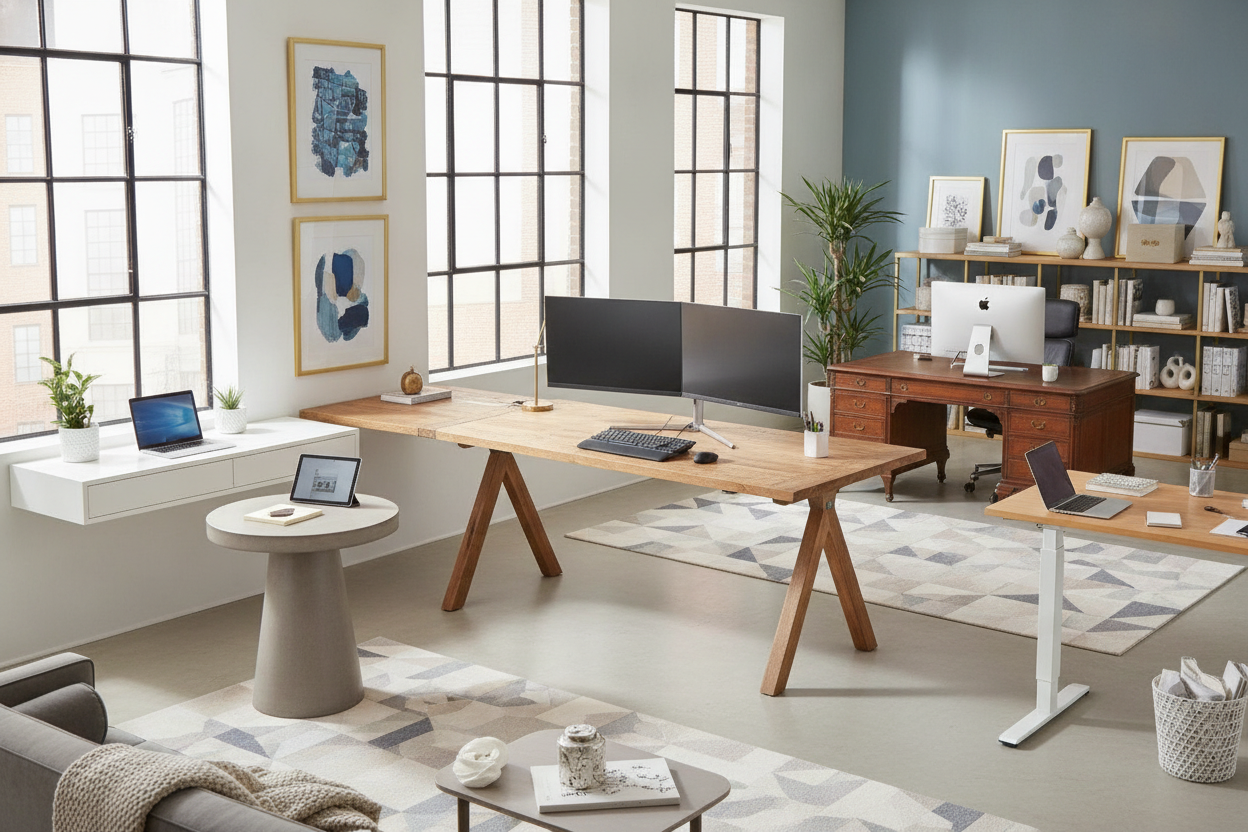
I once spent three weeks trying to make a $99 big-box store desk work for a dual-monitor setup before the particle board started bowing like a cheap shelf. It was embarrassing. I’ve realized that choosing between different types of desk isn't actually about your interior design vibe—it’s about the physics of your gear and whether you can stand looking at a tangled nest of cables every morning.
Most people buy for the aesthetic and regret it by the second Zoom call. I’ve cycled through five distinct styles in five years, from minimalist slabs to massive wooden fortresses. If you’re currently staring at 40 browser tabs of furniture, here is the honest truth about what actually supports a real workload.
Quick Takeaways
- Writing desks are strictly for laptops and a single notebook; don't try to force a monitor mount on one.
- Executive desks are storage kings but will absolutely swallow a small room whole.
- L-shaped desks are the only real solution for anyone running two monitors plus a tablet or notepad.
- Standing desks are functional but usually require extra spending on cable management trays to look decent.
My Five-Year Journey Through Home Office Purgatory
I used to think a desk was just a flat surface with four legs. I was wrong. My journey started with a thrifted vanity that was too high, leading to a year of wrist pain, followed by a glass desk that was perpetually covered in fingerprints and felt freezing to the touch in winter. I was choosing different types of desks based on how they looked in a catalog rather than how I actually worked.
Eventually, I realized that the shape and style of your workstation dictate your posture and your productivity. If you have to clear off your keyboard just to sign a physical document, your desk is failing you. After testing everything from industrial metal frames to solid oak pedestals, I found that the 'perfect' desk is entirely dependent on your hardware footprint.
The Minimalist Writing Desk (An Aesthetic Trap)
We’ve all seen them: those slim, elegant tables with tapered legs and maybe one tiny drawer that can barely fit a pen. While a writing computer desk looks incredible in a Pinterest-perfect corner, it’s a nightmare for the modern remote worker. These desk styles are designed for 'light' work—think a MacBook Air and a latte, nothing more.
The problem with these kinds of desks is the lack of depth. Most are only 20 to 24 inches deep. Once you put a monitor on there, the screen is practically touching your nose. Plus, there is nowhere to hide the power bricks. If you value your sanity and have more than one plug, skip the ultra-slim styles of desks unless you’re okay with a cable waterfall ruining your 'minimalist' look.
The Executive Desk (Are You a 1990s CEO?)
There is something satisfying about an executive desk. They are heavy, imposing, and usually come with enough drawers to hide a small library. These are the traditional types of office desk you see in law firms, and they’re great if you need to hide physical files. However, they are massive. In a standard 10x12 bedroom office, an executive desk makes the space feel like a closet.
I found that I didn't actually need the built-in drawers. Most of that space just became a graveyard for old receipts and dead batteries. I realized that a slim desk bin organizer on a more open frame provides better access to my daily tools without the 200-pound weight penalty. Unless you’re actually signing high-stakes contracts all day, you probably don’t need a pedestal desk.
The Adjustable Standing Desk (My Current Frenemy)
Adjustable frames are the most popular computer desk types right now for a reason. Being able to stretch your legs during a long meeting is a literal back-saver. But let’s be honest: most of them look like industrial lab equipment. They lack the warmth of real furniture. I’ve seen some people try to DIY a standing desk out of a vintage table just to avoid that 'corporate cubicle' aesthetic, which is a great move if you have the tools.
The real issue with these different types of desks is stability. If you buy a cheap one, it will wobble when fully extended. If you’re a heavy typer like me, your monitors will shake every time you hit the 'Enter' key. If you go this route, invest in a heavy-duty dual-motor frame; your coffee cup will thank you.
The L-Shaped Corner Desk (The Dual-Monitor Savior)
If you use two monitors, stop looking at other types of computer desks. The L-shape is the undisputed champion. It utilizes the corner of the room—which is usually dead space—and gives you two distinct zones. I use one side for my monitors and keyboard, and the other side stays completely clear for my morning coffee, my iPad, and actual physical notebooks.
I finally settled on a corner desk with large storage and it was the first time I didn't feel cramped. These types of desk shapes allow you to pivot your chair rather than sliding it back and forth. It’s the most ergonomic way to handle a multi-screen workflow without needing an 80-inch straight desk that looks like a banquet table.
How to Figure Out Which Desk Actually Fits Your Workflow
Before you buy, ignore the color. Focus on the depth and the weight capacity. If you have a monitor arm, check if the desk has a lip for the clamp. Many office desk types have a 'privacy panel' or a frame rail that prevents you from clipping on a monitor mount, which I learned the hard way after scratching a brand-new desktop.
Think about your 'reach zone.' Everything you use every hour should be within an arm's length without you leaning forward. Match the kinds of desks you're browsing to your actual daily tasks. If you're 90% digital, go for depth and cable management. If you're a hybrid worker who still uses paper, the L-shape is your only real friend.
FAQ
How deep should a desk be for a monitor?
At least 24 inches, but 30 inches is the sweet spot. Anything shallower and you'll feel like you're sitting in the front row of a movie theater. Your eyes will strain, and you won't have room for a wrist rest.
Are glass desks a bad idea?
Yes. They are loud, they get cold, and they show every single smudge. Plus, many monitor arms can't be clamped to glass without risking a catastrophic shatter. Stick to wood, laminate, or metal.
What is the best desk for a very small room?
A ladder desk or a wall-mounted 'floating' desk. They use vertical space and have a small footprint. Just keep in mind they usually have lower weight limits, so keep the heavy PC towers on the floor.

Dejar un comentario
Este sitio está protegido por hCaptcha y se aplican la Política de privacidad de hCaptcha y los Términos del servicio.