










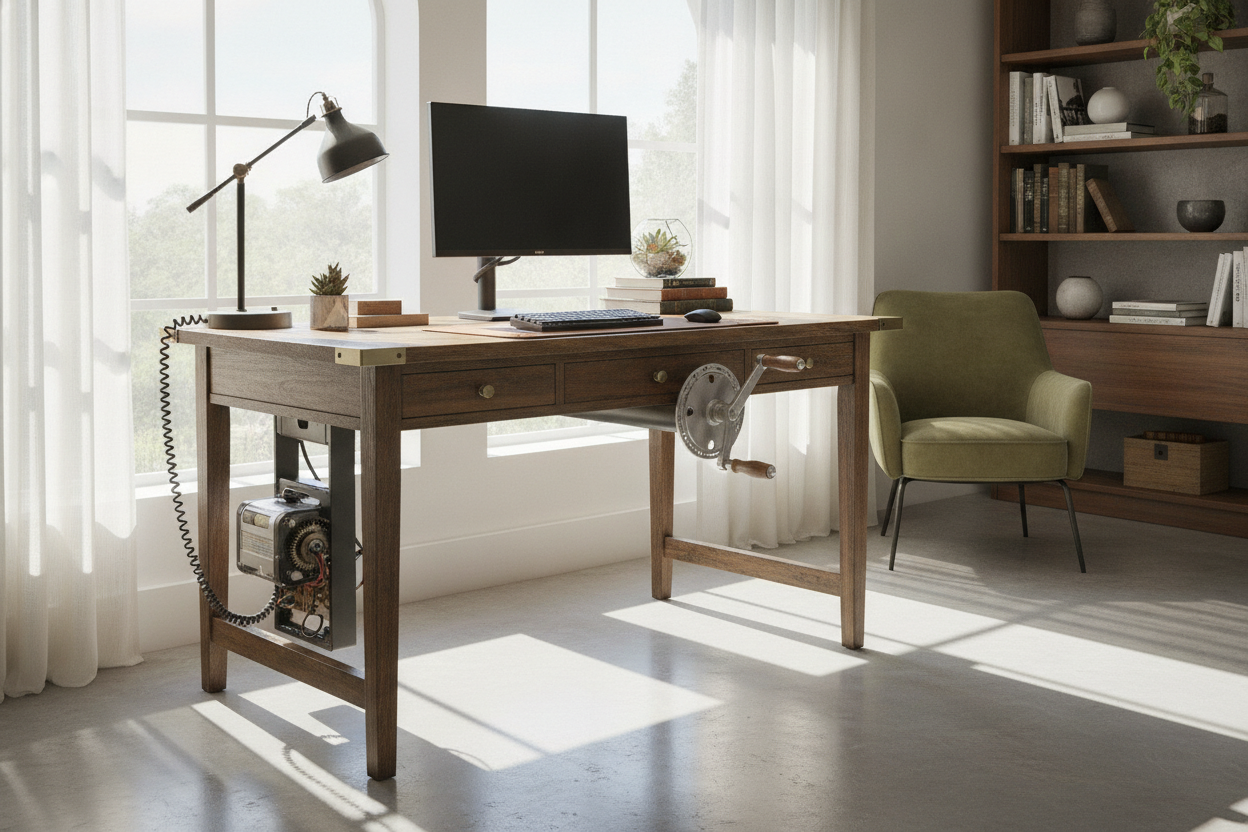
I spent three weeks staring at a particle-board desk that wobbled every time I typed more than twenty words a minute. It was soul-crushing. I wanted character, not a slab of laminate that looked like it belonged in a depressing call center. That is when I realized making your own standing desk was the only way to get a workspace that actually felt like home.
Quick Takeaways
- Solid wood is non-negotiable if you want to avoid the 'monitor shake' while typing.
- Dual-motor frames are worth the extra $100 for heavy vintage tabletops.
- Underside reinforcement is key to prevent 70-year-old wood from bowing under a monitor arm.
- Cable management requires creative adhesive solutions since vintage tables lack grommets.
Why I Refused to Buy Another Soulless White Desktop
I scoured local thrift stores and Facebook Marketplace for weeks, looking for something with a soul. Initially, I thought I would just settle for a standard writing computer desk and accept that I would be sitting for eight hours a day. But every vintage piece I found was built for people in the 1940s—meaning they were way too short for my 6-foot frame.
The corporate options were even worse. Everything looked like it was designed by someone who hates joy. I found a 1950s oak library table for $60 that had the perfect patina, but it was at a fixed height that killed my lower back. I decided right then to stop looking for a pre-made solution and start looking for a way to build a sit stand desk using that oak top as my foundation.
The Anatomy of a DIY Sit Stand Desk
When you decide to build an adjustable standing desk, the frame is everything. Most people make the mistake of buying the cheapest diy standing desk motor they can find on a certain giant retail site. Don't do that. Cheap motors struggle with the weight of real, solid wood, and they sound like a dying blender every time you hit the 'up' button.
I used the Adjustable Height Standing Desk With Electric Lift System 54 Desk With Memory Presets as my benchmark for what a reliable mechanism should do. You want a frame that supports at least 220 pounds and offers a smooth, dual-motor lift. If you are using a heavy slab of oak or walnut, diy adjustable desk legs need to be heavy-duty steel. If the legs feel light when you take them out of the box, they are going to wobble when you are at full standing height.
Preparing an Old Tabletop for a Modern Lifting Mechanism
Drilling into 70-year-old oak is terrifying. I had visions of the wood splitting down the middle the second I pulled the trigger on my drill. To make a table that raises and lowers successfully, you have to prep the underside. I spent two hours sanding off decades of grime and old varnish before I even looked at the DIY standing desk lift mechanism.
The trick is to pre-drill your holes with a bit that is slightly smaller than your screws. Old wood is brittle. If you try to force a screw in, you'll crack the grain. I also added two steel flat bars across the width of the table to ensure the wood wouldn't warp over time. It felt like overkill until I saw how much torque the motorized legs put on the wood during the first test run.
Hiding Cords When Your Desk Has Zero Built-In Grommets
Vintage tables were designed for fountain pens and inkwells, not dual 27-inch monitors and a mess of power bricks. I refused to drill a massive two-inch hole through my beautiful oak top just to run a power cord. Instead, I looked for creative standing desk ideas that kept the aesthetic intact.
I mounted a heavy-duty metal cable tray to the very back of the underside of the table. I took a page out of the guide on Why I Chose an Adjustable Standing Desk Black (And How I Style It) by choosing a matte black frame. The black finish naturally blends into the shadows under the desk, making the wires almost invisible from across the room. I used adhesive clips to route the main power cable down one of the legs so it doesn't dangle like a loose vine.
Was the Vintage DIY Route Actually Cheaper?
Let's talk numbers. I spent $60 on the vintage table and $380 on a high-quality motorized frame. Total: $440. If I had gone out and bought a massive 71 W Height Adjustable Standing Desk with a solid wood top, I would have easily spent $800 to $1,200 for this level of stability.
It wasn't just about the money, though. My homemade adjustable standing desk has a history. There are faint ink stains from some student in the 1950s and a grain pattern that you just can't get from a factory in 2024. It took me a full Saturday to assemble, but every time I press that memory preset button, I’m glad I didn't buy the 'soulless white' version.
FAQ
Can any tabletop work for a DIY standing desk?
Almost any flat surface works, but avoid hollow-core doors or thin particle board. The screws for the motor will eventually pull out of the soft material. Stick to solid wood or high-quality plywood at least 1 inch thick.
How do I know if my DIY standing desk motor is strong enough?
Check the weight capacity. A solid wood top can weigh 50-80 lbs alone. Add monitors, a computer, and your heavy coffee mug, and you're easily over 100 lbs. Look for a motor rated for at least 175 lbs.
Is a DIY hand crank standing desk better than electric?
Only if you want a workout. Cranking a desk up and down forty times a day gets old fast. If you have the budget, go electric. You'll actually use the standing feature way more often.

Dejar un comentario
Este sitio está protegido por hCaptcha y se aplican la Política de privacidad de hCaptcha y los Términos del servicio.