










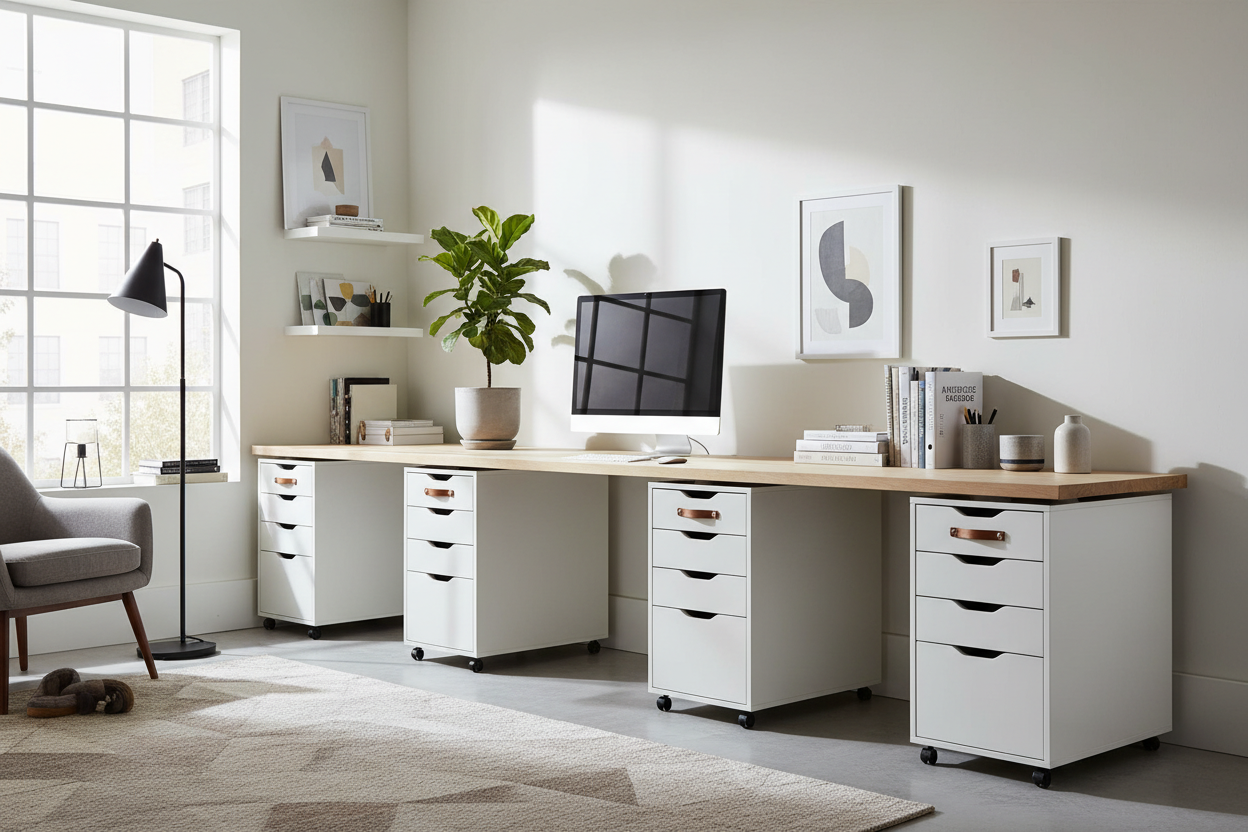
Designing a home office that balances professional functionality with residential warmth is a challenge I see in almost every project. You want the utility of a corporate workspace without the sterile, gray cubicle aesthetic. This is where ikea file drawers often enter the conversation. They are ubiquitous, accessible, and surprisingly versatile, but they aren't a one-size-fits-all solution. Whether you are eyeing the sleek Alex series or the industrial Idåsen, understanding the nuances of these pieces is crucial to ensuring they elevate your workflow rather than hindering it.
Quick Decision Guide
If you are rushing to make a purchase, consider these four critical factors to ensure the unit meets your specific design and functional needs:
- Series Compatibility: The Alex series offers a clean, matte finish ideal for modern spaces, while Idåsen provides a durable, powder-coated steel construction for heavy-duty use.
- Weight Capacity: Check the drawer rating. Particleboard bottoms can bow under heavy archival paper loads; metal drawers offer superior rigidity.
- Mobility: Decide if you need casters. Mobile units offer flexibility but can look temporary; stationary units on plinths often feel more high-end and permanent.
- Paper Sizing: Verify the railing adjustments. Many European designs default to A4 sizing, requiring adjustment or specific inserts for US Letter size hanging folders.
Choosing the Right Silhouette and Material
When selecting storage, we aren't just looking at volume; we are looking at visual weight and texture. In a sophisticated home office, the material choice dictates the mood.
Particleboard vs. Powder-Coated Steel
Most ikea filing drawers, particularly the popular Alex line, are constructed from particleboard with an acrylic paint finish. From a design perspective, this matte finish is excellent for absorbing light and blending into walls for a built-in look. However, be mindful of edges. Over time, the veneer edge banding on lower-tier models can chip if struck repeatedly by office chairs.
For a more industrial or "architectural" aesthetic, steel units like the Trotten or Idåsen are superior. They introduce a different texture—cool and smooth—which contrasts beautifully against warm wood flooring or wool rugs. Steel also offers better longevity against the humidity changes that can sometimes warp composite wood drawers.
Space Planning and Ergonomics
Placement is everything. A common error I see is placing a filing cabinet directly under the primary knee space of a desk. While this saves floor space, it severely restricts ergonomic movement, forcing you to sit off-center.
Instead, consider "flanking" your desk. placing the drawers just outside the desk perimeter creates a lengthened visual line, making the room feel larger. If you must place them under a desk, ensure you have at least 30 inches of clearance for your legs to move freely. For smaller footprints, look for taller, narrower units (often called "helmers" in IKEA speak) to utilize vertical space rather than floor equity.
Visual Balance and Customization
The beauty of IKEA furniture lies in its modularity. To avoid the "dorm room" look, I often advise clients to treat these drawers as a base rather than a finished product. Swapping out standard hardware for brushed brass or matte black pulls can instantly elevate the piece to match your lighting fixtures.
Furthermore, consider the top surface. If the unit is freestanding, the top can become a clutter magnet. Styling it with a structured tray or a substantial table lamp creates a deliberate focal point, signaling that this is a piece of furniture, not just a utility box.
Lessons from My Own Projects
I want to share a specific detail from a project I worked on last year that involved a wall-to-wall installation using the Alex series. On paper, the dimensions were perfect. However, during the install, I realized something that product photos don't show: the drawer extension.
IKEA drawer slides are decent, but they aren't always "full extension." In this specific case, the back three inches of the drawer were hard to access because the drawer stopped short. For a client who needed daily access to archived files, this was a friction point. We solved it by using the back of the drawers for long-term storage (tax returns from three years ago) and the front for active files. Also, a word of warning regarding assembly: I always use a dab of high-quality wood glue on the dowels and specifically in the groove where the drawer bottom sits. That thin bottom panel is the weak link; gluing it in place creates a rigid structure that prevents that annoying "sag" and scraping sound five years down the road.
Conclusion
Integrating ikea file drawers into a cohesive interior design scheme is about balancing their utilitarian nature with thoughtful styling. By choosing the right material for your durability needs and positioning the unit to favor ergonomics, you can achieve a workspace that feels curated and professional. It isn't just about hiding papers; it's about creating a system that supports your best work.
Frequently Asked Questions
Can IKEA filing drawers accommodate legal-size hanging folders?
It depends on the specific model. The Galant and Idåsen series are generally designed for professional use and can accommodate legal size via adjustable rails. However, compact units like the Micke or Helmer are often restricted to standard letter or A4 sizes. Always check the internal drawer dimensions in the product schematic.
How do I stop the drawers from tipping over when open?
Safety is paramount. Most IKEA units come with a safety mechanism that prevents multiple drawers from opening simultaneously to stop tipping. However, for freestanding units, I strictly recommend anchoring them to the wall using the provided hardware, especially if the unit is placed on plush carpet which can make it unstable.
Can I paint IKEA laminate drawers to match my room color?
Yes, but preparation is key. The smooth laminate finish resists standard paint. You must scuff-sand the surface with 120-grit sandpaper, apply a high-adhesion shellac-based primer (like BIN), and then apply your cabinet enamel. Without the right primer, the paint will scratch off with fingernail pressure.


Dejar un comentario
Este sitio está protegido por hCaptcha y se aplican la Política de privacidad de hCaptcha y los Términos del servicio.