










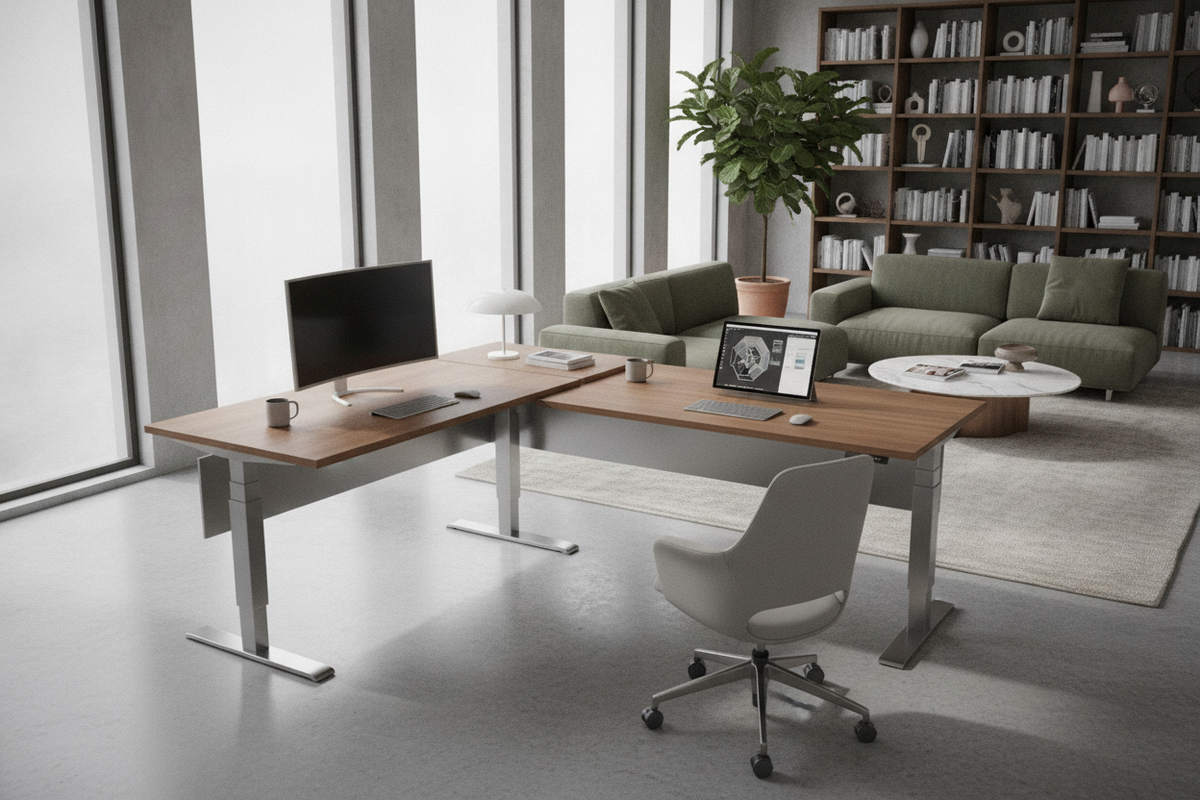
A modern home office or hybrid executive workspace demands flexibility that static furniture rarely delivers. As workflows alternate between computer-intensive tasks, physical paperwork, and collaborative discussions, workspace layouts must adapt dynamically. An l shaped rotating standing desk bridges the gap between active sit-stand ergonomics and modular surface arrangement by integrating a pivoting return wing with height-adjustable framing.
Understanding the L-Shaped Rotating Standing Desk
Unlike conventional fixed corner desks, an l shaped rotating standing desk features a secondary worktop connected to the primary desk body via an articulated pivot joint. This architecture lets users change the physical footprint of the workspace on demand to support different activities throughout the workday.
Core Mechanics: Pivot Axis vs. Height Elevation
The core utility of a rotating sit-stand configuration lies in separating the pivot axis from the vertical lift mechanism. In most practical arrangements, the primary elevation column controls the primary desktop height for computer tasks, while the secondary wing rotates smoothly on heavy-duty casters or bearing plates. Similar multi-directional concepts are common in adaptable home furniture, such as a versatile rotating desk product where articulated joints serve dual-purpose functional zones.
Corner, Inline, and Overlapped Configurations
An adjustable rotating desk generally transitions across three primary geometric formations:
- Standard 90-Degree L-Shape: Ideal for wrapping around the user to keep digital screens and physical documents within an ergonomic reach envelope.
- 180-Degree Inline Linear Setup: Extends both desk segments into a long continuous bench, ideal for multi-monitor arrays, drafting, or collaborative side-by-side work.
- Nested / Overlapped Compact Setup: Folds the rotating return directly beneath or parallel to the primary desk to free up walking pathways when active work is complete.
Spatial Clearance and Pivot-Radius Planning
Because the return surface swings across an open radius, planning spatial clearances requires more care than installing a static corner desk. Mapping the room footprint before placement ensures frictionless daily movement.
Mapping the Arc of Rotation
When positioning an l shaped rotating standing desk, map out the full rotational arc of the moving return wing. Ensure the swing path remains clear of baseboard trim, door swings, floor vents, and nearby shelving units. Always verify that flooring transitions, like area rug borders, do not impede the caster wheels or pivot hardware during reconfiguration.
Room Zoning: Corner Enclosures vs. Open Floating Positions
Deciding between an enclosed corner and an open room-divider layout determines how often you can pivot the return. Placing the desk against a wall provides a stable corner workstation, similar in presence to a dedicated shaped desk product, but may restrict rotation to a single ninety-degree quadrant. Floating the desk in the center of the room allows full circular articulation for room zoning, as detailed in our comprehensive standing desk guide on architectural desk placement.
Dual-Zone Task Architecture and Ergonomics
A dual-tier or rotating surface allows distinct separation of work modes, preventing digital equipment from cluttering analog tasks.
Primary Elevation Zone for Active Computing
The height-adjustable primary surface should host computer peripherals, monitor arms, and keyboard platforms. Setting the primary desk to proper ergonomic elbow height while sitting or standing reduces shoulder strain and encourages regular postural shifts throughout the day.
Secondary Pivoting Surface for Meetings and Analog Tasks
The rotating wing acts as a dedicated analog surface for note-taking, reference manuals, audio equipment, or client collaboration. During video calls or in-person meetings, pivoting the secondary wing outwards provides an inviting collaborative counter without shifting your primary computing monitors. Exploring intentional visual styling across dual surfaces, such as highlighted in our visual standing desk guide, ensures both worktops remain functional and clean.
Storage Architecture and Cable Routing for Movable Wings
Because one section of the desk rotates while the other changes height, wire management and storage placement require thoughtful planning to avoid snagging cables or unbalancing the desk frame.
Flexible Cable Spines and Articulated Power Channels
Standard static cable clips are insufficient for moving joints. Use articulated cable spines or flexible braided sleeving routed directly through the pivot center. This allows cords to bend naturally without tension or pinch points when swinging the desk between perpendicular and linear layouts.
Under-Wing Pedestals, Shelving, and Weight Distribution
Many rotating desks incorporate open shelving, filing drawers, or low credenza storage beneath the return wing. To maintain effortless rotation, store heavy reference binders and equipment near the base of the pivot column rather than at the outer swinging edge. For those working with non-standard floor plans or sculpted workstation legs, selecting an artistic desk shaped product can provide inspiration for pairing unique geometry with practical everyday utility.
Material Selection, Frame Stability, and Longevity
The mechanical demands of an adjustable rotating workstation make material quality and structural stability paramount.
Engineered Wood, Hardwoods, and Scratch-Resistant Finishes
Continuous rotation can cause wear around the pivot axis. Melamine surfaces, high-pressure laminates, and sealed engineered boards offer strong resistance to daily surface friction, while solid timber provides warm tactile appeal when properly finished with durable sealants.
Locking Casters and Joint Rigidity
To prevent unwanted drift during typing or height adjustments, the secondary wing requires smooth-gliding, industrial-grade locking casters. When engaged, the locks stabilize the desk against accidental shifts, ensuring a firm foundation across both sitting and standing transitions.
Step-by-Step Buying and Assembly Decision Framework
Before purchasing and assembling your l shaped rotating standing desk, follow this practical checklist:
- Measure Full Radial Sweep: Confirm that the secondary return wing can rotate through your planned positions without colliding with walls or furniture.
- Verify Lift and Pivot Independence: Check whether the elevation mechanism adjusts the primary deck alone or both tiers simultaneously.
- Plan Cable Slack: Ensure power cables include sufficient slack to accommodate both maximum standing height and a fully extended linear configuration.
- Test Floor Leveling: Level the primary base before attaching the rotating return to prevent binding along the pivot hinge.
By carefully balancing pivot clearance, ergonomic heights, and adaptable wire management, an l shaped rotating standing desk transforms any home office into a dynamic, highly productive workstation.

Dejar un comentario
Este sitio está protegido por hCaptcha y se aplican la Política de privacidad de hCaptcha y los Términos del servicio.