





A metal outdoor bench can last for many seasons outside, but only as long as its finish keeps water off the metal: wash it, check it for chips and rust spots every season, and touch up bare metal before rust spreads under the coating. Before you buy, check the frame and finish, the weight capacity, the seat height and depth, and how the bench will stay put in wind. A metal seat in full sun can also get hot enough to burn, so plan for shade and a quick touch test, especially with young children around.
Below: specs, rust care, hot seats, weight ratings, seat height, wind, placement and winter storage, then two FUFU&GAGA benches: a black metal set of four and a non-metal 63-inch HDPE alternative. More outdoor seating is in our outdoor chairs and benches collection.
Key takeaways
- The finish is the rust barrier. Iowa State University Extension warns that dirt and residues left on metal let it corrode and pit; the RHS says to treat damage with rust-preventing paint after removing loose material.
- Sun makes metal hot. The CPSC has reported bare metal in direct sun heating past 120 degrees, even on a 70 to 80 degree day.
- Read capacity per bench. A rating is for the whole bench; a one-seat bench rated 300 lb is still one seat.
- Seat height varies a lot. Accessible benches under the 2010 ADA Standards sit 17 to 19 inches high; many backless patio benches are lower.
- Wind needs a plan. FLASH advises bringing outdoor furniture inside or anchoring it with ground anchors and cables or chains.
What to check before you buy a metal outdoor bench
Most of what decides whether a metal bench holds up is on the spec sheet:
| Spec | What to look for | Why it matters |
|---|---|---|
| Frame material | Steel, iron or aluminum, named in the listing | Iowa State Extension notes aluminum resists rust but can pit and dull; iron and steel rely on their coating |
| Finish | The coating type (powder coat, paint, enamel) if listed | Rust starts where the coating is cracked or chipped |
| Weight capacity | A stated number, and whether it is per bench or per set | Tells you how many adults the bench is built for |
| Seat height | Floor to top of seat, in inches | Compare with the chairs you already own and with who will sit there |
| Seat depth | Front to back of the seat | A shallow seat suits perching and fire-pit gatherings more than long sitting |
| Product weight | Whether the listed weight is one bench or the whole set | Light benches are easy to move and easier for wind to shift |
If a listing does not name the coating, do not assume powder coat: keep the finish clean, check it often and repair chips quickly.
How do you keep a metal outdoor bench from rusting?
On a coated metal bench, watch the places where the finish is cracked or chipped, the joints and fasteners, and spots where water and dirt sit. Care comes down to keeping the coating clean and whole.
- Wash it every season. Iowa State University Extension recommends washing outdoor furniture at the start of each season and warns that when dirt and residues are allowed to set, metals corrode and become pitted (Iowa State University Extension, Maintenance of Outdoor Furniture). Use the cleaning method in your bench's listing.
- Inspect the coating. The Royal Horticultural Society says metal garden furniture should be cleaned and checked for rust, which can appear in plastic-coated metal where the plastic has cracked. Look closely at the feet, welds, the underside of the seat and around screws.
- Treat rust spots early. The RHS advises treating any damage with rust-preventing paint after removing loose material (RHS, maintaining garden seats and tables). Brush off flaking rust, clean and dry the spot, then paint it.
- Prime bare metal. For wrought iron, Iowa State Extension says to touch it up whenever bare metal is exposed and to use a rust-resistant metal primer so rust does not spread under the paint.
- Swap rusted fasteners. The same Iowa State article says missing, broken or rusted fasteners should be replaced with rustproof ones, such as aluminum, galvanized steel or stainless steel.
- Refresh the finish. The RHS suggests repainting metal furniture every two to three years so the barrier to weather is maintained.
Two habits help too: set the bench on pavers rather than soil or lawn, where the feet stay damp, and do not leave wet cushions or leaves on the seat for days.
Do metal benches get hot in the sun?
Yes, and hot enough to burn. In a 1993 notice about bare metal playground decks, the U.S. Consumer Product Safety Commission said solid metal in direct sun can heat to more than 120 degrees, even on a 70 to 80 degree day, and that staff had reports of 201 children with serious burns from sitting on or climbing hot metal play equipment (CPSC). A bench is not playground equipment, but a dark metal seat in full afternoon sun is the same kind of surface.
The St. Louis Department of Health's playground heat guidance adds three points that apply to any outdoor seat (City of St. Louis, heat safety on playgrounds):
- Children 2 years old and younger are most at risk, and a young child's skin burns faster than an adult's.
- If a surface feels hot to your hand, it may be too hot for a child's bare skin.
- Some materials transfer heat more slowly and may not feel hot with a quick touch. The same page describes a serious burn from a plastic slide on a 74 degree day, so a non-metal bench is not automatically safe either.
Put the bench where it gets afternoon shade, from a tree, an umbrella or a structure like those in our patio gazebo buying guide, lay a towel over a sun-warmed seat, and make the hand test a habit before a child sits down.
Outdoor bench weight capacity: what the number means
A weight capacity is the most load the maker rates the bench to carry; read it with the seat count. A one-seat bench rated 300 lb is built for one adult, while a long bench rated 650 lb shares that load among several people. For a set, check whether the figure is per bench. Do not stand on a bench to reach string lights, and recheck the screws each spring: a loose joint flexes and wears the finish around it.
Seat height and seat depth
There is no single standard height for a patio bench, but the 2010 ADA Standards give a useful reference point. Where an accessible bench is required, for example in dressing and locker rooms or saunas, section 903 sets the top of the seat at 17 to 19 inches above the floor and the seat at 20 to 24 inches deep, with back support or a wall behind it (2010 ADA Standards, 903 Benches). That range is built around transferring onto a bench, so it is a good guide if someone in your household finds low seats hard.
| Bench (as listed) | Seat height | Below the 17 in ADA minimum by | Seat depth | Shallower than 20 in by |
|---|---|---|---|---|
| Black metal bench, set of 4 | 15.7 in | 17 - 15.7 = 1.3 in | 13.5 in | 20 - 13.5 = 6.5 in |
| Gray HDPE bench (non-metal) | 13.7 in | 17 - 13.7 = 3.3 in | 16.9 in | 20 - 16.9 = 3.1 in |
Both benches are lower and shallower than an accessible transfer bench, and neither has a back. That suits casual seating around a fire pit, low tables and garden paths. For someone who needs to push up from the seat, a chair with arms and a back may be the better choice.
How do you keep a metal bench from blowing over or moving?
Light outdoor furniture can slide, tip or be thrown in a storm. FLASH, the Federal Alliance for Safe Homes, advises securing outdoor items or bringing them inside, including furniture on a patio or deck; if an object can be safely stored indoors, bring it in; and if it stays out, attach it to the deck or patio with ground anchors and cables or chains (FLASH, Secure Potential Yard Debris).
Before a storm, stack small benches in a garage or shed. On exposed decks, run a coated cable or chain through the frame to an anchor so it cannot scratch the finish. For everyday breezes, place benches against a wall, railing or hedge rather than in the open.
Do not drill through a bench frame to bolt it down unless the maker says the frame allows it: a new hole is bare metal and a fresh place for rust to start.
Where to put a metal outdoor bench
Garden and paths. Set the feet on pavers, stepping stones or firm gravel so they do not sink or sit in wet soil.
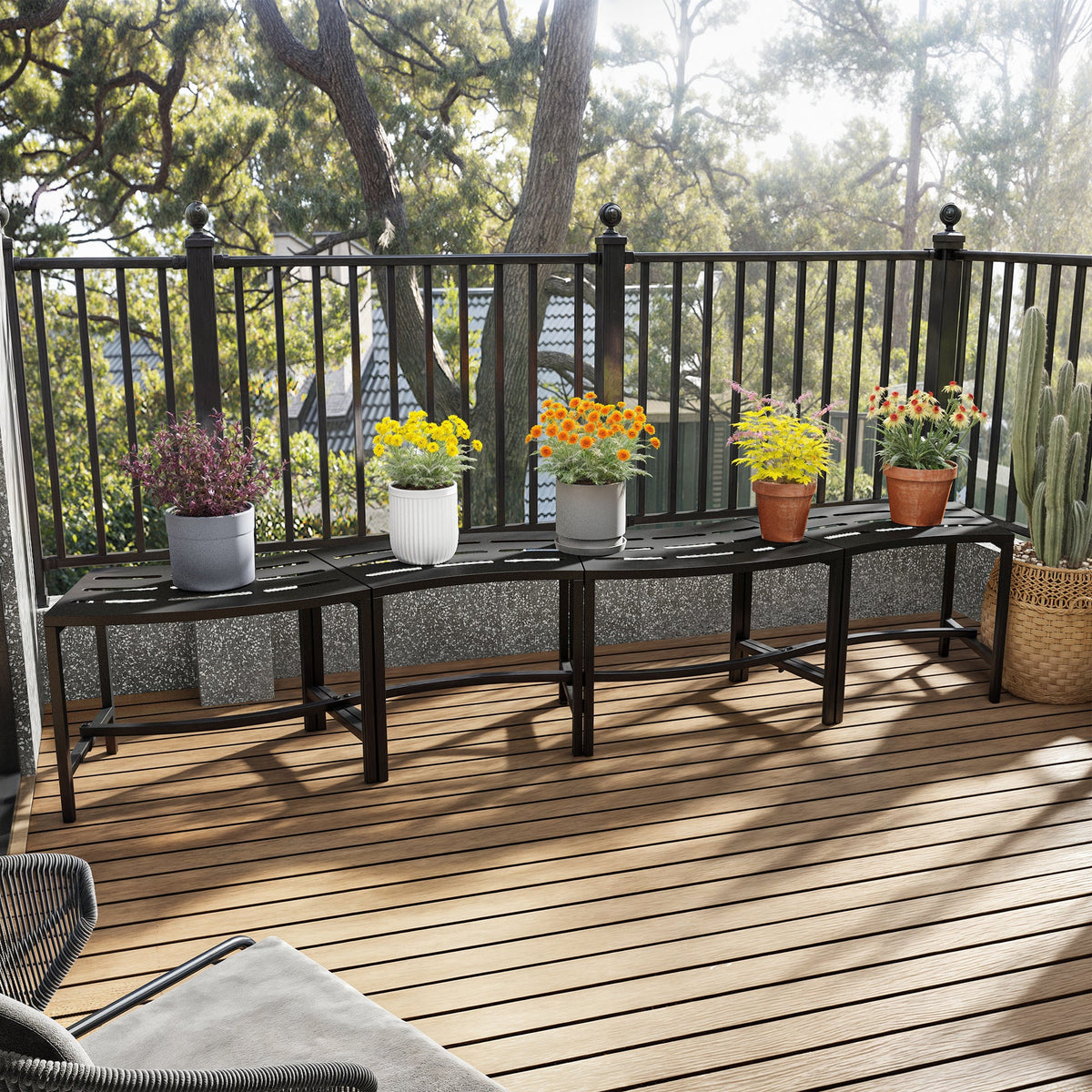
Porch, balcony and deck. Measure the walkway left after the bench goes in, and keep the bench clear of door swings. On a balcony, a narrow backless bench can double as a plant stand, as in the photo below.
Around a fire pit. Curved benches are made to ring a round fire pit. Follow your fire pit's manual and local fire rules for how close seating can be; our propane fire pit table buying guide covers placement and clearances. A metal seat close to a fire can also get warm, so use the same hand test as for sun.
Dining. A bench can replace chairs on one side of an outdoor table. Subtract the bench height from the table height and compare that gap with your dining chairs; low benches pair more naturally with low tables.

Ways to use a set of four benches
Four small one-seat benches give more layouts than one long bench: a ring around a round fire pit or low table, a row along a railing for guests or plants, pairs facing each other across a path, or two by the fire and two by the door, gathered together when guests arrive.
Winter storage for metal benches
The RHS suggests doing any maintenance and storing of garden furniture at the end of summer, in dry weather. For a metal bench that means washing it, letting it dry fully, touching up chips, then storing it.
A shed or garage keeps snow and meltwater off the finish; stand the benches on a scrap of wood so the feet are off a damp floor. If a bench stays outside, set it on a hard, well-drained surface and clear snow off the seat. In spring, wash it before first use, as Iowa State Extension recommends at the start of each season, and recheck the screws.
Metal outdoor bench buying checklist
- Frame and finish: metal type and coating, as listed; plan on touch-up paint either way.
- Capacity and seating: a stated per-bench number and seat count.
- Seat height: compare with 17 to 19 inches if anyone finds low seats hard.
- Seat depth: deeper for long sitting, shallow for perching.
- Wind: where it goes in a storm, or how you will anchor it.
- Shade: where afternoon shade falls on the spot.
- Care and assembly: a cleaning method you will keep up, and the tools needed (our guide on how to assemble flat-pack furniture helps).
Our picks
Facts below come from each listing; assembly guides are in the User Manual tab on each product page.
23.9" Industrial Black Outdoor Bench, Set of 4
Four black metal benches with gently curved, slotted seats, designed so the set can encircle a round fire pit, line up along a garden path or face each other in pairs. Each bench measures 15.7" H x 23.9" W x 13.5" D, seats one and is rated for 300 lb. The listing gives a metal seat frame and exterior in an industrial black finish, rated rust-, UV-, water- and weather-resistant, and says the benches are light enough to move easily; it lists 37 lb without saying whether that is one bench or the set, and it does not name the coating type. Care is a rinse with a garden hose or pressure washer. No cushions are included. One person can assemble the set with a screwdriver; the listing says to avoid power tools.
Best for: fire-pit circles, flexible extra seating you can rearrange, and a metal look on a deck, patio or balcony.
Skip it if: you want a seat with a back or a seat at chair height (15.7 inches is low), you need one bench to seat two, or the benches will sit in full sun where children use them without a cover. Plan touch-up paint for chips, since this is coated metal.
63" Gray All-Weather HDPE Outdoor Patio Bench (non-metal alternative)

This bench is not metal: the exterior is high-density polyethylene (HDPE) over a plastic inner frame, in gray. It is here for readers who like the idea of a metal bench but do not want to deal with rust or touch-up paint. It measures 13.7" H x 63" W x 16.9" D, is rated for 650 lb and weighs 48 lb. The listing describes UV stabilizers so the bench resists fading, cracking and warping, reinforced legs and a gently curved seat, and says it never needs sanding or sealing: clean it with soap and water. Assembly needs a screwdriver; the listing says one person can set it up in about 5 minutes. It has no back and no cushions are listed.
Best for: several people sitting side by side at a barbecue, along a garden path or at the long side of an outdoor table, with care limited to soap and water.
Skip it if: you want the look of metal, a backrest or a seat near chair height (13.7 inches is the lower of the two). It can still get hot in sun, like any outdoor seat.
Picks compared
| Pick | Size (H x W x D, as listed) | Material | Capacity | Best for |
|---|---|---|---|---|
| Black metal bench, set of 4 | 15.7 x 23.9 x 13.5 in, each | Metal, black | 300 lb, one seat per bench | Fire-pit circles, flexible seating |
| Gray HDPE bench (non-metal) | 13.7 x 63 x 16.9 in | HDPE, plastic inner frame | 650 lb | Group seating with no rust care |
See more outdoor seating in our outdoor chairs and benches collection.
FAQ
How do I stop a metal bench from rusting?
Keep the coating clean and intact. Iowa State Extension says to wash outdoor furniture each season because dirt left on metal leads to corrosion and pitting. The RHS says to check for rust and treat damage with rust-preventing paint after removing loose material, and to repaint every two to three years.
Can I leave a metal bench outside all winter?
It is better stored. The RHS suggests cleaning and storing garden furniture at the end of summer in dry weather. If it must stay out, keep it on a well-drained hard surface and touch up chips first.
How hot does a metal bench get in the sun?
Hot enough to burn. The CPSC has reported bare metal in direct sun heating past 120 degrees, even on a 70 to 80 degree day. Test it with your hand before a child sits down.
How do I keep outdoor benches from blowing away?
Bring light benches inside before storms. FLASH advises that items left outside be attached to the deck or patio with ground anchors and cables or chains.

Dejar un comentario
Este sitio está protegido por hCaptcha y se aplican la Política de privacidad de hCaptcha y los Términos del servicio.