





The right raised garden bed height depends on who gardens and what grows in it. On decent soil, a bed 6 to 11 inches tall is enough for most vegetables, because roots carry on into the ground below; on pavement or poor soil, plan at least 10 to 12 inches of soil, and more for tomatoes, potatoes and squash. If bending is the problem, university extension guides suggest about 24 to 27 inches to the top of the bed for gardeners in a wheelchair and about 36 inches for gardeners who stand.
Below: height and soil-depth figures from extension sources, elevated beds versus tall beds on the ground, soil arithmetic, wood and liners, placement, and a 34-inch cedar bed from the FUFU&GAGA outdoor structures collection.
Key takeaways
- Soil depth first: most garden crops need at least 10 inches of soil (University of Georgia Extension).
- Root depth by crop: lettuce, onions and peppers about 6 to 12 inches, tomatoes, carrots and beans 18 to 24 inches, pumpkins and asparagus 30 inches or more (Utah State University Extension).
- Height for comfort: 24 to 27 inches for wheelchair users, about 36 inches to avoid bending when standing; sources differ, so measure the gardener.
- Width matters too: keep the middle within arm's reach, about 2 to 2.5 feet from one side.
How tall should a raised garden bed be?
A raised garden bed should be as tall as the plants' roots and the gardener's back need, and no taller, because every extra inch costs soil and water. The University of Minnesota Extension says that for many gardeners, raising beds more than a few inches above the soil may not be necessary, and that beds built on the ground are usually 6 to 8 inches high (University of Minnesota Extension). Iowa State University notes that heights typically range from 6 to 20 or more inches, and that 11 inches is common because it is the height of two 2x6 boards (Iowa State University Extension).
Go taller when the ground is the problem or the gardener is. The University of Georgia Extension sets a minimum of 10 inches of soil for most garden crops and warns that on a hard surface 10 inches may not be deep enough for some crops, like potatoes. The same guide says beds should be 24 inches tall for wheelchair access and that a bed 36 inches off the ground helps avoid excessive bending over, while young children need beds closer to the ground (UGA Extension, Raised Garden Bed Dimensions).
| Situation | Height to the top of the bed | Source |
|---|---|---|
| Good garden soil below, most vegetables | 6 to 8 inches is typical; 11 inches with two 2x6 boards | Minnesota, Iowa State |
| Hard surface, rocky or poor soil below | At least 10 inches of soil, more for potatoes | Georgia |
| Bed on hot pavement | Raise it one or two feet to reduce heat | Minnesota |
| Children | Lower sides, closer to the ground | Georgia, Minnesota |
| Gardener in a wheelchair | 24 inches (Georgia), 27 inches (Minnesota), 2 to 3 feet (Iowa State) | All three |
| Tabletop (elevated) garden | 30 to 33 inches | Iowa State |
| Standing gardener who wants to avoid bending | About 36 inches | Georgia |
Because the figures differ, measure the gardener: sitting or standing where they will work, the height of a hand held at a comfortable working level is your target for the top of the soil.
How deep should a raised bed be? Root depth by crop
Soil depth and bed height are not the same thing. On open ground, roots grow down through the bed into the soil below, so a short bed works if the native soil is loosened; UGA suggests tilling the soil under beds shorter than 10 inches. On a patio, a deck or in an elevated planter with a floor, the bed is all the soil the plants get, so its depth has to cover the roots.
Utah State University Extension groups vegetables by effective root depth, the zone where most roots take up water (Utah State University Extension):
| Root depth group | Effective root depth | Examples |
|---|---|---|
| Shallow | 6 to 12 inches | Lettuce, spinach, chard, radish, broccoli, kale, garlic, onion, pepper |
| Moderate | 18 to 24 inches | Tomato, potato, eggplant, carrot, beet, bean, pea, cucumber, summer squash, cabbage, sweet corn |
| Deep | 30 inches or more | Asparagus, pumpkin, other squash, watermelon |
Read the table as a guide to where roots do most of their work, not a hard floor. Iowa State says most plants need at least 6 to 12 inches of soil, plus room for 1 to 2 inches of mulch on top. In practice, a salad and herb bed on a patio can be about a foot deep, while tomatoes, potatoes and carrots do better with 18 inches or more when only pavement lies underneath.
Elevated garden beds vs raised beds on the ground
An elevated garden bed is a planter box on legs, like a table, with a floor that holds the soil. A raised bed on the ground has walls but usually no floor, so it sits on soil, gravel or lawn and drains straight down.
- Elevated (tabletop) beds bring the soil to working height with far less soil, and a seated gardener can roll under one. UGA notes that raised planters can be built 10 inches deep and lifted on legs or blocks. Iowa State suggests 30 to 33 inches to the top, 36 to 48 inches wide, a base drilled with 1/2-inch holes every 6 inches, and landscape fabric over the bottom. Their shallow soil suits salad crops, herbs and flowers more than deep-rooted vegetables.
- Tall raised beds on the ground give deep-rooted crops all the room they want. The trade-off is volume: a 30-inch-tall bed holds three times the soil of a 10-inch one on the same footprint. Minnesota notes that gardeners often fill very tall beds, higher than 2 feet, with lasagna-style layers of sticks, leaves, compost and soil, usually to reduce costs. Solid sides also mean a wheelchair user works from the side, with no knee space.
Both kinds dry out faster than the open garden. Minnesota puts it plainly: raised beds act as containers, and the taller the bed, the more often you need to water. The upside is that their soil warms more quickly in spring.

How wide should a raised bed be?
Width decides whether you can reach the middle without stepping on the soil, and it matters more on tall beds, which you cannot lean over as easily. Sources agree on arm's reach but differ on numbers:
- Reach from one side only (a bed against a fence or wall): 2.5 feet at most (Minnesota) or 1.5 to 2 feet (Iowa State).
- Reach from both sides: up to 5 feet (Minnesota), 3 to 4 feet (Iowa State), or 4 feet for adults and 3 feet for children (Georgia).
- Wheelchair users: Georgia suggests 3 feet wide for adults, and Iowa State gives a forward reach from a wheelchair, without bending, of about 30 inches.
Between beds, UGA suggests at least 12 inches of path, ideally 18 to 24 inches, and 4 feet where a cart, wheelbarrow or wheelchair has to pass.
How much soil do I need for a raised bed?
Multiply length by width by soil depth, all in feet (inches divided by 12), to get cubic feet. Divide by 27 for cubic yards, the unit bulk soil is sold in, or by the volume printed on the bag for bagged soil.
- A 4 x 8 ft bed filled 11 inches deep: 4 x 8 x (11 / 12) = 29.3 cubic feet, or about 1.1 cubic yards.
- A footprint of 95 x 33 inches (the overall size of the cedar bed below): 95 x 33 = 3,135 square inches, or 21.8 square feet, so every inch of depth takes about 1.8 cubic feet. That is about 21.8 cubic feet (0.81 cubic yards) for 12 inches of soil, 32.7 cubic feet (1.21 cubic yards) for 18 inches and 43.5 cubic feet (1.61 cubic yards) for 24 inches. In bags marked 1.5 cubic feet, 21.8 cubic feet is 15 bags (14.5 rounded up). Outside dimensions overstate the fill slightly.
As UGA puts it, the higher the bed, the more imported soil you need, which adds cost and labor: a good reason to choose the lowest height that suits the gardener.
What soil goes in a raised bed?
Use a mix of topsoil and compost, not straight potting soil. Minnesota recommends roughly 2/3 to 1/2 topsoil (loam or sandy loam) with 1/2 to 1/3 plant-based compost, and warns that too much compost causes water-retention problems and that potting soil dries out too quickly in raised beds. Iowa State offers equal parts topsoil, organic matter and coarse sand, or about 70 percent topsoil and 30 percent compost. The common ground is a light, well-drained mix with plenty of real soil in it.
Cedar or treated lumber: which wood for a raised garden bed?
Cedar is the usual choice because it resists decay without chemical treatment. Iowa State recommends decay-resistant wood such as cedar or redwood, and Minnesota notes that cedar and hemlock cost more than pine and fir but last much longer. The University of Maine Cooperative Extension recommends naturally water- and rot-resistant woods such as untreated hemlock or cedar, while noting that they do eventually break down (UMaine Extension).
- New treated lumber: Iowa State considers modern pressure-treated lumber safe for vegetable gardens. Oregon State University Extension, citing Penn State, describes ACQ (alkaline copper quaternary) as containing no arsenic, chromium or other chemical the EPA considers toxic (Oregon State University Extension). Minnesota adds that treated wood in the garden should be labeled for ground contact.
- Old lumber and railroad ties: avoid them. Lumber made before 2004 often contained arsenic-based preservatives (Iowa State), and Minnesota says railroad ties and CCA-treated lumber are harmful to vegetable crops.
Do raised beds need a liner or a bottom?
Usually not. Minnesota says that in most cases you will not need a barrier between raised bed soil and the soil underneath. A liner can prolong the life of the wood; Minnesota advises a material that lets water through, such as landscape fabric, rather than nonpermeable plastic, and Iowa State suggests woven geotextile fabric. UMaine lists sheet plastic as one way to separate soil from treated wood, so sources differ; if you use plastic, keep it to the walls so water still drains out the bottom.
The case for a bottom layer is burrowing animals. Minnesota suggests hardware cloth at the bottom of the bed to reduce the chances of mice and chipmunks tunneling up into it, and notes that raised beds make it easy to add netting or fencing against rabbits. Elevated beds on legs need a floor with drainage holes, as above.
Where to put a raised garden bed
- Sun: at least 6 to 8 hours a day for full-sun crops (Minnesota); at least six hours for most vegetables and flowers (Iowa State). In part shade, Minnesota lists lettuce, baby kale, scallions, radishes and beet greens.
- Water: close to a tap or hose, since raised beds need watering more often.
- Level ground: the frame should sit level so the soil surface is flat. On a slope, UGA suggests stepping beds like stairs, with the short side running across the slope.
- Orientation: north-south where possible, so tall crops do not shade lower ones in neighboring beds (UGA).
- Away from shade structures: a pergola or gazebo that shades the patio will shade a bed beside it too; our patio gazebo buying guide covers sizing and placement if you are planning one.
Raised bed buying checklist
- Height: the gardener's measured working height; about 24 to 27 inches for a wheelchair user, about 36 inches for a standing gardener who wants to avoid bending.
- Soil depth: at least 10 to 12 inches, and 18 inches or more for tomatoes, potatoes and carrots over pavement.
- Width: no more than 2 to 2.5 feet to the middle from the side you work.
- Soil volume: length x width x depth in feet, divided by 27 for cubic yards, worked out before you settle on height.
- Wood: cedar or other decay-resistant wood, or new treated lumber rated for ground contact; never railroad ties or old CCA lumber.
- Drainage and pests: an open bottom on the ground or drainage holes in an elevated bed; hardware cloth underneath for burrowers.
- Site: 6 or more hours of sun, a hose within reach, level ground and 18 to 24 inches of path, or 4 feet for a wheelchair.
Our pick: a tall cedar raised garden bed
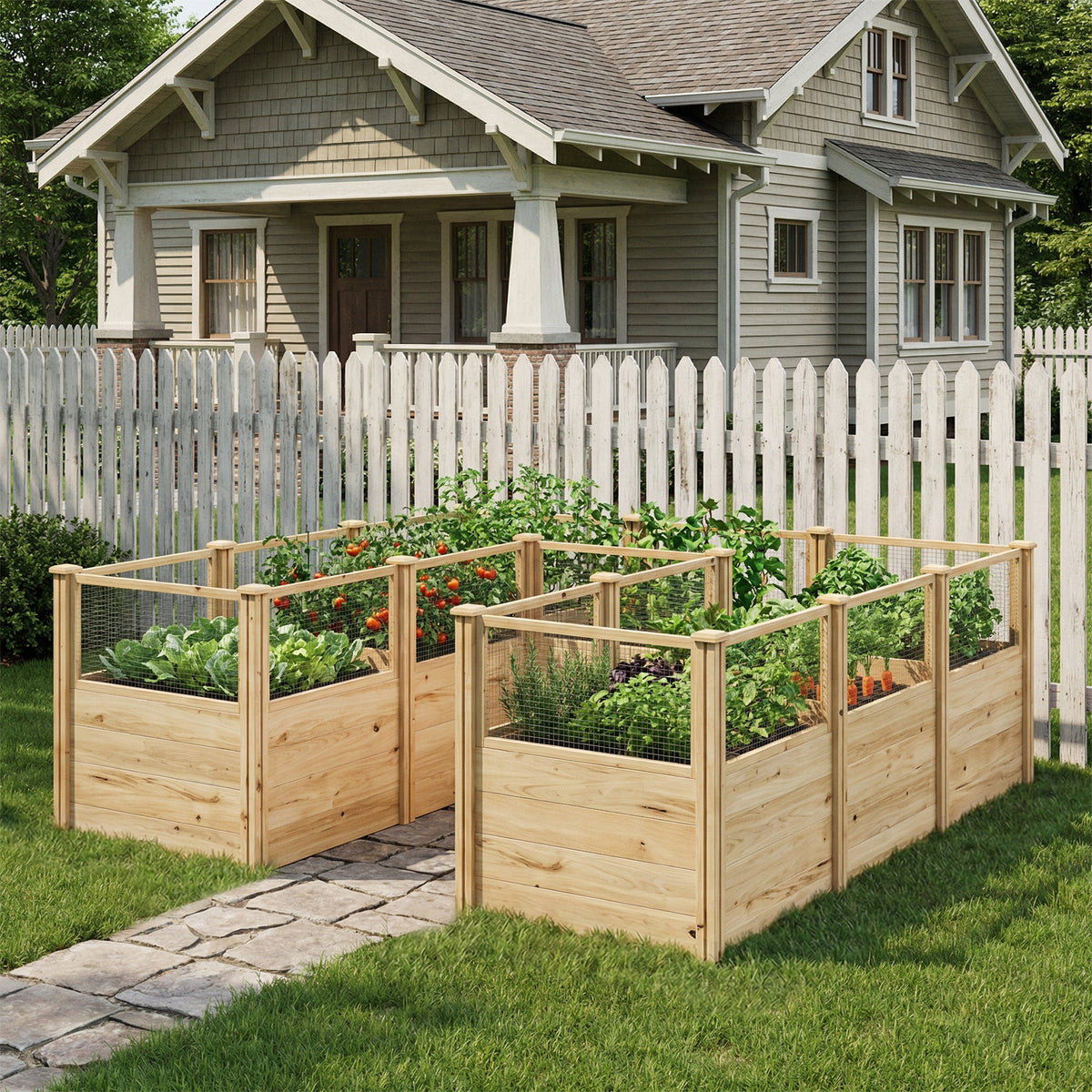
Our current range has one raised garden bed, a tall cedar bed built for gardening standing up. Facts come from its product listing; the assembly guide is in the User Manual tab on the product page.
Natural Cedar Planter Raised Garden Bed with Galvanized Pest Mesh Liner

A set of handcrafted solid cedar planter boxes that stands 34 inches tall, 95 inches wide and 33 inches deep overall and weighs 136.8 lb. The boxes join with mortise-and-tenon panels that snap together without screws or tools, and the listing says they can be arranged in five different layouts to suit a patio, deck or backyard. A galvanized steel mesh liner is included to keep critters away from the plants; in the photos the mesh forms panels around the upper part of each box.
Key facts: listed as mold and mildew, UV and weather resistant, with natural grain color variation. Care is simple: hose it down. There are no wheels, and assembly is required, though no tools are needed. The listing does not give a soil depth or say whether the boxes have a floor; in the photos they stand directly on gravel and lawn. Ask customer service if the fill depth matters for your crops.
Best for: gardeners who want to work standing up with less bending, deep-rooted crops such as tomatoes and carrots, and a backyard or gravel area where the bed can stay put.
Skip it if: you garden from a wheelchair or with young children: at 34 inches it is taller than the wheelchair heights in the table above, and the solid sides leave no knee space. Also skip it if the bed must be worked from one side only, since 33 inches deep is more than the one-sided reach the extension guides suggest, or if you want a light, movable planter for a balcony.
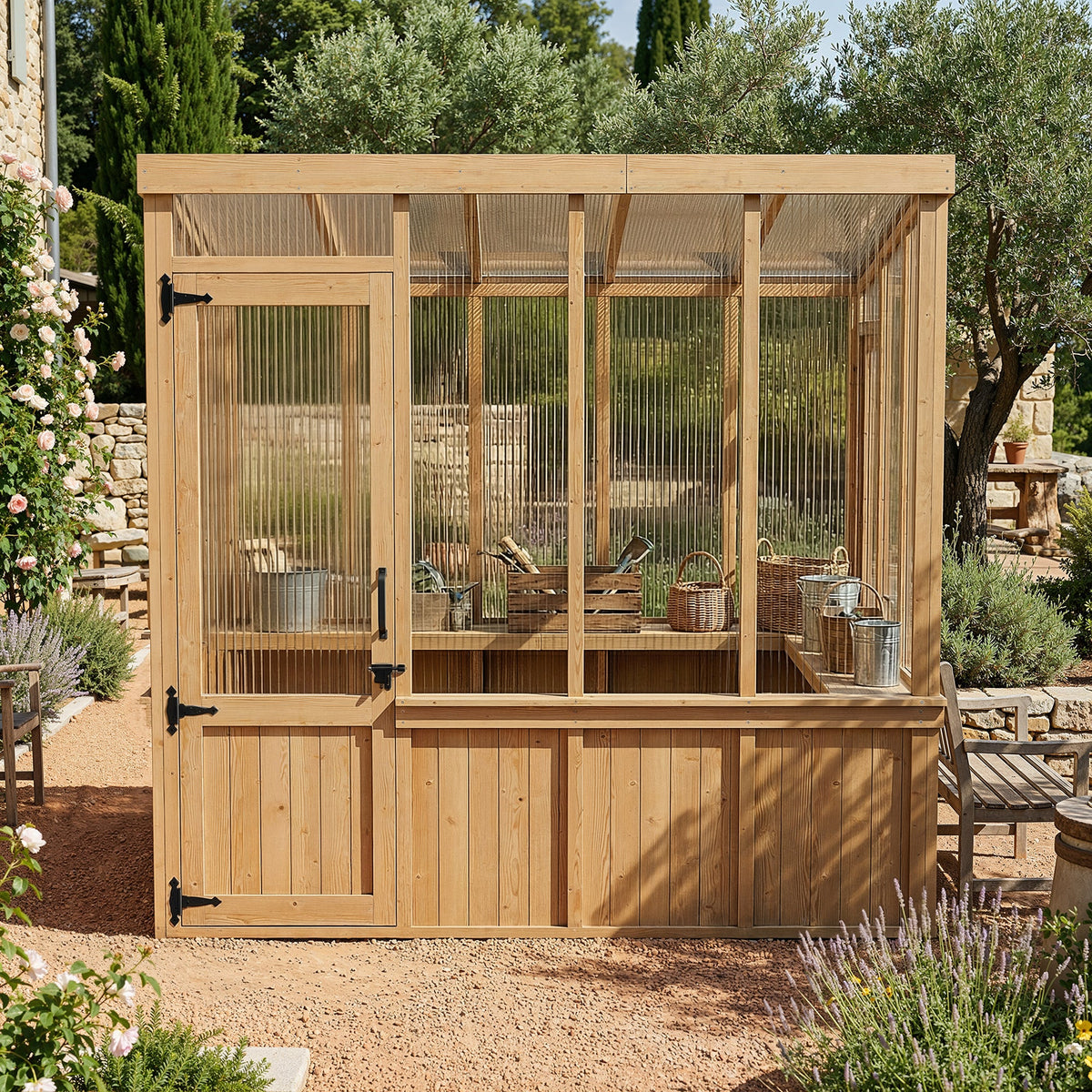
If you start seedlings early in the season, a walk-in cedar greenhouse from the same outdoor range pairs naturally with a bed like this one.
Filling a tall cedar bed
A bed this tall is close to the 36-inch standing height Georgia gives, but filling it with bought soil takes about 1.8 cubic feet per inch of depth across its footprint. Following Minnesota's note on beds over 2 feet tall, put coarse layers of sticks, leaves and compost in the bottom and a topsoil and compost mix on top. Level the ground first, and add hardware cloth under the soil if voles or chipmunks are a problem. Browse more garden pieces in our outdoor structures collection.
FAQ
How tall should a raised garden bed be?
For most vegetables on decent soil, 6 to 11 inches is enough, since roots continue into the ground. On pavement or poor soil, aim for at least 10 to 12 inches of soil. For comfort, extension guides suggest about 24 to 27 inches for wheelchair users and about 36 inches for standing gardeners who want to avoid bending.
Is 12 inches deep enough for a raised bed?
Twelve inches suits shallow-rooted crops such as lettuce, spinach, onions and peppers, which Utah State places at 6 to 12 inches of effective root depth. On open, loosened ground it works for most other vegetables too. Over pavement, give tomatoes, potatoes and carrots 18 inches or more.
Should I put anything in the bottom of a raised bed?
On open ground, usually nothing: Minnesota Extension says most beds need no barrier below. Add hardware cloth if burrowing animals are a problem, and use permeable landscape fabric rather than plastic if you line it. Very tall beds can take layered sticks, leaves and compost at the bottom.
Is cedar better than pressure-treated wood for a raised bed?
Cedar resists decay without treatment, and several extension services recommend it. Iowa State considers modern pressure-treated lumber safe for vegetable gardens; avoid railroad ties and lumber treated before 2004, which may contain arsenic.


Dejar un comentario
Este sitio está protegido por hCaptcha y se aplican la Política de privacidad de hCaptcha y los Términos del servicio.