





Size a walk-in greenhouse from the inside out: decide how deep your benches will be, add an aisle you can stand in, and check that both fit the interior floor, not the overall footprint. Then choose panels for light and heat (polycarbonate resists impact, glass lasts longest), plan vents or a fan so it does not overheat, set it on a level foundation, and put it where it gets the most winter sun.
Below: a size chart with the arithmetic, a glazing comparison, vent and fan sizing, siting, anchoring, snow, permits, cedar care and our pick from the FUFU&GAGA outdoor collection.
Key takeaways
- Size: side benches 2 to 3 feet deep plus an aisle of 18 to 30 inches; about two-thirds of a greenhouse is usually bench space.
- Panels: single-layer polycarbonate passes about as much light as glass and resists impact; glass lasts 25 years or more but breaks easily unless tempered.
- Ventilation: high and low vents of 15 to 20 percent of the floor area each, or a fan that changes the air once a minute in summer.
- Site: south or southeast of the house, on ground that drains; avoid the north side.
- Base: level and anchored as the manual says; close the door and vents before high wind.
What is a walk-in greenhouse?
A walk-in greenhouse is one you can stand and work inside, with a full-height door, unlike a cold frame you reach into from outside. Listings range from portable shelving units with a plastic film cover and a zip door to permanent kits with a rigid frame and polycarbonate or glass panels on a foundation. The cover decides how long it lasts and how much wind and snow it can take, so read that line first.
| Type | Cover | Base | Good for |
|---|---|---|---|
| Portable film greenhouse | Plastic film on a light tube frame | Pegs or ties; easy to move | Spring seed starting; covers need frequent replacing |
| Wood or metal frame kit | Polycarbonate panels | Level foundation, anchored | Seedlings, overwintering, year-round growing |
| Glass greenhouse | Glass, often tempered | A good foundation and a strong frame | A permanent garden building |
How big should a walk-in greenhouse be?
Start with the benches. The University of Georgia Extension bulletin Hobby Greenhouses gives these planning figures:
- Side benches should be no wider than you can reach across: about 2 feet for some people, up to 3 feet for others. Center benches, worked from both sides, could be as wide as 6 feet.
- Aisles: 18 or 19 inches is enough to stand and tend benches; 24 to 30 inches lets visitors pass.
- Bench height: a working height of 36 inches. Colorado State's PlantTalk suggests about 30 inches, so the range is roughly 30 to 36 inches.
- Space: most plants in 6 inch pots need at least 1 square foot of bench, and about two-thirds of a greenhouse is usually bench space.
- Height: an eave of 5 feet suits side benches of low plants; 6 to 7 feet suits tall plants.
The bulletin also advises building 25 to 50 percent larger than you think you need. Clemson Cooperative Extension's hobby greenhouse fact sheet notes that temperatures in small greenhouses fluctuate more rapidly, and suggests minimum sizes of 6 by 10 feet for a lean-to and 8 or 10 by 12 feet for a freestanding greenhouse. Many backyard kits are smaller, so plan ventilation with extra care.
Walk-in greenhouse size chart
The chart is arithmetic from those figures, with benches along both long sides and the door on an end wall.
| Interior floor | Benches | Aisle left | Bench area | Share of floor |
|---|---|---|---|---|
| 6 x 8 ft (72 x 96 in) | Two 24 in | 72 - 48 = 24 in | 2 x 2 x 8 = 32 sq ft | 32 of 48, 67% |
| 8 x 8 ft (96 x 96 in) | Two 30 in | 96 - 60 = 36 in | 2 x 2.5 x 8 = 40 sq ft | 40 of 64, 63% |
| 8 x 12 ft (96 x 144 in) | Two 30 in | 36 in | 2 x 2.5 x 12 = 60 sq ft | 60 of 96, 63% |
| 10 x 12 ft (120 x 144 in) | Two 36 in | 120 - 72 = 48 in | 2 x 3 x 12 = 72 sq ft | 72 of 120, 60% |
At 1 square foot per 6 inch pot, the 6 by 8 foot plan holds about 32 pots on one level; shelves above add room for seedlings. Choose a wider aisle if two people will work inside or you will bring in a cart.
Worked example: a 95 x 70 inch interior
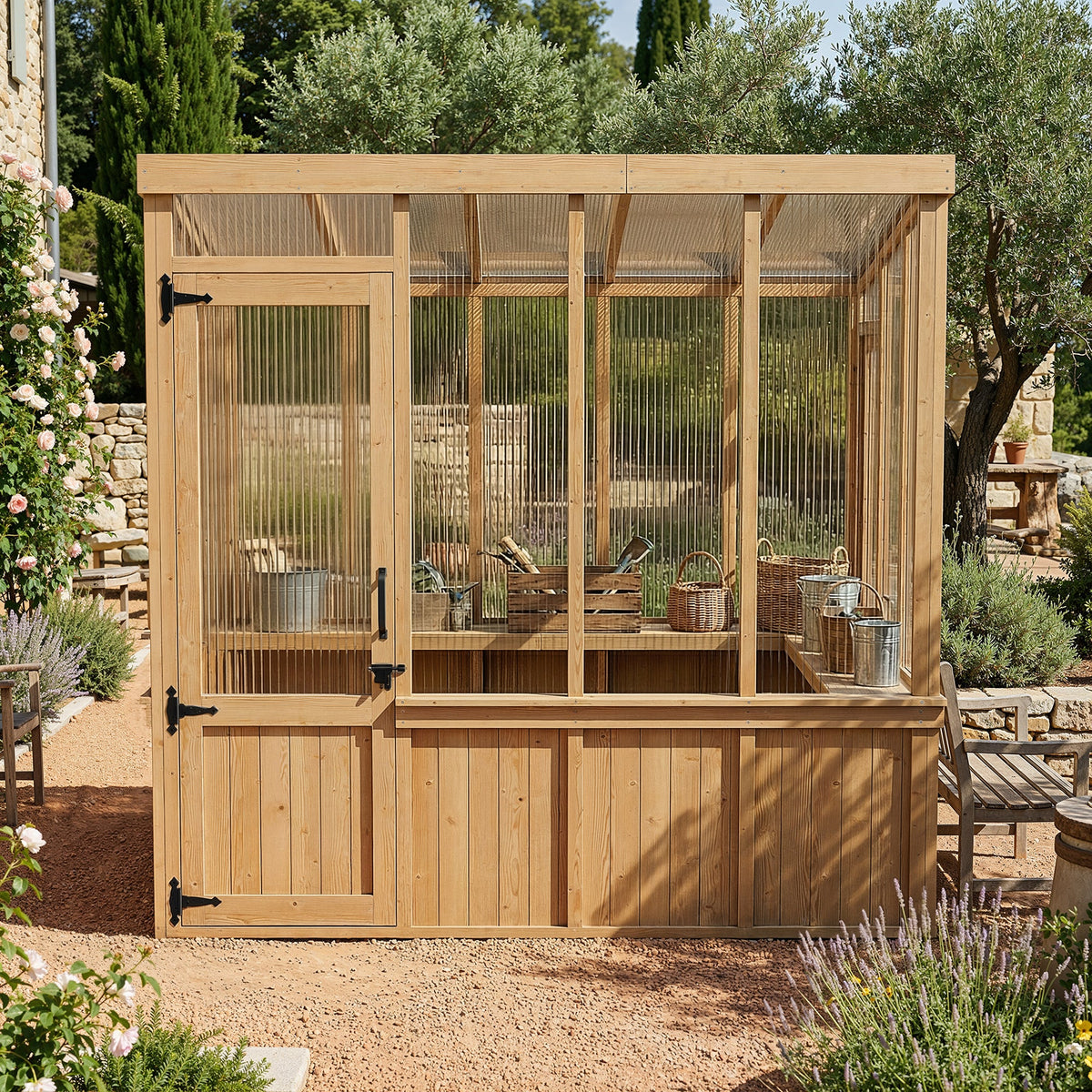
Our cedar greenhouse below has an interior of about 95 x 70 inches: 6,650 square inches, or about 46.2 square feet, with the door in the long front wall.
- A 24 inch bench along the back wall: 95 x 24 = 2,280 square inches, about 15.8 square feet, leaving 70 - 24 = 46 inches to stand in.
- Add a 24 x 46 inch end bench on the side away from the door: about 23.5 square feet in all, with about 71 x 46 inches of standing room.
- A U-shape reaches about 31 square feet, near the two-thirds rule, if the bench on the door side stops short of the doorway.
Measure the pre-installed shelves first and plan around them.
Polycarbonate vs glass greenhouse panels
Glazing sets how much light reaches the plants, how much heat stays in and how often panels need replacing. The UGA bulletin's glazing table, mostly manufacturers' data by its own note, gives these figures:
| Glazing | Light transmitted | Estimated life | Strengths | Drawbacks |
|---|---|---|---|---|
| Glass (double strength) | 85% | 25+ years | Resists heat, UV and abrasion | Low impact resistance unless tempered; heavy |
| Polycarbonate, single layer | 87% | 7 to 10 years | High impact resistance; handles high temperatures | Can yellow under UV; scratches easily |
| Polycarbonate, double wall | 75% | 5 to 7 years | Holds more heat | Less light |
| Polyethylene film | Up to about 87%, by grade | 8 months to 3 years | Light and easy to fit | Short life |
Clemson adds that tempered glass is two or three times stronger than regular glass, that glass needs a good foundation and strong frame, and that double-layer panels retain more heat, so energy savings of 30 percent are common. In short: glass for a permanent house on a solid base, polycarbonate where hail or stray balls are a worry, double wall where winter heat matters more than maximum light. Check whether a listing calls the panels UV-protected, and clean them with a soft cloth, since polycarbonate scratches easily.

Greenhouse ventilation: vents, fans and heat
A greenhouse traps heat by design. The UGA bulletin warns that without ventilation the air can get hot enough to injure or kill plants. It says a night temperature of 55 to 65 degrees F suits most greenhouse plants, with about 40 degrees F as the minimum and 85 degrees F as the maximum in most situations.
How much vent area?
The UMass Amherst fact sheet Natural Ventilation in Greenhouses says the combined sidewall vent area should equal the combined ridge vent area, each 15 to 20 percent of the floor area: cool air comes in low and warm air leaves high.
For a 46.2 square foot floor, that is 46.2 x 0.15 = 6.9 to 46.2 x 0.20 = 9.2 square feet high and the same low. Kit listings often give no vent sizes; if yours does not, open the door too on warm days. A 78.7 x 26 inch door is 2,046 square inches, about 14.2 square feet of opening.
Sizing a fan
Clemson says exhaust fans should exchange the total air volume each minute: one to one and a half changes per minute in summer, 20 to 30 percent of one change per minute in winter. Small circulation fans should move about one quarter of the volume per minute, run continuously in winter.
Example: 95 x 70 x 94 inches / 1,728 = about 362 cubic feet at most (less in practice, since the roof slopes). Summer exhaust: about 362 to 543 cubic feet per minute; winter about 72 to 109; circulation about 90. In hot spells Clemson says evaporative cooling, shade cloth or shading paint may be needed. Have power run by a professional, as the UGA bulletin advises for electrical and plumbing work.
Where to put a walk-in greenhouse
Maximize winter sun. Clemson's first choice is the south or southeast side of a building or shade tree, and it says an east-side location captures the most November-to-February sunlight; north of major structures is the least desirable spot. Deciduous trees can shade the house from late-afternoon summer sun, while evergreens block winter sun. Where needed, build above the surrounding ground so water drains away. The UGA bulletin adds that a greenhouse lying lengthwise north-south gets more light than one lying east-west, which matters most in winter, and warns about falling limbs. Leave room to walk around the outside to clean panels.
Foundation, anchoring and wind
A rigid greenhouse needs a level, square base, or doors bind and panels strain. For floors, the UGA bulletin lists gravel, cinders, crushed stone, concrete or brick, and says the areas under benches should always be water-absorbent. Your kit's manual decides what the frame sits on and how it is fastened.
Then plan for wind. The UMass fact sheet Reducing Storm Damage to Your Greenhouses says to close all vents, louvers and doors before a storm, because the effective force of the wind is doubled when it gets inside, and to secure anything that could be thrown through the glazing. Before you dig footings or drive anchors, contact 811: the 811 Before You Dig site calls it the free national before-you-dig service and says every digging project requires contacting 811 a few days in advance. Our patio gazebo buying guide compares anchoring on decks, pavers, concrete and soil.
Can you use a walk-in greenhouse in winter?
Yes, if it is rated for it and you manage heat and snow. Clemson says gas, oil and wood heaters must be vented to the outside, and unvented propane or kerosene heaters are not recommended.
Snow is heavier than it looks. The UMass storm-damage sheet says 12 inches of fluffy snow, or 3 inches of wet snow, can equal 1 inch of rain, which loads a greenhouse with 5.2 pounds per square foot. On a 96.1 x 70.9 inch roof (about 47.3 square feet), that is 47.3 x 5.2 = about 246 pounds. Local building codes set design snow loads; check your greenhouse's manual for its rating and clear heavy snow as it describes.
Do you need a permit for a greenhouse?
Often. The UGA bulletin says a building permit is usually required to erect a greenhouse. Ask your city or county building department and your homeowners association about size limits, setbacks and foundations before you buy.
Caring for a cedar greenhouse
The USDA Forest Products Laboratory's Wood Handbook chapter on biodeterioration groups cedars, including western and eastern redcedar, as resistant to decay. That applies to heartwood; untreated sapwood of essentially all species has low resistance. Resistant heartwood generally serves well above ground, and only very resistant species do well in ground contact. Serious decay occurs only when wood is wetter than about 30 percent moisture, from rain, condensation or wet ground.
- Keep the sills off the soil with a foundation, and vent out condensation.
- Clean gently. The Wood Handbook chapter on finishing says aggressive power washing can leave weathered wood with a washboard surface.
- Protect plants when finishing. The same chapter gives a 1 to 3 year service life for a water-repellent preservative and cautions that fungicides in these finishes and in semitransparent stains are toxic and may be herbicides. Empty the greenhouse before you treat the frame.
Walk-in greenhouse buying checklist
- Sketch benches 24 to 36 inches deep with an aisle of 18 to 30 inches on the interior floor.
- Count pots at 1 square foot each, then add 25 to 50 percent.
- Check the door against what you will carry in.
- Choose panels: polycarbonate for impact, double wall for heat, glass for longest life.
- Compare vent area with 15 to 20 percent of the floor; add a fan if it falls short.
- Pick a south or southeast site with winter sun and drainage.
- Read the manual's foundation and anchoring steps; contact 811 before digging.
- Look for listed wind and snow ratings, and ask about permits.
Our pick: a solid cedar walk-in greenhouse
Here is how our cedar walk-in greenhouse measures up. It needs assembly and installation; our flat-pack assembly guide has general tips, and the manual governs the foundation.
96.1" natural solid cedar walk-in greenhouse with polycarbonate panels and ventilation

A compact, permanent growing room for seed starting, overwintering and potting. It measures 96.1 inches wide, 70.9 inches deep and 94.3 inches tall overall and weighs 310 lb. The interior is about 95 x 70 inches with 94 inches of height at the peak of the pitched roof, and the lockable door is 78.7 inches tall and 26 inches wide.
The frame is solid cedar in a natural finish, with polycarbonate panels that the listing says filter UV and help retain warmth. Ventilation is manual: an adjustable window vent plus screened lower vents. Cedar shelves come pre-installed. The base is open-bottom for drainage; the listing says a foundation is needed and installation is required, and lists it for year-round use. Assembly needs a screwdriver; clean it with soap and water. The listing gives no wind rating, snow load or anchoring hardware, so check the User Manual tab before you build the base.
Best for: a gardener with a patio or yard corner of about 8 x 6 feet who wants room for a bench or two, shelves and a person working inside.
Skip it if: you need listed wind or snow ratings for an exposed or snowy site, want automatic roof vents, or need a big growing area; it is smaller than Clemson's suggested minimum for a freestanding greenhouse. The listing's shelf width is unreliable, so measure the shelves before buying extra benches.
| Spec | As listed |
|---|---|
| Overall (W x D x H) | 96.1 x 70.9 x 94.3 in |
| Interior | About 95 x 70 in, 94 in at the peak |
| Door | 78.7 x 26 in, lockable |
| Panels and frame | Polycarbonate; solid cedar |
| Ventilation | Manual window vent, screened lower vents |
| Base | Open bottom; foundation needed |
| Weight | 310 lb |
To grow outside it too, our cedar raised garden bed, also in the outdoor collection, pairs well with it. Browse more in the FUFU&GAGA outdoor collection.
FAQ
What size walk-in greenhouse do I need?
Add your bench depths to an aisle and compare with the interior floor. Two 24 inch side benches and a 24 inch aisle need 72 inches of width, so a 6 by 8 foot floor gives about 32 square feet of bench. UGA Extension suggests building 25 to 50 percent larger than you think you need.
Is polycarbonate or glass better for a greenhouse?
In the UGA glazing table, single-layer polycarbonate passes 87 percent of light and resists impact but can yellow and lasts about 7 to 10 years; glass passes 85 percent and lasts 25 years or more but breaks easily unless tempered and needs a strong frame.
How do you keep a walk-in greenhouse from overheating?
Open low and high vents together, aiming for 15 to 20 percent of the floor area each, and open the door on hot days. If that is not enough, add an exhaust fan that changes the air once a minute in summer, and use shade cloth. UGA gives 85 degrees F as the usual maximum.
Does a walk-in greenhouse need a foundation?
A rigid-panel greenhouse does: a level base keeps the frame square, and it must be anchored against wind as its manual describes. Portable film greenhouses are lighter and are usually staked or tied. Contact 811 before you dig footings or drive anchors.

Dejar un comentario
Este sitio está protegido por hCaptcha y se aplican la Política de privacidad de hCaptcha y los Términos del servicio.