




The right reptile enclosure size depends on the species and its adult length, and published minimums range from about 10 gallons for a single leopard gecko to more than 110 gallons for an adult bearded dragon. Veterinary and animal welfare sources do not all agree, so treat every figure below as a floor, not a target: the Merck Veterinary Manual advises giving reptiles the largest enclosure possible.
This guide turns those minimums into inches and gallons, explains why floor space matters for ground dwellers and height matters for climbers, and covers doors, materials, heat, humidity and stands. It ends with two terrariums from the FUFU&GAGA small pet habitats collection and who each one suits.
Key takeaways
- Size by adult length and lifestyle: ground-dwelling (terrestrial) species need floor area; tree-dwelling (arboreal) species need height.
- Gallons from inches: length x width x height in inches, divided by 231, equals US gallons.
- Bearded dragon: VCA Animal Hospitals gives 60 to 100 gallons or larger for adults; the RSPCA minimum works out to about 114 gallons.
- Snakes: the RSPCA sizes the vivarium from the snake's length, with width and height at least a third of that length. Doors must lock.
- Heat and UVB: every lamp needs a guard and every heat source a thermostat; glass and plastic block most UVB.
How big should a reptile enclosure be? Reptile enclosure size by species
The table below gives the minimum adult enclosure size from veterinary and animal welfare sources for five of the most common pet reptiles. RSPCA figures are in centimeters on the original pages; they are converted here at 2.54 cm per inch, and the gallons are worked out with the formula in the next section.
| Species | Lifestyle | Published minimum for one adult | In inches (L x D x H) | About |
|---|---|---|---|---|
| Bearded dragon | Terrestrial, active basker | RSPCA: 120 cm long x 60 cm high x 60 cm wide. VCA: 60 to 100 gallons or larger, length at least 3 times the lizard's total length, width at least 16 in | 47.2 x 23.6 x 23.6 (RSPCA) | 114 gal (RSPCA) |
| Leopard gecko | Terrestrial, ground dweller | RSPCA: 60 cm long x 40 cm high x 30 cm deep. VCA: a 10-gallon aquarium, at least 6 in high | 23.6 x 11.8 x 15.7 (RSPCA) | 19 gal (RSPCA), 10 gal (VCA) |
| Crested gecko | Arboreal climber | RSPCA: 45 cm wide x 60 cm tall x 45 cm deep. Texas A&M vet school: an upright tank of 20 gallons, if not larger | 17.7 x 17.7 x 23.6 (RSPCA) | 32 gal (RSPCA) |
| Corn snake | Mostly terrestrial, climbs | RSPCA: a 150 cm snake needs at least 150 cm long x 50 cm wide x 50 cm deep | 59.1 x 19.7 x 19.7 for that snake | 99 gal for a 59 in snake |
| Ball python (royal python) | Terrestrial | RSPCA: a 120 cm snake needs at least 120 cm long x 40 cm wide x 40 cm deep | 47.2 x 15.7 x 15.7 for that snake | 50 gal for a 47 in snake |
Sources: RSPCA care pages for the bearded dragon, leopard gecko, crested gecko, corn snake and royal python; VCA Animal Hospitals on bearded dragon housing and leopard gecko care; and Texas A&M School of Veterinary Medicine.
Notice how far apart the leopard gecko figures are: VCA's 10 gallons is about half the RSPCA minimum. Where sources differ, the larger figure gives your animal more room to explore, and many keepers choose well above any minimum. Your reptile vet can tell you what suits your animal's size, age and health.
Babies and juveniles can start smaller. VCA says a juvenile bearded dragon can begin in a 20-gallon aquarium, and the RSPCA says hatchling crested geckos may start in a smaller setup that is enlarged as they grow. Plan for the adult size, though: reptiles grow quickly, and it is often simpler to buy the adult enclosure once.
How do you work out a reptile tank size in gallons?
A US gallon is 231 cubic inches, as defined by NIST. So multiply length x width x height in inches and divide by 231:
- 48 x 24 x 24 in (a "4x2x2"): 27,648 cubic inches / 231 = about 120 gallons.
- 36 x 18 x 18 in: 11,664 / 231 = about 50 gallons.
- 30 x 12 x 12 in: 4,320 / 231 = about 19 gallons.
- 12 x 12 x 18 in: 2,592 / 231 = about 11 gallons.
Two cautions. First, outer dimensions overstate the space inside, because frames, the base and the top take up room, so the usable volume is a little smaller. Second, gallons alone do not tell you whether a tank fits: a tall 90-gallon terrarium and a long 90-gallon terrarium suit very different animals. Always check the length, depth and height against the species minimum, not just the gallon number.
Floor space vs height: active lizards, climbers and snakes
The Merck Veterinary Manual sizes terrestrial lizards by floor area and arboreal lizards by volume, and that is the practical rule for choosing a shape. Terrestrial reptiles such as bearded dragons and leopard geckos live on the ground, so a long, deep enclosure gives them enough space to roam between the warm and cool ends. Active lizards such as beardies use that floor space every day to bask, hunt and cool down.
Arboreal species need height. A Texas A&M veterinarian notes that crested geckos spend most of their time in trees and need upright tanks, and the RSPCA crested gecko minimum is taller (60 cm) than it is wide. A low, wide terrarium wastes much of its volume for a climber.
Snakes sit in between. The RSPCA sizes their vivaria from the snake's length, with width and height at least a third of it. Whatever the species, length matters for thermoregulation: a reptile can only set its own body temperature if the enclosure is long enough to hold a real warm end and cool end.
Why does a correct heat gradient need space?
Reptiles are ectotherms; in the wild they move between sun and shade to control their body temperature, and in captivity the enclosure has to do the same job. Merck advises placing heaters toward one end to create a thermal gradient. The published ranges show why a small tank is prone to problems: VCA lists about 90 to 100°F at the warm end and 75 to 80°F at the cool end for bearded dragons, and the RSPCA recommends that a beardie's back stays 25 to 30 cm (about 10 to 12 in) from the basking lamp. Fitting a lamp, a safe distance and a cool retreat into a short tank is hard.
Other ranges from the sources: the RSPCA gives a 28 to 30°C (about 82 to 86°F) basking zone and 24 to 26°C (75 to 79°F) cool end for leopard geckos, and VCA gives about 90 to 95°F warm and 70 to 75°F cool for many pet snakes. These vary by species, so follow a care sheet for yours and confirm with your vet.
Front-opening vs top-opening reptile terrariums
Many reptile terrariums open at the front with sliding or hinged glass doors, while a converted aquarium opens at the top. Front access makes feeding, spot cleaning and changing water easier and lets you reach in at the animal's level instead of from above. A top-opening tank keeps a full screen lid available for lamps. If you choose sliding doors, check how they close: VCA says snake cages must be escape-proof, with sealed seams and a secure top that locks.
Glass vs wood-and-glass enclosures
Each material has trade-offs, and the sources point in different directions:
| Material | Strengths | Watch out for |
|---|---|---|
| All glass | Full view; easy to wipe; the RSPCA prefers glass over wood for crested geckos because of the high humidity they need | Merck calls glass a poor insulator that can lead to temperature swings; full visibility can stress some animals |
| Wood with a glass front | Merck calls wood, plastic and fiberglass enclosures more versatile and preferable to glass; a wood cabinet also looks like furniture in a living room | VCA notes wooden cages are hard to clean and disinfect thoroughly; check how the base and corners are sealed |
| PVC or plastic panels | Same advantages Merck lists for non-glass enclosures | Merck notes they can be expensive; check ventilation and lamp mounting |
A wood-and-glass cabinet is a natural fit for species kept relatively dry. The RSPCA gives about 30 to 40 percent humidity for bearded dragons and leopard geckos, compared with 50 to 60 percent for royal pythons and misting up to 80 percent for crested geckos.
Ventilation, heat lamps and UVB fixtures
Ventilation is not optional. The RSPCA calls good ventilation essential to reduce the risk of respiratory infections and bacteria, and Merck warns that reducing ventilation to hold heat or humidity frequently causes skin and respiratory disease. Look for mesh panels or vents at both ends so air can move through.
For lamps, the RSPCA says heat bulbs and UV lamps must be guarded to prevent burns, and that a thermostat must be used with all heat sources. Merck adds that heaters should be thermostat-controlled and screened from the animal, and that most plastic and glass barriers block UVB, which is why lamps usually sit above a mesh top or inside the enclosure behind a guard. UVB output fades: VCA advises replacing the bulb every six months or as the maker directs, and keeping it within about 6 to 18 in of a bearded dragon. Follow each lamp maker's instructions for mounting and clearance, and never use hot rocks, which Merck and VCA both warn can burn reptiles.
Stands, floor weight, anchoring and locks
A large terrarium is heavy before you add substrate, rocks and water. Put it on a level floor and on a stand or cabinet that matches its full footprint, so the base is supported at every edge. A cabinet-style terrarium stands tall and carries weight high up, so anchor it to the wall if its instructions allow; our guide on anchoring furniture to the wall shows the method. Keep the enclosure away from radiators and bright windows, which the RSPCA says can throw off the temperature.
Locking doors keep snakes in and small children out. If a terrarium has no lock, add one made for reptile enclosures before housing a snake.
Buying checklist
- Look up the adult size of your species and write down the minimum length, depth and height from a vet or welfare source.
- Compare inner dimensions, not only outer dimensions or gallons.
- Choose the shape: long and deep for terrestrial species, tall for arboreal species.
- Check the length allows a warm end and a cool end with the lamp at a safe distance.
- Confirm there is a mesh top or vents for airflow and a safe way to mount guarded lamps.
- Check door type: front-opening for easy access, with a lock for snakes.
- Match the material to humidity: glass for humid species, wood-and-glass works best for drier ones.
- Plan the stand: full-footprint support, a level floor and wall anchoring for tall cabinets.
- Check the cord route for heaters and lamps.
Our picks: two reptile terrariums for different setups
FUFU&GAGA currently carries two terrariums that suit reptiles, and they solve different problems: one is a large standalone habitat, the other combines a habitat with a storage cabinet. Neither is big enough for every species, so check the table above first.
47.2" Large Reptile Terrarium with Sliding Glass Doors and Top Mesh Ventilation

This is the larger habitat of the two. It measures 27.6" H x 47.2" W x 19.7" D outside, which works out to 47.2 x 19.7 x 27.6 = 25,664 cubic inches, or about 111 gallons by outer dimensions. The listing gives the capacity as 90 gallons, which reflects the smaller space inside the frame. It has a tempered glass front with dual sliding doors, and the listing describes fine mesh on the top and side panels for airflow and for UV and IR light. It weighs 86 lb, comes in beige or dark brown, and needs assembly with a screwdriver.
How it compares with the minimums: its 47.2" length matches the RSPCA's 120 cm bearded dragon minimum and falls within VCA's 60 to 100 gallon range by capacity, but its 19.7" depth is less than the RSPCA's 60 cm (23.6"). By VCA's rule of three times body length, its length suits a dragon up to about 15.7 in long (47.2 / 3). For a snake, the RSPCA rule means a snake up to roughly the enclosure's inner length, with 19.7" depth and 27.6" height clearing a third of that.
Best for: leopard geckos with room to spare, a young or smaller bearded dragon, or a corn snake or ball python sized to its length, set on a sturdy stand or low furniture.
Skip it if: you keep a large adult bearded dragon (the depth is below the RSPCA minimum), you want a lock (the listing does not mention one, so add one for a snake), or you need a stand included. The listing photos show a top with round openings and round side vents; ask customer service how lamps mount before ordering if your setup depends on a full mesh top.
47.2" Modern Natural Reptile Terrarium with Lower Cabinets and Glass Slide Doors

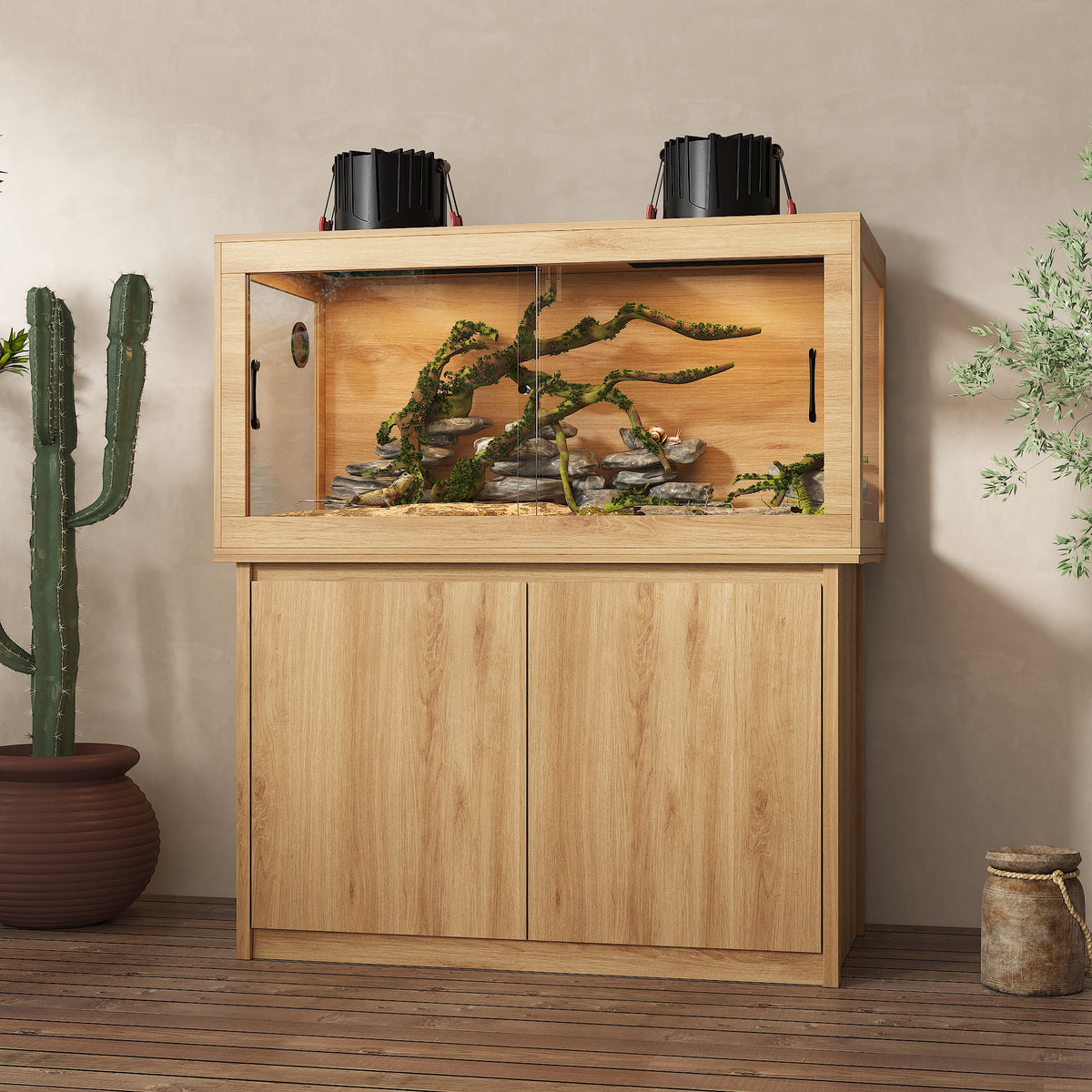
This model is a piece of furniture: a glass-walled habitat on top of a two-door storage cabinet, 53.7" H x 47.2" W x 23.6" D overall, including the base. The listing gives the habitat capacity as 220 quarts. With 4 quarts to a gallon, that is 55 gallons, or about 12,705 cubic inches (55 x 231). The listing does not give the inside length, depth or height of the habitat, so do not assume the 53.7" height is living space: most of it is the cabinet below.
According to the listing, three tempered glass panels give a 270° view, the black iron mesh top supports heat and UV lamps, a grommeted cable port routes cords, the aluminum-framed sliding doors have a child-proof lock, and a waterproof PP tray sits at the bottom. The cabinet holds six adjustable shelves, 20" deep, for feed, tools and substrate. It weighs 202 lb, is listed for indoor use, and names small lizards, geckos, turtles and tortoises as suitable pets.

Best for: a leopard gecko or another small ground-dwelling lizard in a living room or bedroom, when you want lamps, feed and cleaning supplies in one footprint and doors that lock.
Skip it if: you keep an adult bearded dragon (55 gallons is below VCA's 60 to 100 gallons), a crested gecko or other climber (the habitat is the low upper section), or a large snake; or if you need to know exact interior dimensions before buying. At 202 lb it needs a level floor, and it arrives for assembly; see our flat-pack assembly guide.
Compare the two terrariums
| Feature | 47.2" Large Reptile Terrarium | 47.2" Terrarium with Lower Cabinets |
|---|---|---|
| Outer size | 27.6" H x 47.2" W x 19.7" D | 53.7" H x 47.2" W x 23.6" D (with base) |
| Listed capacity | 90 gallons (about 111 by outer size) | 220 quarts = 55 gallons |
| Doors | Dual sliding glass, no lock listed | Sliding glass with child-proof lock |
| Top and airflow | Mesh top and side panels (per listing) | Iron mesh top that supports lamps, cable port |
| Storage | None | Two-door cabinet, six adjustable shelves |
| Weight | 86 lb | 202 lb |
| Best for | Leopard geckos, smaller beardies, snakes sized to length | Leopard geckos and other small lizards |
Browse every habitat, including small-animal cages, in the small pet habitats collection.
FAQ
Is a 40 gallon tank enough for a bearded dragon?
For an adult, no by either source used here: VCA Animal Hospitals gives 60 to 100 gallons or larger, and the RSPCA's 120 x 60 x 60 cm minimum works out to about 114 gallons. VCA says a juvenile can start in a 20-gallon aquarium, so a 40-gallon tank can serve a growing baby for a while.
Is a 120 gallon tank good for bearded dragons?
A 48 x 24 x 24 in tank holds about 120 gallons (27,648 / 231). Those dimensions meet the RSPCA minimum of 47.2 x 23.6 x 23.6 in and exceed VCA's 60 to 100 gallons. By VCA's rule that length should be at least three times the lizard's total length, 48 in suits a dragon up to 16 in long; a bigger dragon needs a longer enclosure, so ask your vet.
What reptiles can live in a 36x18x18 enclosure?
A 36 x 18 x 18 in enclosure is about 50 gallons. It is larger than the RSPCA minimum for a leopard gecko and, by the RSPCA's length rule, can house a snake up to about 36 in long. It is too short for the RSPCA crested gecko minimum (23.6 in tall) and too small for an adult bearded dragon.
How big is a 90 gallon tank?
It depends on the shape, because gallons only measure volume. A 90-gallon tank holds about 20,790 cubic inches (90 x 231). Our 47.2" terrarium is listed at 90 gallons with outer dimensions of 47.2 x 19.7 x 27.6 in; other 90-gallon tanks are taller and shorter.
Can I turn a cabinet into a terrarium?
Only with care. VCA notes wooden cages are hard to clean and disinfect, Merck warns that poor ventilation causes respiratory and skin disease, and the RSPCA requires guarded lamps and thermostats. A purpose-built terrarium cabinet, with a mesh top for lamps, vents and a sealed tray, is designed around those needs.

Dejar un comentario
Este sitio está protegido por hCaptcha y se aplican la Política de privacidad de hCaptcha y los Términos del servicio.