










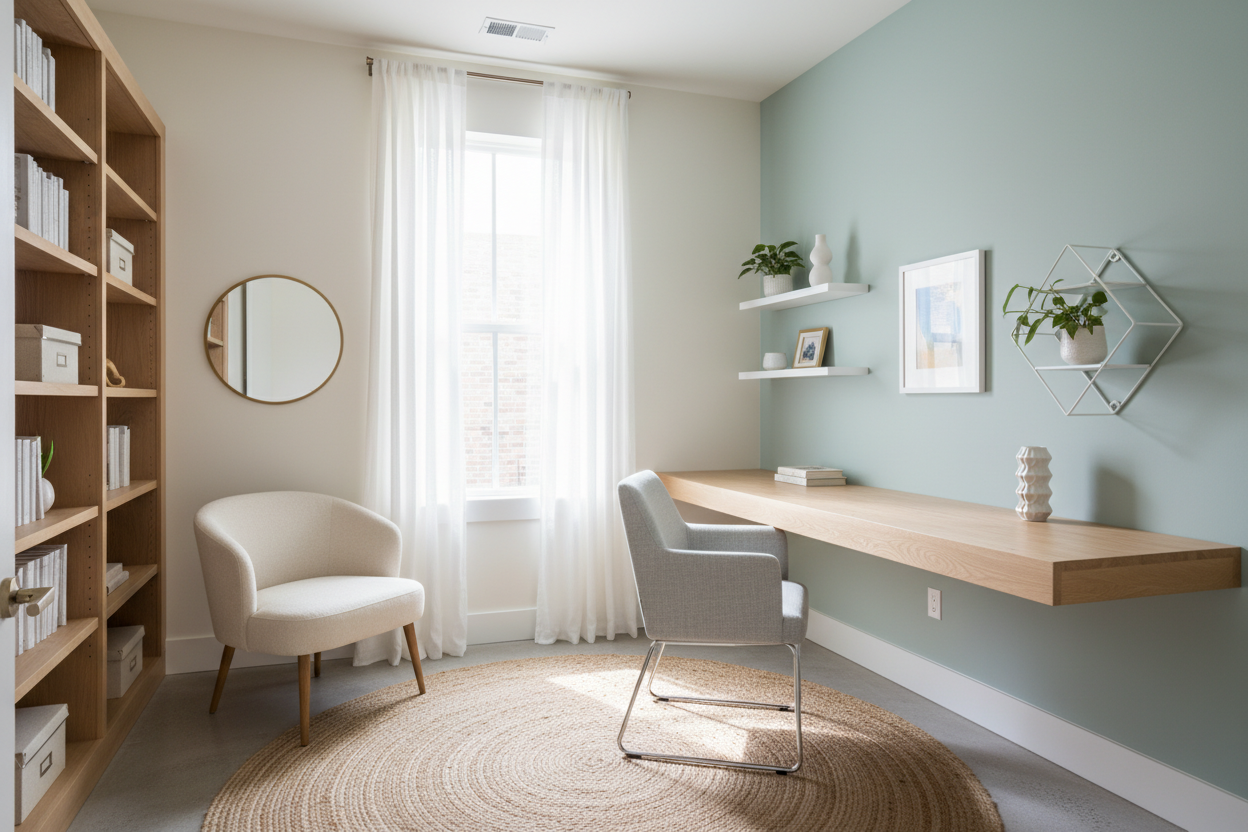
We have all seen it: a tiny spare bedroom or a cramped alcove hastily turned into a workspace. You push a bulky desk against the wall, set up your monitors, and suddenly the room feels suffocating. The quickest way to fix a claustrophobic workspace is not knocking down drywall—it is rethinking your small home office colour scheme.
Color dictates the visual weight of a room. Get it wrong, and the walls close in on you by 3 PM. Get it right, and even an 8x10 box can feel intentional, focused, and breathable. In this guide, we will walk through exactly how to select hues that maximize your square footage while keeping you comfortable and productive.
Quick Decision Guide
- Use color drenching (painting walls, trim, and doors the same hue) to blur harsh lines and push the walls outward.
- Match your desk finish to your wall tones to reduce visual clutter and maintain a seamless sightline.
- Avoid stark white paint unless the room receives abundant, direct sunlight; otherwise, it will look dingy and cast gray shadows.
- Balance warm and cool tones carefully—cool greens promote focus, while subtle warm accents prevent the room from feeling clinical.
Space Planning With Paint
The Magic of Color Drenching
In small North American homes, standard white baseboards and window casings act as visual borders, outlining the exact dimensions of a tiny room. By painting your walls, trim, and even the ceiling the exact same color, you eliminate these high-contrast stopping points. This technique blurs the edges of the room, creating an optical illusion that makes the ceiling feel higher and the walls feel further away.
Lighting Dictates Everything
Before you commit to a paint swatch, check your window exposure. North-facing rooms receive cool, indirect light that can make light colors feel icy. In these spaces, lean into warmer undertones. South-facing rooms get blasted with bright, warm light, allowing you to experiment with cooler blues and greens without the room feeling chilly.
Coordinating Furniture and Paint
Mastering Desk Color Schemes
Your furniture choices carry immense visual weight. When exploring desk color schemes, remember that high-contrast pieces chop up a small room. A heavy, dark espresso desk against a pale gray wall creates a jarring focal point that immediately draws the eye and makes the room feel cramped. If you want the space to feel larger, choose a desk finish that closely relates to your wall color—like a pale white-oak desk against a soft sage wall.
Curating Home Office Colour Scheme Ideas
If you are searching for foolproof home office colour scheme ideas, look to nature. Monochromatic palettes work beautifully in tight quarters. Layering different shades of the same color—such as a deep forest green rug, mid-tone olive walls, and pale mint curtains—creates depth and interest without overwhelming the senses during a long workday.
Moody vs. Bright: What Actually Works
Borrowing Global Inspiration
If you browse design portfolios, you might notice that searches for the best colour for home office uk often yield images of incredibly deep, moody spaces. British designers are masters at wrapping tiny, light-starved box rooms in rich navy or plum. However, there is a catch: heritage homes often feature complex plaster moldings that catch the light beautifully. If you try to replicate this in a standard flat-drywall suburban room, the paint can fall flat. To make dark colors work in a typical modern home, use an eggshell finish to bounce a little light and add heavily textured fabrics to bring the walls to life.
Designer's Honest Take
Early in my career, I tackled a tiny 8x9 foot suburban den. I assumed painting it a brilliant, stark white would make it feel expansive. I was dead wrong. Because the room only had one small north-facing window, the white paint lacked the natural light needed to glow. Instead, it cast gray shadows in the corners and felt like a sterile utility closet.
I ended up repainting it a rich, warm terracotta. The dark color actually blurred the corners of the room, making the boundaries recede. It felt cozy and intentional. The major caveat? Dark walls absorb light like a sponge. I had to invest heavily in a layered lighting plan, adding a dedicated brass task lamp and perimeter wall sconces. I learned quickly that without excellent artificial lighting, a moody small office just feels like a cave.
Frequently Asked Questions
Does a small office have to be painted white?
Not at all. White only works if you have abundant natural light to reflect. If your room is dark or north-facing, leaning into a mid-tone or dark color can actually blur the corners and make the space feel significantly larger and more inviting.
How do I add color without painting the walls?
If you are a renter or simply hate painting, introduce your small home office colour scheme through a large area rug, floor-to-ceiling drapery, and your office chair. A vibrant, oversized piece of art can also set the color palette for the entire room while leaving the walls neutral.
What is the most productive color for a workspace?
Soft greens and blues are scientifically proven to reduce eye strain and promote sustained focus. While warm colors like yellow or orange can boost initial energy, they often become visually agitating in a small, enclosed space over a full eight-hour workday.

Dejar un comentario
Este sitio está protegido por hCaptcha y se aplican la Política de privacidad de hCaptcha y los Términos del servicio.