










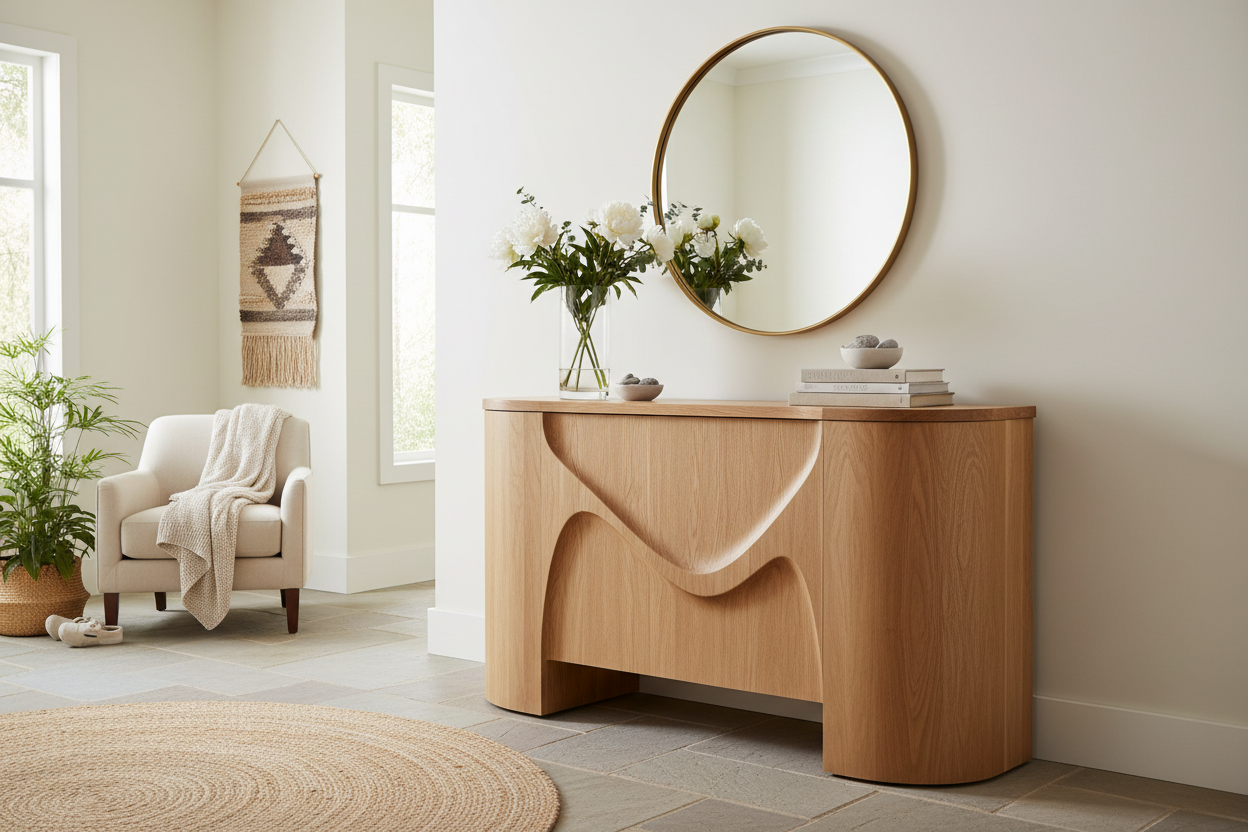
Your front door is the handshake of your home. It sets the expectation for everything that follows. Yet, so many foyers feel rigid, dominated by boxy architecture and sharp-edged furniture that interrupts the natural path of movement. If you are looking to create a space that feels immediately inviting rather than strictly utilitarian, a curved entryway cabinet is the design solution that bridges the gap between function and flow. These pieces do more than hold your keys; they physically and visually soften the transition from the chaotic outdoors to your personal sanctuary.
Rectangular consoles have been the default for decades, but they often impose on the walking space, creating potential hazards for hips and shins in tighter hallways. A rounded entryway cabinet, by contrast, respects the circulation path. It guides traffic into the home gently rather than blocking it. This shift toward organic shapes is not just a fleeting trend; it is a response to our need for homes that feel safer and more relaxed. By eliminating corners, you gain floor space where it matters most—the pivot points where you take off coats, greet guests, or carry in groceries.
The Psychology of Curves in High-Traffic Zones
There is a subtle psychological relief in seeing rounded edges. Sharp angles signal caution to the brain, while curves suggest comfort and safety. In a foyer, which is often a high-stress zone during the morning rush or evening return, this matters. A curved entryway cabinet acts as a visual exhale. It softens the hard lines of door frames, staircases, and floor tiles.
I learned this lesson the hard way in my previous apartment. The hallway was narrow, barely four feet wide, and I insisted on keeping a beautiful, but very sharp-cornered, mid-century rectangular credenza right by the door. It looked great in photos, but living with it was a different story. Every time I came in with grocery bags, I had to maneuver awkwardly to avoid clipping the corner. It created a subconscious hesitation every time I walked through the door. When I finally swapped it for a demilune (half-moon) console with tambour doors, the entire energy of the apartment changed. The hallway felt a foot wider, and that subtle anxiety of bumping into furniture vanished. It taught me that in pass-through spaces, the footprint of your furniture dictates your comfort level.
Material Matters: Textures That Complement the Shape
The beauty of a rounded entryway cabinet often lies in how the material handles the curve. Unlike flat surfaces that reflect light uniformly, a curved surface creates a gradient of light and shadow that adds depth to a small room. Wood is a classic choice, particularly when craftsmanship highlights the grain wrapping around the radius.
Fluted or reeded details are particularly effective here. Vertical slats on a rounded cabinet emphasize the height of the piece while camouflaging the doors, making the unit look more like a sculptural column than a storage box. If you prefer a sleeker look, lacquered finishes on a curved form evoke an Art Deco sensibility, bringing a touch of glamour to the foyer. For a grounded, organic modern aesthetic, look for matte oak or walnut finishes where the tactile quality of the wood takes center stage.
Stone and Mixed Media
Adding a stone top to a wooden base is a practical way to elevate the look while increasing durability. Marble or travertine tops cut in a kidney or oval shape are impervious to water rings from a wet umbrella or scratches from tossing keys down. The contrast between a cold, hard stone top and a warm, curved wooden base creates a sophisticated balance that anchors the entry without weighing it down.
Storage Solutions Behind the Curve
One misconception is that you lose storage space with a curved design. While you might lose the deep back corners of a square cabinet—which often become graveyards for lost items anyway—you gain accessibility. A rounded entryway cabinet with swinging doors often provides easier access to the contents because you don't have to stand directly in front of it to open it fully.
Look for interiors with adjustable shelving. Since entryways are catch-alls, you need vertical versatility. Top shelves can hold mail sorting trays and sunglasses, while lower shelves are perfect for hiding unsightly items like dog leashes, reusable shopping bags, or seasonal accessories like gloves and scarves. Some newer models feature sliding tambour doors that follow the track of the curve, meaning the doors never encroach on the hallway space when open. This is a game-changer for narrow city apartments or corridors.
Styling the Surface: Breaking the Symmetry
Decorating a round or oval surface requires a different approach than styling a rectangle. A long rectangular console begs for symmetry—a lamp on each end, art in the middle. A curved entryway cabinet, however, thrives on asymmetry and organic grouping. Because the edge recedes, placing a tall, slender lamp on one side and balancing it with a low, wide bowl or stack of books on the other creates a dynamic visual interest.
Mirrors are the natural companion to these cabinets. Avoid square mirrors, which can look harsh above a soft edge. Instead, opt for round, oval, or irregular organic-shaped mirrors. The repetition of the curve on the wall reinforces the design intent. If you have a high ceiling, a tall, arched mirror leaning or mounted behind the cabinet draws the eye up, making the foyer feel grander.
Selecting the Right Dimensions
Proportion is the difference between a cabinet that looks custom-fit and one that looks like an obstruction. Before purchasing, measure not just the width of your hallway, but the swing radius of your front door. You need at least 36 inches of clearance for a comfortable walkway, though 42 inches is ideal. A curved cabinet helps cheat this rule slightly; because the corners are shaved off, you can often get away with a deeper cabinet in the center (say, 16 inches) that tapers off at the sides, giving you storage volume without the visual bulk.
Consider the visual weight as well. A cabinet with legs (open underneath) will make a small foyer feel larger because you can see the floor extending to the wall. A solid-to-the-floor plinth base cabinet feels more substantial and grounded, which works well in larger, airier foyers that need an anchor.
Lighting and Ambiance
Lighting plays a pivotal role in how a rounded piece is perceived. If you can, install a wall sconce above the cabinet rather than relying solely on a table lamp. Downlighting washes over the curved front, highlighting the texture—especially if you have chosen a fluted or reeded design. If hardwiring isn't an option, a small portable LED lamp or a slender table lamp with a cylindrical shade keeps the geometry consistent.
Choosing a curved entryway cabinet is about prioritizing the human experience of entering a home. It acknowledges that movement should be fluid and that our eyes prefer soft transitions over hard stops. Whether you choose a vintage mid-century piece or a contemporary fluted design, the result is a foyer that feels finished, thoughtful, and welcoming.
Frequently Asked Questions
Can I use a curved cabinet in a narrow hallway?
Yes, they are actually superior for narrow spaces. The rounded edges allow for easier movement and prevent the "tunnel effect" that rectangular furniture can create. Look for a demilune (half-moon) shape that sits flush against the wall to maximize floor space.
How do I protect the top of a wood cabinet from key scratches?
Use a decorative tray or bowl to designate a drop zone for keys and coins. This protects the wood finish and keeps small items organized. Alternatively, having a piece of custom glass cut for the top or choosing a cabinet with a marble surface offers permanent protection.
What is the best mirror shape to pair with a rounded cabinet?
Round, oval, or arched mirrors work best as they echo the curvature of the furniture. An irregular, organic-shaped mirror can also add a modern, artistic touch. Avoid sharp square or rectangular mirrors unless they have a very thin frame, as they can clash with the soft lines of the cabinet.

Dejar un comentario
Este sitio está protegido por hCaptcha y se aplican la Política de privacidad de hCaptcha y los Términos del servicio.