







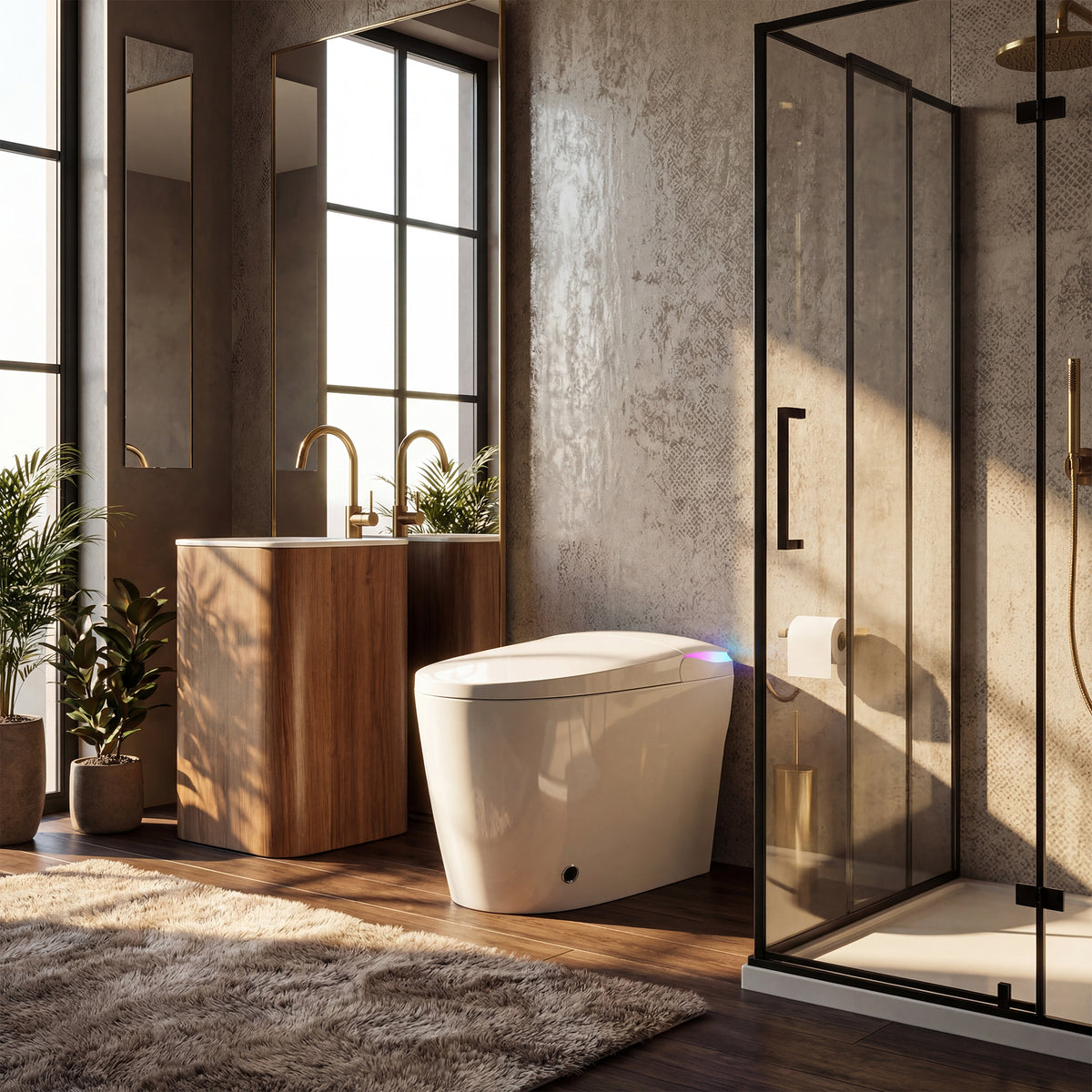
A smart toilet is a complete toilet with a built-in bidet and powered features, such as a heated seat, warm air dryer and automatic flushing, all in one unit. A bidet seat replaces only the seat on your existing toilet, and a bidet attachment is a thin sprayer that fits under the seat you already have, usually with no power at all.
Before you choose a smart toilet, confirm four things: your rough-in distance, a GFCI-protected outlet within reach of the cord, your water pressure, and the seat height you want. This guide explains each check and the core features, then gives five picks from the FUFU&GAGA smart toilet collection, with who should skip each.
Key takeaways
- Type: a smart toilet replaces the whole toilet; a bidet toilet seat or attachment upgrades the one you have.
- Rough-in: 12 inches is the most common, but 10- and 14-inch rough-ins exist in older homes. Measure before you buy.
- Power: plan for a grounded, GFCI-protected outlet near the toilet, added by a licensed electrician if needed.
- Water: our models list 1 to 1.29 gallons per flush. None of the listings claims the WaterSense label.
- Outages: outage flushing varies by model and may need a backup battery.
Smart toilet vs bidet seat vs bidet attachment
The three options differ in how much of the toilet you replace. Consumer Reports describes the bidet attachment as the simplest and least costly option, the bidet seat as a middle step that replaces only the seat, and the smart toilet as the most complete and the most expensive. This table sums up the practical differences.
| Option | What you replace | Power needed | Typical features | Installation |
|---|---|---|---|---|
| Bidet attachment | Nothing; it sits under your current seat | Usually none | A water spray; no heated seat or dryer | Simplest; fits most existing toilets |
| Bidet seat (bidet toilet seat) | Only the toilet seat | Electric models need an outlet | Warm water wash, heated seat, dryer, night light on many models | Moderate; the seat must match your bowl shape, round or elongated |
| Smart toilet (bidet toilet) | The whole toilet | Yes, plug-in | Bidet functions plus heated seat, warm air dryer, auto flush, automatic lid, remote control | Full toilet replacement; check rough-in, water supply and outlet |
Choose a bidet attachment to try washing at the lowest cost, and a bidet seat if your existing toilet is in good shape and you want a heated seat and warm water. Choose a smart toilet when you are replacing the whole toilet anyway, for example in a bathroom renovation, or want one integrated unit with a clean look.
What does a smart toilet do?
A smart toilet combines a ceramic toilet bowl with a powered seat unit that holds the electronic components: the wash nozzle, water heater, dryer fan, sensors and controls. You sit, pick a wash setting on the remote control or side knob, and the nozzle extends, sprays and retracts.
Core features
- Bidet wash: rear wash and front (feminine) wash are standard on our models. Several add an oscillating or pulse wash, with adjustable pressure and nozzle position.
- Warm water: the toilet heats its own wash water. An instant heater (sold as tankless heating) warms temperature controlled water as it flows; our 27.5-inch model's listing describes this.
- Heated seat: most models offer three or four temperature settings, and some add an eco mode that lowers seat heat when idle.
- Warm air dryer: blows warm air after washing. Our listings say it cuts down on toilet paper use, not that it removes the need entirely.
- Self-cleaning nozzle: the nozzle rinses itself before or after use. One of our models adds UV-C light to its self-cleaning cycle, according to its listing.
More features
- Automatic flushing: the toilet flushes when you stand up; most also flush by foot kick, remote or knob.
- Automatic lid: the lid opens as you approach, or when a foot sensor is triggered, and closes after use.
- Foot sensor: flushes or opens the lid with a kick at the base.
- Night light: a soft glow for late-night trips without the overhead light.
- Deodorizer: an odor filter in the seat unit that works while you sit.
- Foam shield: some models release foam into the bowl when you sit down. The solution needs refilling.
Compare models by the features each listing actually states; these are conveniences, not health claims.

What is required to install a smart toilet?
A smart toilet needs the same drain and water supply as any toilet, plus an electrical connection. Check these before you order: an installed toilet is no longer returnable as unused.
1. Measure the rough-in
The rough-in is the distance from the finished wall behind the toilet to the center of the drain, which you find at the closet bolts that hold the toilet to the floor. Upgraded Home's rough-in guide lists the standard rough-ins as 10, 12 and 14 inches, with 12 inches the most common and the other two mostly in older homes. Measure from the wall itself, not the baseboard, to the center of the rear bolts, and round down to the nearest standard size if you land between two.
Our 29.9-inch model lists a 12-inch rough-in. The installation guides for our 16.1-inch night light model, our 1-gallon digital display model and our 15.9-inch model ask for a measured rough-in of 11.81 inches or more, which is 300 millimeters. A toilet built for 12 inches will not fit a 10-inch rough-in.
2. Plan a GFCI outlet within cord reach
Every smart toilet needs a nearby electrical outlet. According to EC&M's summary of the National Electrical Code, GFCI protection is required for all 15- and 20-amp, 125-volt receptacles in the bathroom of a dwelling unit. The manuals for three of our models say the same thing in product terms: connect only to a grounded receptacle protected by a ground-fault circuit interrupter, at 110 volts AC.
Those manuals also list an average power of 1,380 watts. At 110 volts, that works out to about 12.5 amps (1,380 divided by 110). Ask your electrician whether the bathroom circuit can carry that alongside a hair dryer. If there is no nearby outlet, do not use an extension cord: hire a licensed electrician to add a GFCI outlet or a new circuit, following your local code.
3. Check water pressure and water supply
A smart toilet connects to the cold water supply valve behind the toilet, like a traditional toilet, and heats its own wash water. Consumer Reports notes that some smart toilets are tankless and need adequate water pressure to flush properly: low water pressure can mean a weak flush, and very high pressure can wear parts faster. The installation guide linked on several of our listings gives an inlet pressure range of 0.15 MPa (flowing) to 0.75 MPa (static), which is roughly 22 to 109 psi (1 MPa is about 145 psi). If your home has low water pressure, or you are on a well, have a plumber measure it first.
Our listings describe the flush as siphon jet, pressure assisted, dual flush or vortex, but most don't say whether it runs from a hidden tank or straight from supply pressure. If your pressure is borderline, ask customer service first.
4. Choose bowl shape and seat height
All five picks below have an elongated bowl. Measure the space in front of the toilet: our overall depths run from 26.9 to 29.9 inches, and the bathroom storage guide linked below covers how much clear floor to leave around a toilet.
Seat height matters, especially for people with mobility issues. Mr. Rooter puts comfort-height toilets at 17 to 19 inches and traditional toilets at about 15 inches, and notes that the taller seat makes it easier to sit down and stand up. The U.S. Access Board's guide to ADA toilet rooms uses the same 17 to 19 inches for accessible toilets, measured to the top of the seat. Three of our picks list an 18.1-inch seat height, inside that range; one lists 16.5 inches.
Do smart toilets work when the power goes out?
Some do, but the method varies, and the bidet, heated seat and dryer stop working without power. Our 29.9-inch model's listing describes power-outage flushing plus an emergency gravity flush. The 16.1-inch night light model and the 1-gallon digital display model list power-outage flushing, and their manuals explain that it runs on a backup battery: ten AA batteries in one case, a 9-volt battery in the other. Check the battery before a storm, not during one. If a listing does not mention outage flushing, assume it may not flush without power, and ask before you rely on it.
How much water does a smart toilet use?
Our smart toilets list 1 to 1.29 gallons per flush. The EPA WaterSense program labels toilets that use 1.28 gallons per flush or less, compared with the federal standard of 1.6 gallons, and only toilets that pass third-party certification can carry the label. None of our listings claims WaterSense certification, so read a low gallons-per-flush figure as a listed spec, not a certification. Bidet washing uses some water too; our listings do not state how much.
Do you need an electrician or plumber to install a smart toilet?
Treat a smart toilet as a plumbing and electrical job, not a casual DIY project. Our models weigh between about 95 and 100 pounds, and installation involves setting the bowl on a new wax ring or flange seal, connecting the water supply, and confirming the GFCI outlet works. Use a licensed plumber if the drain, flange or supply valve needs changes, and a licensed electrician for any new outlet or circuit. Check which parts come in the box: some listings include the wax ring, closet bolts and supply line, and others do not.
How do you clean a smart toilet?
Cleaning a smart toilet is like cleaning a traditional toilet, with a few extra steps for the electronics. The manuals for our models cover these steps:
- Unplug the toilet before cleaning the seat unit, and never spray it with water or a shower head.
- Wipe the seat and lid with a soft, damp cloth and a neutral cleaner; avoid bleach, scouring powder and thinner.
- Run the nozzle-cleaning function, and wipe the nozzle gently when it is extended.
- Clean the inlet filter screen when the wash spray weakens. Close the supply valve first; how often depends on your water quality.
- Refill the foam shield solution if your model has one, and replace remote and backup batteries as needed.
Consumer Reports adds that the bidet's water filter and the deodorizer's air filter need periodic replacement.

Are smart toilets worth it?
A smart toilet is worth it if you would use the bidet functions every day, you are replacing a toilet anyway, and you have, or can add, a GFCI outlet. A warm water bidet, heated seat and automatic flushing make the bathroom experience more convenient.
The downsides are real: a smart toilet costs more than a bidet seat, needs power, and has more parts that can fail, such as nozzles, sensors, remotes and filters. If your current toilet works and you mainly want a wash, a bidet seat or attachment is the lower-cost route. Warranty coverage and replacement parts matter more here than with a traditional toilet: FUFU&GAGA's replacement parts service reviews requests within 24 hours.
Smart toilet buying checklist
- Rough-in measured from the finished wall to the bolt centers (12 inches for most models below).
- A grounded, GFCI-protected 125-volt outlet within cord reach, or an electrician booked to add one.
- Water pressure checked if you have low pressure or a well.
- Seat height of 17 to 19 inches for comfort height, lower if shorter users prefer it.
- Overall depth that leaves walking room in front of the bowl.
- Gallons per flush, if water use matters to you.
- Outage flushing method, and whether it needs a battery.
- Box contents: wax ring, closet bolts and supply line.
Our picks
All five are one-piece, floor-mounted, elongated smart toilets in glossy white ceramic. Specs come from each listing and its installation guide.
29.9-inch Smart Toilet with Auto Flush, Heated Seat and UV-C Self-Cleaning Nozzle
The most complete feature set in our range, and the only listing that states its 12-inch rough-in and safety listings. It flushes automatically when you stand, by foot kick or remote, and the listing describes power-outage flushing plus an emergency gravity flush. The bidet offers front wash, rear wash and rear pulse massage in warm or cold water, and the UV-C self-cleaning nozzle rotates 360 degrees. It also has a four-setting heated seat, a warm air dryer and a night light. The listing states ETL Listed, UL Listed and CSA Certified, and IPX4 water resistance. It measures 29.9 inches deep, 16.9 inches wide and 19.6 inches high, with an 18.1-inch seat height and 1.28 gallons per flush, dual flush.
Best for: buyers who want the most features and a stated rough-in and safety listing.
Skip it if: your bathroom is short on depth; at 29.9 inches it is the longest of our picks, about 3 inches longer than the 16.1-inch model.
16.1-inch Smart Toilet with Heated Seat, Warm Air Dryer and Night Light
A well-rounded choice with a night light and battery-backed outage flushing. It flushes by foot sensor or automatically when you stand, and you run the rear and front wash, heated seat and dryer from the remote or the side knob. Its manual describes a backup battery pack (ten AA batteries) for flushing during an outage. It measures 26.9 inches deep, 16.1 inches wide and 18.1 inches high, with an 18.1-inch seat and a siphon jet flush at 1.28 gallons per flush.
Best for: comfort-height seating, night-time use and households that want outage flushing.
Skip it if: you need floor bolts and a supply line in the box; the listing says they are not included.
White Smart Toilet with Built-In Bidet, Digital Display and Side Knob
The lowest flush volume in our range: 1 gallon per flush, with a pressure-assisted flush. It offers four ways to flush (foot sensor, off-seat, remote and power-outage flushing), and its manual says outage flushing uses a 9-volt backup battery. It also has rear and front wash, a heated seat, a warm air dryer and a soft-close lid and seat. It is 26.9 inches deep and 18.1 inches high, with an 18.1-inch seat.
Best for: households that want the lowest listed water use per flush.
Skip it if: you have low water pressure; ask customer service how its pressure-assisted flush performs on your supply first.
15.9-inch Smart Toilet with Heated Seat, Warm Dryer and Remote Control
The lowest profile at 17.9 inches high, with a full installation kit: like the 29.9-inch model, the listing includes the seat and lid, bolts with caps, supply line and wax ring kit. It has rear and front wash with a self-cleaning nozzle, an adjustable heated seat, warm air dryer, foot sensor flush and automatic off-seat flush, with dual flush at 1.28 gallons per flush. It measures 27 inches deep and 15.9 inches wide.
Best for: a low, compact look and an install day with fewer extra parts to buy.
Skip it if: you need a confirmed seat height or outage flushing; the listing states neither.
27.5-inch Smart Bidet Toilet with Heated Seat, Auto Flush and Vortex Wash
A lower seat and instant water heating. The listing describes tankless instant heating for endless warm wash water, rear, front and oscillating wash, a four-level heated seat, automatic lid, auto flush when you walk away, a night light, and IPX4 water resistance. The vortex flush uses 1.29 gallons per flush. It measures 27.5 inches deep, 15.5 inches wide and 17 inches high, with a 16.5-inch seat.
Best for: shorter users who prefer a seat closer to standard height, and anyone who wants endless warm water.
Skip it if: you want a warm air dryer or a comfort-height seat; the listing mentions no dryer, and the seat sits below 17 inches. The wax ring kit, bolts and supply line are sold separately.

Picks compared
| Pick | Depth | Seat height | Gallons per flush | Outage flushing | Standout |
|---|---|---|---|---|---|
| 29.9-inch UV-C | 29.9 in | 18.1 in | 1.28 (dual) | Yes, plus gravity flush | Most features, 12-inch rough-in listed |
| 16.1-inch night light | 26.9 in | 18.1 in | 1.28 (siphon jet) | Yes, battery backup | Night light, side knob |
| Built-in bidet, digital display | 26.9 in | 18.1 in | 1.0 (pressure assisted) | Yes, battery backup | Lowest water use |
| 15.9-inch compact | 27 in | Not listed | 1.28 (dual) | Not listed | Lowest profile, install kit included |
| 27.5-inch vortex | 27.5 in | 16.5 in | 1.29 (vortex) | Not listed | Instant heater, lower seat |
Planning the rest of the room? Our bathroom storage cabinet guide covers over-the-toilet units and the clearances around a toilet.
FAQ
Do you still use toilet paper with a smart toilet?
Usually some. Our listings say the warm air dryer cuts down on toilet paper rather than replacing it, and the installation guide for several of our models suggests blotting with a little paper before drying to speed it up. You can flush toilet paper in a smart toilet just as you would in a traditional toilet.
Can a smart toilet replace any existing toilet?
Only if the rough-in matches and there is power nearby. Most homes have a 12-inch rough-in, which suits the models that list it, but a 10-inch rough-in will not fit them. You also need a GFCI-protected outlet within reach of the cord.
What is the downside of a smart toilet?
Cost, the need for an outlet, and more parts to maintain. The bidet, heated seat and dryer also stop working in a power outage.
Ready to compare models side by side? Browse the full smart toilet collection and check each listing's rough-in, seat height and box contents against your bathroom.

Dejar un comentario
Este sitio está protegido por hCaptcha y se aplican la Política de privacidad de hCaptcha y los Términos del servicio.