







A good standing desk with drawers keeps the drawer out of your knee space at the lowest sitting height, counts the drawer and everything in it against the motor's lift capacity, and stays steady at full standing height. Before you buy, check three numbers: the minimum height minus the drawer's depth (your real knee clearance), the desktop weight capacity, and the drawer weight capacity. On the five electric standing desks with drawers we recommend below, drawers are rated for 10 to 30 lb each and desktops for 120 to 300 lb.
This guide is written for anyone setting up a home office or small workspace who wants storage space without adding a separate filing cabinet. Integrated drawers keep the desktop clear, which helps comfort and focus over a long workday. It explains the three main drawer designs, how to check clearance and weight, how to handle cables and wobble, and which desks from the FUFU&GAGA standing desk collection fit different rooms.
Key takeaways
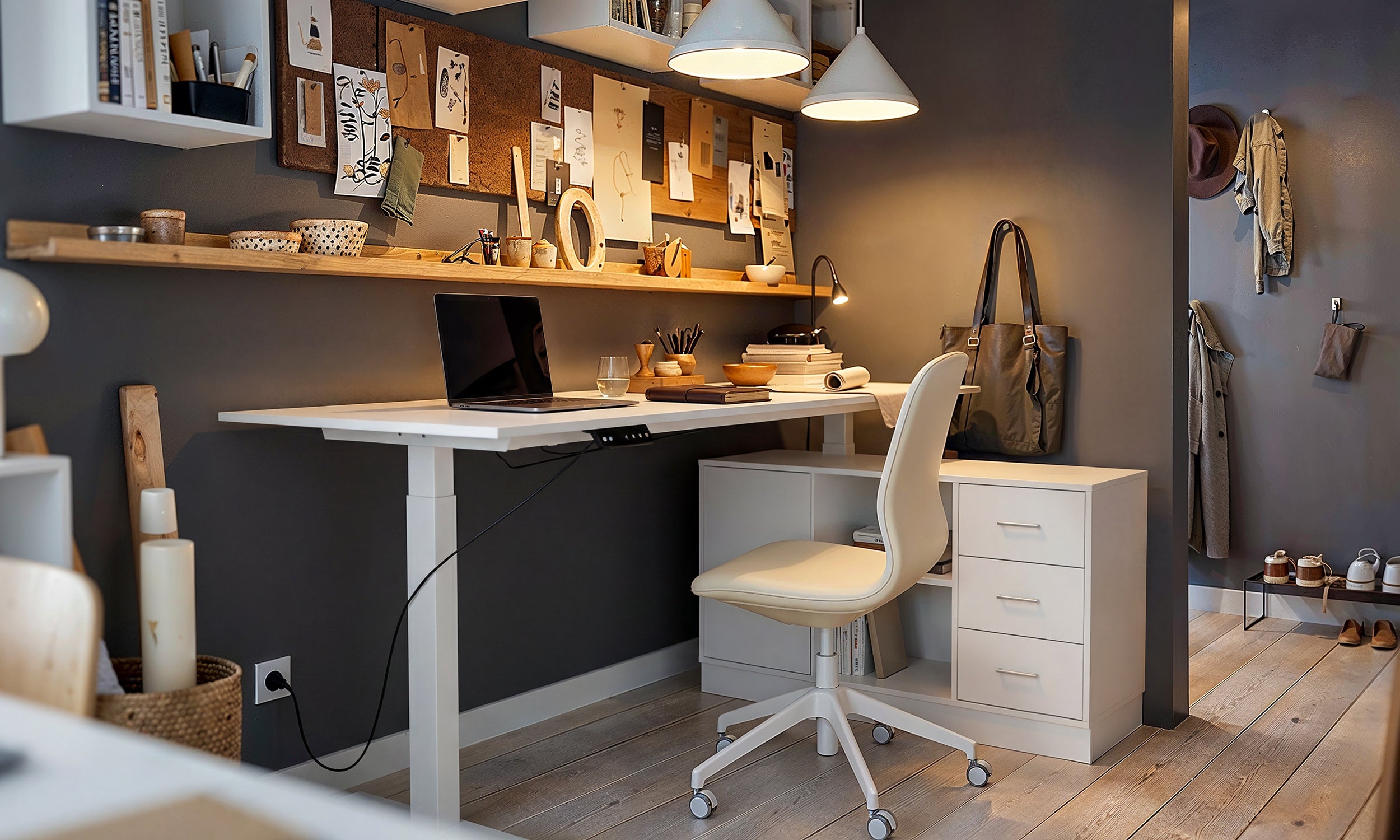
- Three designs: a drawer mounted under the desktop, a drawer unit or pedestal built into the frame, or a side cabinet that stands next to the lifting desk.
- Knee room first: OSHA's minimum leg space is 20 in wide, 17 in deep at the knee and 24 in deep at the foot. A drawer under the top must not eat into it.
- Weight adds up: anything attached to the desktop, including drawers and their contents, counts toward the lift capacity.
- Cables need slack: a desk that travels from 29.5 to 44.1 in moves almost 15 in, so every cable must reach at full height.
- Stability: wobble is greatest at the top of the range, so keep heavy items low and centered.
Why don't most standing desks have drawers?
Most standing desks are a motorized frame with a flat top, and three things make drawers harder to add than on a fixed desk. First, the frame's crossbar and motor housing run under the desktop, which limits where a drawer can mount and how deep it can be. Second, a drawer hanging under the top reduces knee clearance when the desk is lowered for sitting. OSHA's computer workstation guidance even suggests removing center drawers from conventional desks to create more thigh clearance (OSHA desk guidance). Third, every drawer adds weight that the motors must lift along with the desktop.
That is why the best standing desk with drawers is usually designed around storage from the start, rather than having a desk drawer bolted on later.
What drawer and storage options do height adjustable desks offer?
Storage on height adjustable desks comes in three built-in forms, plus a separate cabinet you can add to any desk. The table compares them.
| Drawer type | Moves with the desktop? | Strengths | Watch out for |
|---|---|---|---|
| Under-desk drawer (center or pencil drawer) | Yes | Keeps pens, cables and small items within reach at any height | Reduces knee clearance; counts toward lift capacity |
| Built-in drawer unit or drawer pedestal | Depends on the design | Several drawers, often a filing drawer or a lockable drawer | Takes leg space on one side; check its weight rating |
| Side cabinet or storage return | Depends on the design | Most storage space: drawers, cabinets and shelves | Wider footprint; usually sold as an L-shape |
| Separate mobile file cabinet | No | Easy to add to any desk, rolls out of the way | Not integrated; needs floor space under or beside the desk |
A pencil drawer is the smallest under-desk option: a shallow tray for small items. Built-in drawers in a pedestal or side cabinet hold more, including hanging files, but they take floor space. If you want a corner layout with a storage return, our L-shaped standing desk buying guide covers sizing and leg configurations.
How much knee room do you need under a drawer?
Knee room is the most common problem with an electric standing desk with drawers. At standing height there is plenty of space, but at the lowest sitting height a drawer under the top can hit your thighs.
OSHA lists minimum clearances for the space under a work surface: 20 inches wide, 17 inches deep at knee level, 24 inches deep at foot level and 4 inches high at the foot, with the height near the user adjustable between 20 and 27 inches (OSHA work space guidance). To check a desk before you buy:
- Sit in your chair at your normal height and measure from the floor to the top of your thighs.
- Find the desk's minimum height and the height of the drawer box. The lowest point of the drawer is roughly the minimum height minus the desktop thickness and the drawer depth.
- Compare. If the drawer bottom sits at or below your thigh height, you will either work higher than you want or hit the drawer.
- Check the width between the legs or between the leg and the drawer pedestal; it should be at least 20 inches.
For example, a desk with a 29.5-inch minimum height, a 1-inch top and a 4-inch drawer box leaves about 24.5 inches under the drawer at its lowest setting. Shorter users who sit with the desk near its minimum feel this most, which is why drawers placed to the side of the knee space are often the better choice for them.
How do drawers affect lift capacity and motors?
The weight capacity on a standing desk is the total load the motors and frame can raise. Everything attached to the moving desktop counts: the top itself is already accounted for, but monitors, monitor arms, a computer, a lamp, a drawer and the items inside the drawer all add to the load.
Use the two ratings together. Our 54.3-inch white standing desk is rated for 120 lb on the desktop and 30 lb per drawer; our 63-inch desk with pegboard is rated for 240 lb on the desktop and 15 lb per drawer. Add up your monitors, computer and accessories, add the drawer contents if the drawers lift with the top, and stay comfortably under the rating. Overloading slows the lift, strains the motors and makes the desk less stable.
A few habits help: keep heavy items between the legs rather than at one end, store paper and books in a stationary side cabinet rather than a drawer hanging from the top, and use monitor risers or a monitor arm only within the weight limit.
How do you plan cable management on a standing desk with storage?
Cable management matters more on a standing desk than on a fixed one, because the cables move every time the desk does. Measure the travel: a desk that moves from 29.5 to 44.1 inches travels about 14.6 inches, and every power and data cable must reach at full height without pulling.
- Mount a power strip under the desktop so most cables move with the top and only one power cord runs to the wall.
- Use a cable tray or the desk's built-in cable management to keep wires off the drawers and out of the knee space.
- Leave a slack loop for the cord that runs to the outlet, and route it away from the drawer slides and the lifting columns.
- Keep stationary cabinets separate: if a side cabinet holds a printer, run its cable so the desktop does not drag it when it rises.
Is a standing desk with drawers stable at full height?
Any electric standing desk wobbles a little more at the top of its range, because the columns are extended. Drawers can help or hurt. A heavy drawer full of supplies hanging from one end of the top adds side-to-side sway, while a solid side cabinet or bookcase connected to a sturdy frame can make the whole workstation feel more planted.
To keep it steady: level the feet on uneven floors, keep the heaviest items low and centered, close drawers before you raise or lower the desk, and tighten the frame bolts after the first few weeks of use. A deeper desktop and wider leg base also resist wobble better than a narrow top.
Solid wood, laminate and size: what else affects the choice?
Desktop material changes both looks and load. A solid wood top or solid wood drawer fronts feel warmer and can be refinished, while laminated or melamine-faced MDF resists scratches and stains and is easy to wipe clean. Whatever the material, check the top's weight if you buy a frame and top separately, because it comes out of the motor's capacity. Four of our five picks have tops of solid plus manufactured wood; the 54.3-inch desk uses a manufactured wood top.
Size works the same way. A compact standing desk of about 48 to 55 inches suits a bedroom or small home office, and side storage adds to the footprint, so measure the full width including the cabinet or hutch, not just the desktop.
What height range should you look for?
The height range decides whether the desk fits both your sitting and standing posture. Among our picks below, minimum heights fall between 28.1 and 29.8 inches and maximum heights between 44 and 46.6 inches. Taller users should look for a higher maximum. To find your standing height, stand with relaxed shoulders, bend your elbows to about 90 degrees and measure from the floor to your forearm. Your desk should reach that height with a little to spare.
Standing desk with drawers buying checklist: features to compare
- Height range: minimum low enough for sitting, maximum at or above your standing elbow height.
- Knee clearance: at least 20 in wide and 17 in deep under the drawer at your sitting height.
- Desktop weight capacity: above the total weight of your equipment plus any drawers that lift with the top.
- Drawer weight capacity: 10 to 30 lb per drawer is typical; choose higher for files.
- Drawer type: under-desk drawer for small items, pedestal or side cabinet for files and bulk storage.
- Memory presets: at least three, so you can save sitting and standing heights.
- Cable management: built-in grommets, tray or power strip.
- Footprint: desktop depth of about 23 to 32 in for a monitor at least 20 in from your eyes, plus room for a side cabinet if included.
- Reversible storage: a cabinet that installs on the left or right fits more rooms.
Our picks: standing desks with drawers and storage
These five electric desks cover the main storage designs, from a compact white standing desk with drawers to a U-shaped workstation. All have memory presets and come from the FUFU&GAGA standing desk range.
71" Modern Minimalist Standing Desk with File Drawer and Storage Cabinet

A wide, deep desktop with a side file drawer for small supplies and a double-door cabinet with an interior shelf for binders and books. The handle-free fronts keep the look clean, and built-in cable management keeps cords tidy. At 31.5 inches deep, the top leaves room for a monitor at a comfortable viewing distance.
Key facts: desktop 70.9" W x 31.5" D, height 29.5" to 44.1", programmable memory controller, 150 lb desktop capacity, 10 lb drawer capacity, white, black or burlywood.
Best for: a large home office where you want storage built into one straight desk.
63" Modern Standing Desk with Pegboard Organizer and Keyboard Tray

Two storage modules sit under the desktop: a drawer pedestal on smooth metal slides, with a filing drawer and a fingerprint-lock drawer, and a module with open shelves and a pegboard for headphones or tools. A pull-out keyboard tray frees the desktop for screens and papers.
Key facts: desktop 63" W x 23.6" D, height 29.8" to 45.3", three memory presets, 240 lb desktop capacity, 15 lb per drawer, keyboard tray, lockable drawer.
Best for: anyone who wants lockable drawers and organizer storage on one straight desk.
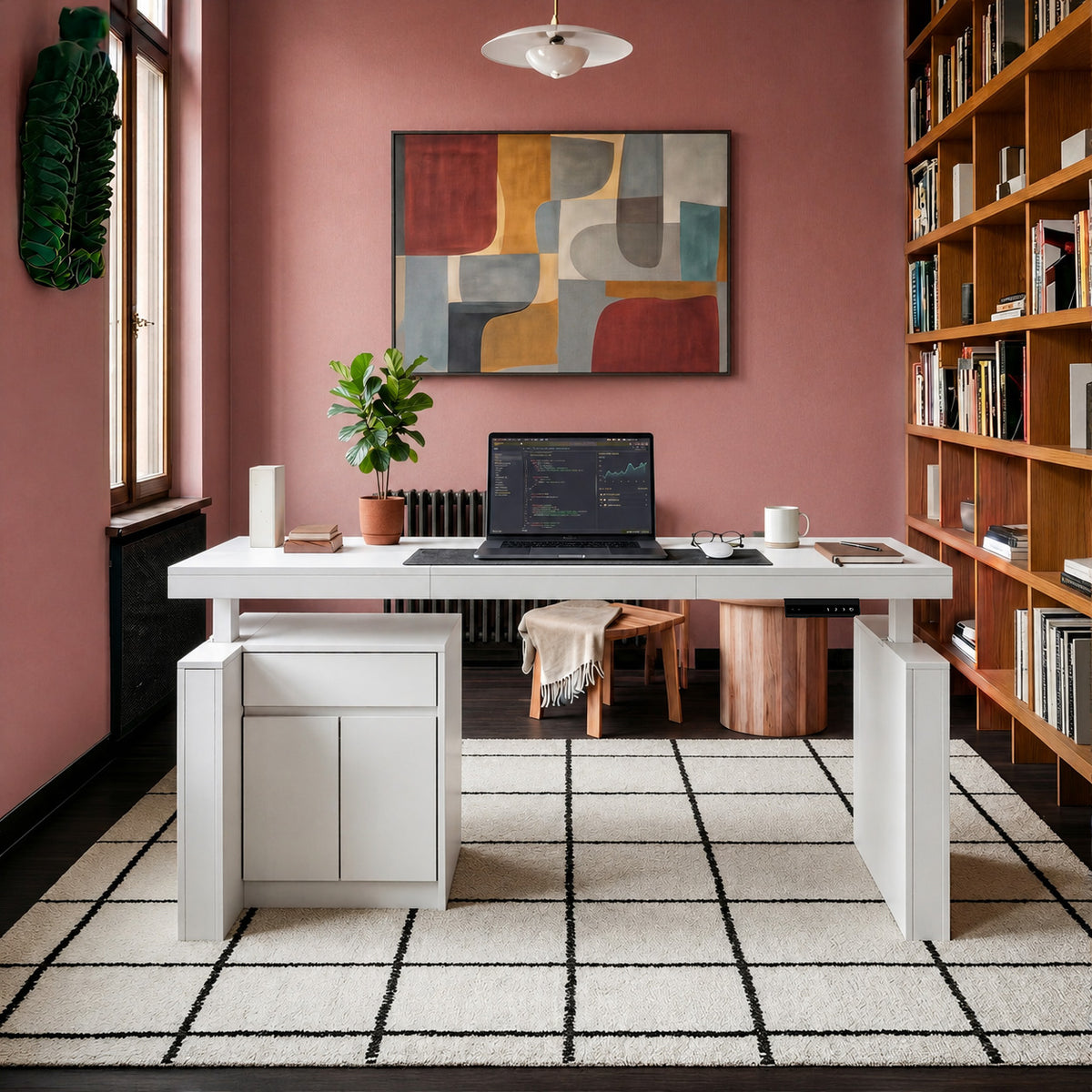
54.3" Minimalist Modern White Standing Desk with Memory Presets
The most compact pick pairs a 54.3-inch white desktop with a storage section of cabinet doors, drawers and open shelves that installs on the left or right. The doors and drawers are push-to-open with beveled edges instead of handles, and the drawers carry the highest per-drawer rating of our picks.
Key facts: desktop 54.3" W x 22.8" D, overall 54.3" W x 47.2" D, height 29.5" to 44", three memory presets, 120 lb desktop capacity, 30 lb per drawer, filing drawer, cabinet interior 25" H x 15" D.
Best for: smaller rooms that need a white standing desk with drawers and a filing drawer.
68.5" Modern White Standing Desk with Hutch and Storage Cabinet
Here the storage arrives as a matching hutch beside the lifting desk: glass-door cabinets, open compartments, three drawers, two lower cabinets and several countertop surfaces. The hutch installs on either side, and a raised top edge helps stop decor from slipping off. It has the highest desktop rating of our picks.
Key facts: overall 68.5" W x 55.1" D, desktop 31.5" D, height 29.5" to 44.5", saves up to three heights, 300 lb capacity, 15 lb per drawer, hutch 68.9" H x 55.1" W x 15" D, white.
Best for: a home office that needs display shelves and closed storage in one set.
63" Modern White U-Shaped Standing Desk with 3 Memory Presets, Drawer and Open Storage

The widest height range of our picks, rising to 46.6 inches, suits taller users. Five open compartments, two cabinets and a handle-free drawer hold books, files, a printer and decor, and the cabinet section is reversible.
Key facts: desktop 63" W x 23.6" D, overall 63" W x 72.4" D, height 28.1" to 46.6", three memory presets, 200 lb desktop capacity, 22 lb drawer capacity, cabinet interior 24.3" H x 15.7" D.
Best for: tall users and anyone who wants a full storage workstation.
Compare the picks
| Desk | Height range | Desktop / drawer capacity | Storage type | Best for |
|---|---|---|---|---|
| 71" desk with file drawer | 29.5 to 44.1 in | 150 lb / 10 lb | Built-in drawer and cabinet | Large home offices |
| 63" desk with pegboard | 29.8 to 45.3 in | 240 lb / 15 lb | Drawer pedestal, pegboard, keyboard tray | Lockable storage |
| 54.3" white desk | 29.5 to 44 in | 120 lb / 30 lb | Side cabinet with drawers | Smaller rooms |
| 68.5" desk with hutch | 29.5 to 44.5 in | 300 lb / 15 lb | Hutch with drawers and cabinets | Display plus storage |
| 63" U-shaped desk | 28.1 to 46.6 in | 200 lb / 22 lb | Cabinets, drawer, open shelves | Tall users |
Mistakes to avoid
- Checking only the maximum height: knee clearance at the minimum height decides whether you can sit comfortably.
- Ignoring the drawer rating: a drawer rated for 10 lb is for supplies, not reams of paper.
- Cutting cables to length at sitting height: they will pull when the desk rises.
- Standing all day: the goal is to alternate, not to replace sitting with standing.
FAQ
What is the best standing desk with drawers?
The best one fits your body and your storage. Look for a minimum height that leaves knee room under the drawer, a maximum at or above your standing elbow height, a desktop capacity above the weight of your equipment, and drawers rated for what you will store. For files, choose a filing drawer or a side cabinet; for small items, an under-desk drawer is enough.
Can you add drawers to a standing desk?
Yes. Add-on drawers mount to the underside of the desktop with screws or clamps, but they must clear the frame's crossbar, leave enough knee room at your sitting height and stay within the lift capacity. A mobile file cabinet on casters is the simplest alternative, since it adds no weight to the motors.
What is the 20-8-2 rule for standing desks?
It is a sit-stand pattern from Cornell University ergonomics guidance: in every 30 minutes, sit for about 20, stand for about 8 and move for about 2. Cornell notes that the exact times are not critical and that standing all day is unhealthy too (Cornell CUergo). Memory presets make these frequent changes quick.
What are the downsides of a standing desk?
Standing for long periods can be tiring and, according to Cornell's ergonomics guidance, prolonged standing at work increases the risk of varicose veins. Standing desks are also heavier than fixed desks, need cables with slack, and can wobble at full height. Drawers add weight and can reduce knee room, so check the specs carefully.
Are electric standing desks worth it?
For most people who work at a desk for several hours a day, yes, as long as they actually alternate between sitting and standing. An electric lift with memory presets makes switching take a few seconds, which makes it more likely you will change posture regularly. Built-in drawers add storage without a separate cabinet, which helps in small offices.
Ready to compare more sizes and finishes? Browse the full standing desk collection. Orders ship free to the contiguous US, and unused, unassembled items can be returned within 35 days.



Dejar un comentario
Este sitio está protegido por hCaptcha y se aplican la Política de privacidad de hCaptcha y los Términos del servicio.