










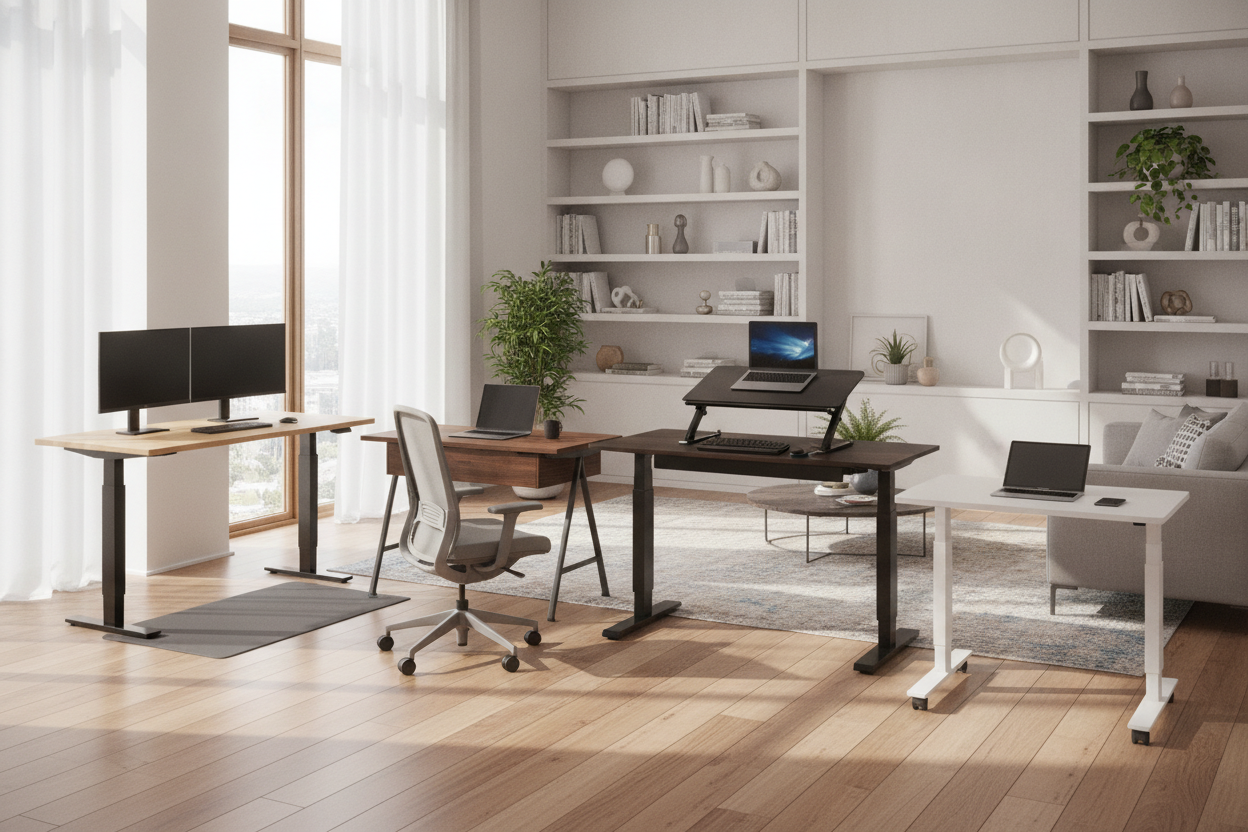
I remember staring at my laptop at 2 AM, surrounded by 47 open browser tabs of desks that all looked identical but ranged from $150 to $2,500. I was paralyzed. I just wanted to stop my back from aching, but instead, I was drowning in specs about 'linear actuators' and 'telescoping legs.' It turns out, finding the right standing desk types doesn't require an engineering degree—it just requires knowing how you actually work.
The market exploded a few years ago, and now every furniture brand has a dozen 'ergonomic' options. But before you drop half a paycheck, you need to understand that the mechanism matters more than the finish. Whether you are dealing with a cramped studio or a dedicated home office, your choice impacts your layout ideas for standing desks more than you think. Some desks need an outlet; some need a lot of muscle.
- Electric: The gold standard for ease, but requires a nearby power outlet.
- Pneumatic: Fast, cordless, and quiet—perfect for minimalists.
- Converters: The best way to keep your existing desk while adding height.
- Manual Crank: Cheap and sturdy, but a literal workout to adjust.
Electric Standing Desks: The WFH Standard
If you have the budget and a power outlet, this is usually the right answer. Electric desks use small motors hidden in the legs to do the heavy lifting. I’ve tested single-motor versions that struggled with two monitors and a heavy desktop, and I’ve tested dual-motor beasts that could probably lift my couch. If you have a heavy setup, go dual-motor. It’s smoother, quieter, and won't sound like a dying blender every time you want to stand up.
The one feature I will fight people on is memory presets. Seriously, do not buy an electric desk without them. Without presets, you’ll spend three minutes every day micro-adjusting the height to find that 'sweet spot' where your elbows aren't screaming. An electric desk with memory presets allows you to hit one button and walk away to grab a coffee while the desk does the work. It’s the only way I actually stick to a sit-stand routine.
The downside? Cords. You’ll have a power cable hanging down, which means you’ll need a cable management tray unless you want your office to look like a server room gone wrong. Also, if the motor dies out of warranty, you’re left with a very expensive, very heavy static table.
Pneumatic Standing Desks: Fast and Cordless
Pneumatic desks are the cool, quiet cousins of the electric world. They use a gas cylinder—exactly like the one under your office chair—to raise and lower the surface. The biggest win here is speed. You can go from sitting to standing in about two seconds, whereas an electric desk takes ten or fifteen. There’s no buzzing motor, just a satisfying 'whoosh' sound.
I love these for minimalist setups because there are no power cords. You can put a pneumatic desk in the middle of a room without tripping over a wire. The catch is that they have weight capacities that are a bit more sensitive. If you change your gear—say, you add a heavy iMac—you might have to adjust the tension of the cylinder so it doesn't fly up or sink down. It requires a bit of physical 'oomph' to push it back down to sitting height, so if you have shoulder issues, stick to electric.
Desk Converters: The Rental-Friendly Hack
Not everyone wants to toss their $800 solid wood dining table just to get some ergonomics. This is where converters come in. They sit right on top of your existing furniture. I used one for a year in a tiny Brooklyn apartment where I didn't have room for a second desk. They are usually spring-loaded or use a simple lever system.
The main complaint is that they can be bulky. Let’s be honest: most of them look like industrial equipment. However, you can style a standing desk converter with some clever monitor arm placement and a decent keyboard tray to make it look less like an eyesore. They are the ultimate 'renter's choice' because you don't have to assemble a whole new piece of furniture, and they are portable enough to move to the kitchen counter if you need a change of scenery.
Manual Crank Desks: A Workout You Didn't Ask For
We need to talk about the manual crank. These are the most affordable types of standing desk, and for a good reason: you are the motor. You turn a small handle—usually 30 to 50 times—to move the desk from top to bottom. I bought one of these during the 2020 desk shortage and I hated it within a week.
If you are on a microscopic budget and you just need something that won't break, a crank desk is fine. It’s mechanically simple, so it’ll last forever. But in reality, most people get tired of the cranking and just leave it in one position forever, which defeats the entire purpose of buying a sit-stand desk. If you genuinely enjoy a bit of upper-body cardio during your morning Zoom calls, go for it. Otherwise, save up another $50 for a basic electric model.
Final Verdict: Which Mechanism Actually Makes Sense for You?
Choosing between these standing desk types comes down to your 'friction' threshold. If a desk is hard to move, you won't move it. If you have a massive setup with three monitors and a heavy PC tower, don't mess around with converters or cheap cranks. You need a large height adjustable standing desk with a high weight capacity and a stable frame.
If you’re a laptop minimalist who hates cables, go pneumatic. If you’re a renter who loves their current furniture, get a converter. Just promise me you won't buy the manual crank unless you really, really like turning a handle. Your back will thank you, and your productivity might actually survive the afternoon slump.
FAQ
Are electric standing desks loud?
Most modern ones are about as loud as a quiet refrigerator. If you're in a library, people might notice. In a home office with a fan or music on, it's barely audible.
Can I put a standing desk on carpet?
Yes, but it might wobble more at full height. Look for desks with 'leveling glides' on the feet so you can compensate for the squish of the carpet fibers.
How much weight can these desks actually hold?
Basic electric desks usually handle 150-175 lbs. High-end dual-motor frames can often lift 300+ lbs. Just remember that the more weight you add, the slower and louder the motor will get.

Dejar un comentario
Este sitio está protegido por hCaptcha y se aplican la Política de privacidad de hCaptcha y los Términos del servicio.