










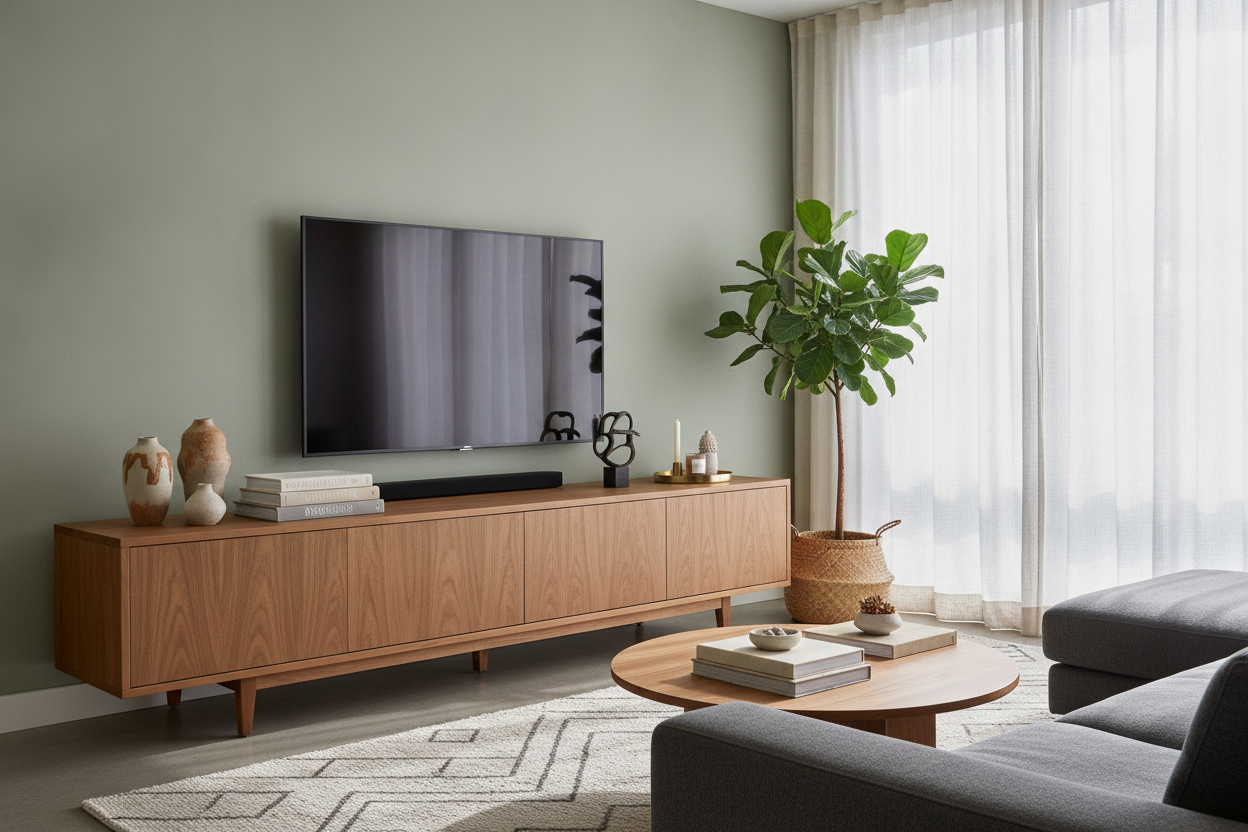
I have spent more hours than I care to admit staring at 47 open browser tabs of media units at 2 AM. I used to think the job was finished once the box was assembled and the cables were shoved out of sight. But a bare console under a giant screen feels cold, like a waiting room in a tech startup. Most people spend weeks shopping for TV stands only to treat them as a landing pad for dust and remotes once they are built.
Mastering interior design for tv stand surfaces is really about one thing: treating that piece of furniture like a styled credenza, not just a parking spot for your PlayStation. If you want a living room that feels like a home instead of an electronics aisle, you have to break the visual dominance of the screen.
Quick Takeaways
- Use varying heights to break up the aggressive horizontal line of the screen.
- Mix organic materials like clay, wood, or greenery to soften plastic tech.
- Hide the clutter in drawers and only display items with visual weight.
- Avoid symmetry; it makes the setup look like a religious altar to Netflix.
The 'Black Hole' Effect (And Why Your Living Room Looks Like a Best Buy)
The biggest hurdle in tv stand interior design is the 'black hole' effect. When you turn off a 65-inch TV, you are left with a massive, soul-sucking void of black glass. If your walls are white and your console is bare, that screen becomes the only thing the eye sees. It’s jarring, and it makes the rest of your decor feel like an afterthought.
I’ve seen beautiful rooms ruined because the owner treated the TV area as a 'utility zone.' You wouldn't leave your dining table completely empty with just a pile of mail on it, so why do we do it here? The goal is to surround the tech with enough personality that the screen becomes just another element in the room, rather than the protagonist. This involves layering objects that have nothing to do with electricity—think vintage bowls, stacked books, or a piece of driftwood you found on vacation.
Rule 1: Anchor the Tech With Organic Textures
Electronics are cold. They are made of glass, plastic, and metal. To make your tv console interior design feel intentional, you have to introduce the opposite: warmth and life. I always recommend adding at least one 'living' element. A trailing Pothos or a structural Snake Plant does wonders for hiding those awkward corners where the screen meets the stand.
If you have a stylish black TV stand, the need for contrast is even higher. A dark unit on a light floor can look like a heavy block. I like to break that up with terracotta pots or raw wood beads. These materials catch the light differently than a screen does. They absorb the glare and provide a matte finish that grounds the entire setup. Don't be afraid of a little messiness—a stack of linen-bound books or a hand-thrown ceramic tray for your remotes adds a human touch that a plastic remote holder never will.
Rule 2: Asymmetry is Actually Your Best Friend
Our instinct is to be symmetrical. We want to put one speaker on the left and one speaker on the right. Or two identical candles. Stop doing that. In interior tv stand design, perfect symmetry creates a formal, stiff vibe that highlights the TV even more. It draws a box around the screen and says, 'Look at this rectangle!'
Instead, aim for a balanced but asymmetrical look. Try a tall, sculptural vase on the left side of the screen. On the right, keep things low—maybe a small stack of coffee table books with a brass object on top. This creates a diagonal line for the eye to follow, which feels much more natural and sophisticated. I’ve found that using the 'Rule of Three' works best here: group objects in odd numbers and varying heights. It tricks the brain into seeing the console as a curated display rather than a support beam for a monitor.
Rule 3: Don't Let Your Wall Swallow Your Furniture
Scale is where most people trip up. If you have an 8-foot ceiling and a low-profile console, there is a massive amount of 'dead air' above the TV. This makes the furniture look tiny and the TV look like it’s floating in space. You need to bridge the gap between the top of the console and the rest of the room.
If you are struggling with fixing your TV wall stand design, consider adding height around the unit. This could be a tall floor lamp on one side or a small gallery wall that wraps around the corner of the screen. Sconces are another great trick—they add a vertical element that draws the eye upward and provides soft, ambient light that makes movie night feel way more cinematic. The goal is to make the TV stand feel like it’s part of the architecture of the wall, not just a box pushed up against it.
My No-Fail Formula for TV Stand Interior Design
If you are staring at a blank console and feeling overwhelmed, use my personal checklist. I use this every time I style a client's home. First, choose a 4-drawer TV stand media console or something similar with closed storage. You cannot style a surface if there are tangled wires peeking out from underneath; it’s like wearing a tuxedo with muddy sneakers. Hide the tech, then start the surface work.
Here is the formula: One tall object (a vase with branches), one flat object (a tray or a large book), and one 'odd' object (something metallic or vintage). Place the tall object on one side. Place the flat object near the center or slightly offset. Put the odd object on top of the flat one. This creates layers and depth. I once tried to style a glass-topped stand with nothing but clear acrylic organizers—it was a disaster. It looked like a pharmacy shelf. Now, I always lean toward heavy, opaque materials like marble or solid oak to give the space some 'thud' factor.
My Honest Mistake
A few years ago, I bought a gorgeous vintage teak console. It was 19 inches deep, which I thought was plenty. I didn't account for the fact that my high-end receiver and all the HDMI plugs needed an extra 3 inches of clearance in the back. I ended up having to saw a giant hole in the back panel and pull the console 4 inches away from the wall. It looked terrible. Always, always measure your deepest piece of equipment—and then add 3 inches for cables—before you commit to a stand.
FAQ
How do I hide my ugly cable box?
If you don't have a cabinet with IR-friendly glass, try 'sandwiching' the box. Put it on a lower shelf and place a decorative (but breathable) basket next to it, or use a mesh-front console that allows the remote signal to pass through while obscuring the plastic box.
Can I put a lamp next to my TV?
Yes, but keep it to the side. Avoid placing a lamp directly in front of the screen or in a spot where it creates a massive reflection. A small lamp with a warm bulb (2700K) is actually great for reducing eye strain during night viewing.
What is the best height for a TV stand?
Your eyes should be level with the middle of the screen when you are sitting on your sofa. For most standard sofas, this means your console should be between 22 and 28 inches tall. If you go higher, you'll be craning your neck like you're in the front row of a movie theater.

Dejar un comentario
Este sitio está protegido por hCaptcha y se aplican la Política de privacidad de hCaptcha y los Términos del servicio.