


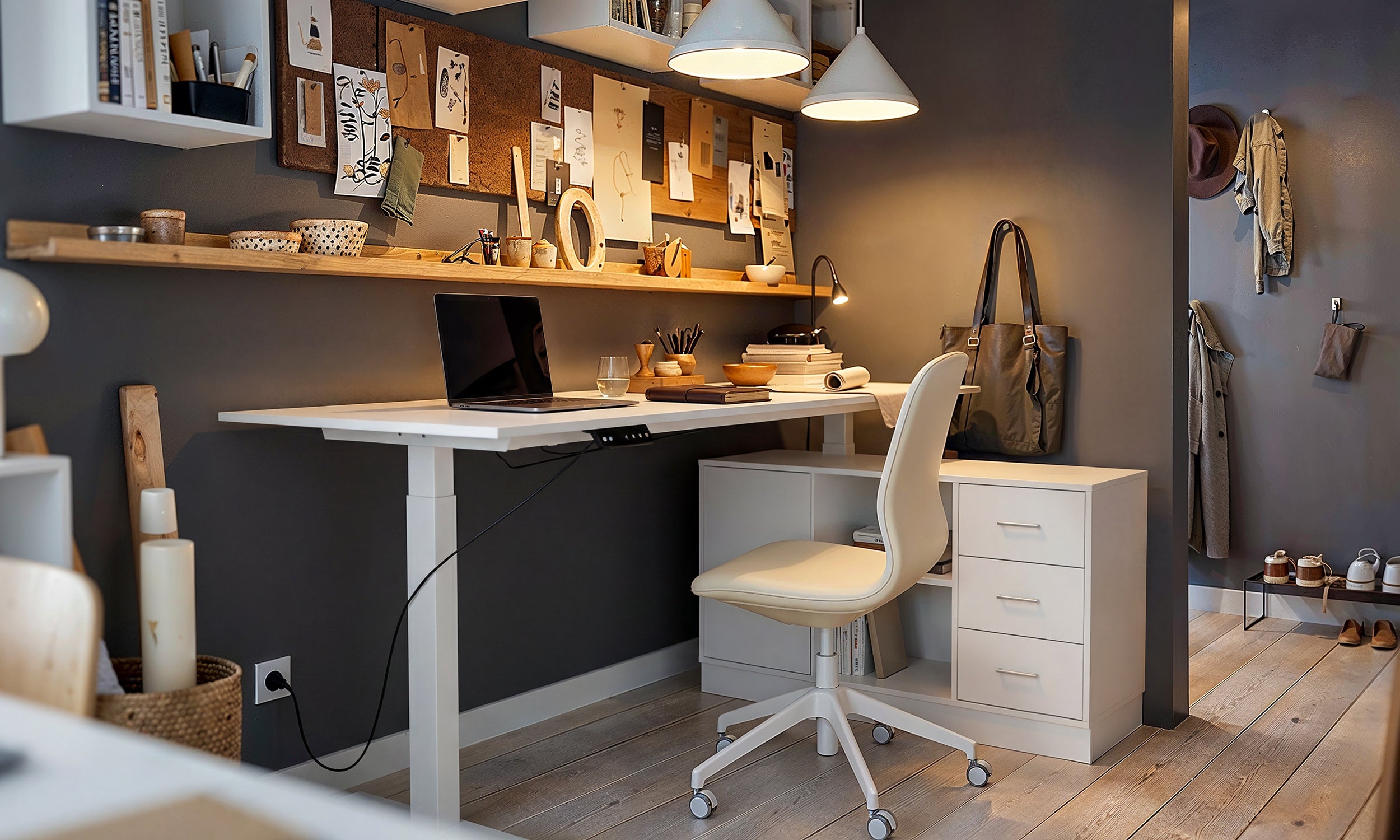
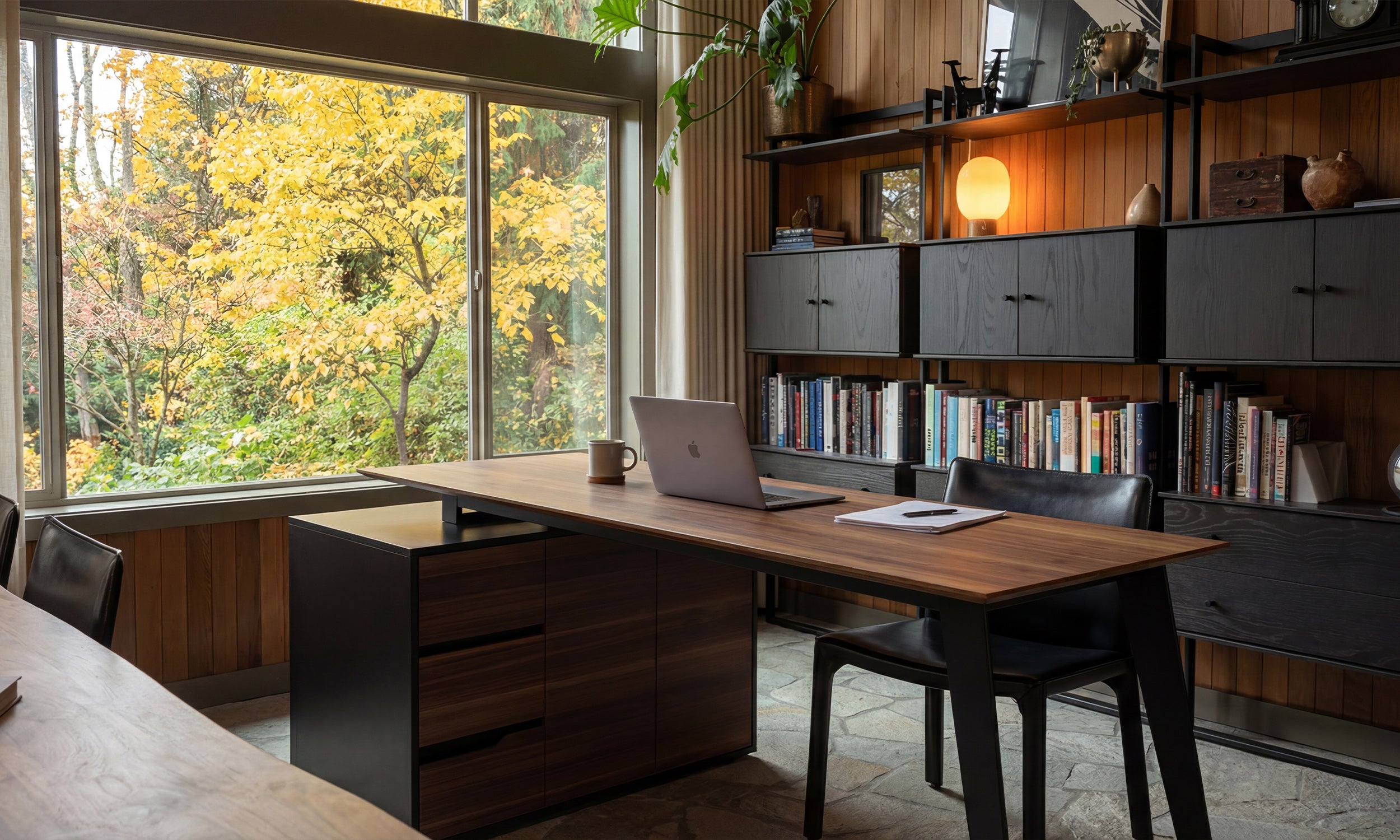



A Victorian style office is built from dark or richly finished wood, deep colors, pattern, carved or turned details, brass, glass-front bookcases and several lamps instead of one bright ceiling light. To make it work as a real office, keep one or two strong period pieces, such as a traditional writing desk or a glass-door bookcase, and pair them with a modern ergonomic chair, glare-free task lighting and hidden cables, so the room feels historic without looking like a museum.
Below: what the style is, walls, desks and bookcases, lighting, technology, a small-room plan, a lighter "Victorian modern" version and five pieces from the FUFU&GAGA home office and study storage collection.
Key takeaways
- One statement piece: a carved or pedestal-style desk, or a dramatic wallpaper, not both at full volume.
- Deep, tonal color: hunter green, navy or burgundy, with a lighter ceiling and wood or brass accents.
- Modern working parts: an adjustable chair, a desk lamp that does not reflect on the screen, cables out of sight.
- Edit: display a few things behind glass and close the rest behind doors.
What is a Victorian style office?
The Victorian era was the reign of Queen Victoria, from 20 June 1837 until her death on 22 January 1901. Its design was not one single look. The encyclopedia entry on Victorian decorative arts explains that designers borrowed and adapted earlier styles, including Gothic, Tudor, Elizabethan, English Rococo and Neoclassical, with the Gothic and Rococo revivals the most common in furniture. The same entry notes that a bare room was considered poor taste, so surfaces were filled with objects.
So "Victorian" can mean pointed Gothic arches in one room and curvy, carved Rococo in another. What a 19th century style office needs is the shared mood: depth, richness and visible craftsmanship.
| Victorian trait | What it looks like | In a working office |
|---|---|---|
| Dark or rich wood | Dark wood and wood-grain finishes | One wood tone on the desk and storage, such as a brown or walnut-look finish |
| Deep color and pattern | Patterned wallpaper, layered rugs and textiles | One patterned wall or a patterned rug, solid colors elsewhere |
| Carved and turned details | Carved legs, corbels, spindles, crown moldings | Arched tops, crown molding, turned legs or spindles on one or two pieces |
| Brass and warm metal | Brass hardware and lamps | Bail or ring pulls, a brass desk lamp, picture lights |
| Books and collections on show | Glazed bookcases, cabinets of curiosities | A glass-door bookcase or curio cabinet that keeps dust off |
| Many surfaces filled | Every table and shelf covered | Clear desktop; display limited to shelves behind glass |
Colors, wallpaper and walls
Victorian office decor starts with the walls. Choose one deep base color and keep its tones related: hunter green with brass and brown leather, navy with walnut, or burgundy with dark wood and cream. Painting the trim the same color as the walls makes wood furniture stand out.
The period offers a useful layout. According to the Victorian decorative arts entry, a favored scheme divided the wall into a dado at the bottom, a middle field and a frieze or cornice at the top, and ceilings were usually tinted lighter than the walls. On plain drywall, an applied chair rail or picture molding suggests the same thing: darker dado, wallpaper or a mid-tone in the field, pale ceiling.
The same entry notes that wallpaper reached far more households through mass production, and the V&A calls William Morris "the father of progressive pattern in the Victorian period", with many designs using motifs taken from British wildlife. A botanical or bird pattern on one wall gives the effect without overwhelming the room. For a gallery wall, use one frame finish, all gilt or all dark wood.
Keep the wall behind the monitor calmer. OSHA's computer workstation guidance recommends a medium-colored, non-reflective paint on walls and surfaces around the screen. Use a matte finish there and save the boldest wallpaper for a wall outside your line of sight.
Furniture: the desk sets the period
Pedestal, partners and secretary desks
The desk does most of the work. Three historic forms are worth knowing:
- Pedestal desk: a large, flat, free-standing desk whose top rests on two pedestals of drawers. The encyclopedia entry says the form appeared mainly in 18th-century England and became more common than secretary desks and writing tables in the 19th and 20th centuries.
- Partners desk: a pedestal desk doubled in size, with drawers on both sides, so two people can work at it at the same time.
- Secretary desk: a base with wide drawers supporting a desk with a hinged writing surface, per the secretary desk entry, often with a bookcase or cabinet above.
A reproduction with drawers below the desktop and a bookcase hutch above combines the desk and bookcase ideas in one piece. That is the shape of the 62.2" traditional writing desk with bookcase in our picks below.
A large dark desk carries a lot of visual weight. In an average spare room, keep the rest of the furniture lighter, or choose a writing desk on legs so light passes underneath. With antiques, measure doorways and stairs first, and check that knee space suits a modern keyboard.

Bookcases and display
Glass-front bookcases show books and objects while keeping dust off, and leather-look spines behind glass read as "library" at once. Look for arched tops, crown molding and framed glass. Our bookcase with glass doors buying guide covers door types, depth and shelves, and our guide to built-in office cabinets shows how to line freestanding units up as one wall.
Chairs
Put a wingback or leather club chair in the reading corner. At the desk, comfort comes first: OSHA's guidance on chairs calls for a height-adjustable seat, a height-adjustable lumbar support, soft armrests and a padded seat with a rounded "waterfall" edge. A task chair in brown leather or with a wood-tone base sits well beside a traditional desk.
Lighting: warm and layered, without glare
A Victorian mood comes from several small pools of warm light rather than one bright overhead fixture: a brass or banker's lamp on the desk, a floor lamp by the reading chair, picture lights over art and lit shelves inside a glass cabinet. A large gilt-framed mirror bounces light around a dark room.
OSHA advises placing the screen at right angles to windows and light sources, positioning task lighting so it does not reflect on the screen, and using blinds or drapes to cut bright light. Heavy curtains do that job well, and a shaded lamp beside the monitor, not behind it, lights paper without glare.
Modern technology in a period room
Monitors and chargers break the mood fastest. To hide them:
- Run cords down the back legs or back panel of the desk with clips, and add a cable tray under the desktop.
- Use a monitor arm and a large leather-look desk pad to keep the wood surface clear.
- Keep the printer and router behind cabinet doors.
The CPSC warns never to cover any part of an extension cord with rugs or other objects while it is in use, not to overload cords, to use extension cords only on a temporary basis, and to keep cords from dangling where they can be pulled down or tripped over. Route cords along walls and furniture, not under the rug.
A Victorian office in a small room
In a small study, choose one period piece and let everything else recede. Compact desks are period-correct: the V&A holds a walnut davenport writing desk from 1850 to 1880 with carved scroll legs, four drawers on the right and four dummy drawers on the left.
- Go vertical: one tall glass-door cabinet beside the desk. Check the wall: a 62.2-inch desk plus a 35.4-inch cabinet needs 62.2 + 35.4 = 97.6 inches, just over 8 feet.
- Use the wall: a shallow shelf with turned spindles adds period detail without using floor space.
- Plan the desk width first: if the wall only takes about 48 inches, our 48 inch desk guide shows what fits.
Victorian modern: avoiding the museum look
The V&A notes that late-century Arts and Crafts homes looked "daringly simple to Victorians used to the ornate interiors" fashionable since the mid-1800s. A Victorian modern office edits the same way:
- Mix eras: a traditional desk with a simple modern lamp, or a modern desk with an ornate mirror and a period-style cabinet.
- Lighter period shapes: a cream cabinet with arched glass doors and crown molding has the silhouette without the weight.
- Clear surfaces: group collections inside one glass cabinet.
- Repeat a few materials: one wood tone, one metal (brass), one leather, one pattern.
For a darker, tailored take with leather and black metal, see our masculine office decor ideas.
Victorian office checklist
- Pick one statement piece: a desk, or a glass-door bookcase or cabinet.
- Choose one deep base color, a lighter ceiling and a matte wall behind the screen.
- Limit pattern to one wall or one rug.
- Add up the widths of every piece on each wall, with room for trim and outlets.
- Compare tall cabinets with your ceiling height (see the tilt-up note below).
- Use an adjustable task chair at the desk; the period chair goes in the corner.
- Plan three light sources and an outlet near the desk.
- Anchor every bookcase and cabinet to the wall.
Our picks for a Victorian style office
Five pieces with traditional, carved, arched, turned or glass-door details. All facts come from each listing.
62.2" Traditional Writing Desk with Bookcase, 9 Drawers and 3-Color LED Lighting
The most period-looking desk in our range: an H-shaped base with nine drawers, a built-in bookcase hutch with shelves and cabinets, and brown or natural finishes with natural wood grain variation. It measures 82.7" H x 62.2" W x 21.1" D with a 59.1" wide desktop and a 200 lb weight capacity. Plug-in LED lighting switches between warm, natural and cool, the shelves adjust, the drawers have safety stops, and wall anchoring hardware is included. It weighs 324.94 lb.
Best for: the classic look of a pedestal desk and bookcase in one piece, against a wall in a medium or large room.
Skip it if: you need a confirmed desktop height (the listing does not give one), your wall is not comfortably wider than the desk, or you want to move the desk often; it is heavy, needs assembly and should be anchored.
61.8" White/Brown Elegant 3-Drawer Display Bookcase with 4 Glass Doors
A wide library bookcase: four glass doors over the display shelves, with three drawers and two side cabinets below. In brown, it gives the darker wood-grain look of a Victorian library, and ribbed detailing adds texture. It is 79.6" H x 61.8" W x 15.7" D, each shelf is rated 20 lb, the back is finished, an anti-tip device is included, and it weighs 235 lb.
Best for: one wall of closed and glazed storage behind or beside the desk.
Skip it if: you plan to fill it with heavy reference books (20 lb per shelf is modest), or you want to see the brown finish before ordering: the listing photos show the white version.
35.4" Display Cabinet with Arched Glass Doors and 2 Drawers
The most architectural piece here: an arched top with fan-shaped detailing, carved corbel accents and slim black iron frames around clear glass doors, over two drawers. It measures 80.7" H x 35.4" W x 16.9" D in a gray-white finish, weighs 194 lb, and has an anti-tip base plus a tipover restraint device in the box.
Best for: a curio or library cabinet for books, brass objects and collections next to a desk or reading chair.
Skip it if: you need a stated shelf weight rating (the listing gives no per-shelf figure), or you want a dark wood cabinet rather than a pale one.

37" Beige Display Cabinet with Arched Glass Doors, LED Lighting and 3 Drawers
A lighter, Victorian modern option: two full-length arched glass doors, a crown molding top and three drawers with silver hardware, in cream beige. It is 92.5" H x 37" W in the listing, which gives the depth as 15.7" in the specs but 18.9" on its dimension drawing, so plan on the deeper figure. It has adjustable shelves rated 22 lb each, LED strips with a remote (batteries not included), a finished back and a tipover restraint; it weighs 198 lb.
Tilt-up check: a cabinet assembled on its back needs headroom for its diagonal, about 94.4 inches here using the drawing's 18.9-inch depth (the square root of 92.5 squared plus 18.9 squared), plus the crown molding. An 8-foot (96-inch) ceiling leaves little margin.
Best for: a brighter Victorian modern room, or a pair flanking a desk or window.
Skip it if: your ceiling is under 8 feet, or you want heavy books on every shelf (22 lb per shelf).

55.1" Natural Wall Display Shelf with Open Shelves and Turned Spindles
For a small room: turned spindles, arched openings and a molded crown put period detail on the wall. It is 31.5" H x 55.1" W x 7.9" D, with three open shelves, each 51.6" wide, 8.8" high, 4.5" deep and rated 20 lb. Solid wood shelves sit in a solid and manufactured wood frame in natural brown; brackets come pre-attached and wall anchors are included.
Best for: small curios, inkwells, cups and miniatures above a desk or along a narrow wall.
Skip it if: you want it for books (4.5-inch-deep shelves are too shallow for most), or your wall cannot take secure fixings.
Compare the picks
| Pick | Size (H x W x D) | Period detail | Storage | Best for |
|---|---|---|---|---|
| 62.2" traditional writing desk | 82.7" x 62.2" x 21.1" | Bookcase hutch, wood grain, brown or natural | 9 drawers, shelves, cabinets | Statement desk |
| 61.8" display bookcase | 79.6" x 61.8" x 15.7" | Glass doors, ribbed detailing, brown option | Shelves, 3 drawers, 2 cabinets | Library wall |
| 35.4" arched display cabinet | 80.7" x 35.4" x 16.9" | Arched top, carved corbels, iron-framed glass | Glass cabinet, 2 drawers | Curio or bookcase |
| 37" arched display cabinet | 92.5" x 37" x 15.7" | Arched glass doors, crown molding, LED | Shelves, 3 drawers | Victorian modern |
| 55.1" wall display shelf | 31.5" x 55.1" x 7.9" | Turned spindles, arches, molded crown | 3 open shelves | Small rooms |
Safety: anchor tall and heavy pieces
Tall bookcases, cabinets and hutch desks are top-heavy. The CPSC's Anchor It campaign says anchoring all furniture with drawers, doors and shelves to the wall prevents tip-over injuries and deaths. Every pick above lists a tipover restraint, anti-tip device or wall anchors; fix them into studs or anchors rated for your wall, as our guide to anchoring a bookcase shows.
FAQ
What is Victorian office decor?
It recreates a 19th-century study: rich or dark wood, deep greens, navies and burgundies, patterned wallpaper or rugs, carved or turned details, brass lamps and glass-front bookcases. In a working room, keep one or two strong period pieces and modern ergonomics for the chair, lighting and cables.
What did a 19th century office look like?
Desks of the period included the pedestal desk, which became more common than secretary desks and writing tables in the 19th century, and the secretary with its hinged writing surface. Victorian rooms were full, since a bare room was considered poor taste, and a favored wall scheme was dado, field and frieze under a lighter ceiling.
How do I make a Victorian office feel less dark?
Keep the ceiling lighter than the walls, limit the darkest color to one wall or the dado, use matte paint, and layer a desk lamp, a floor lamp and picture or cabinet lights. A large framed mirror and a cream cabinet with arched glass doors brighten the room.
Browse more traditional desks, glass-door bookcases and cabinets in our home office and study storage collection.

Dejar un comentario
Este sitio está protegido por hCaptcha y se aplican la Política de privacidad de hCaptcha y los Términos del servicio.