


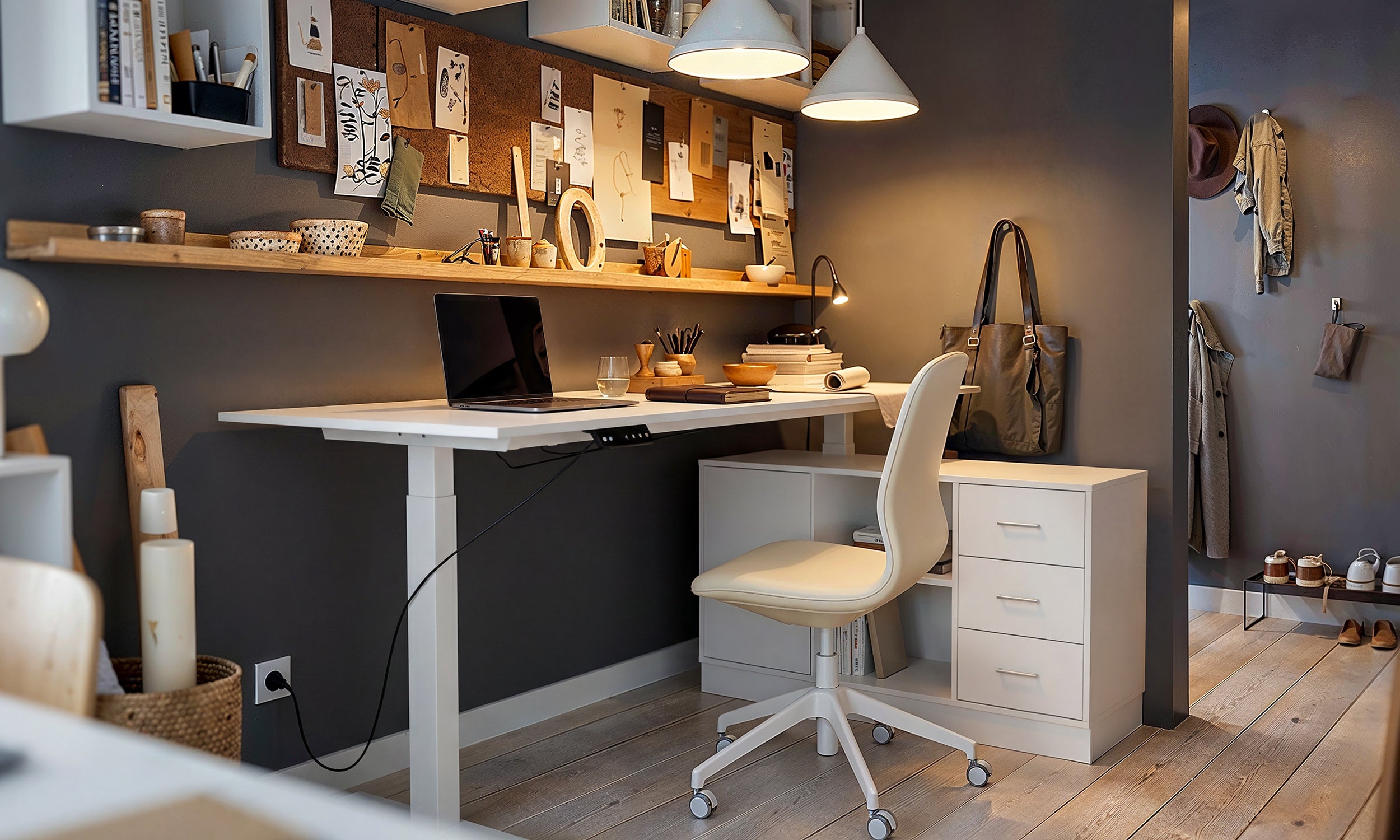



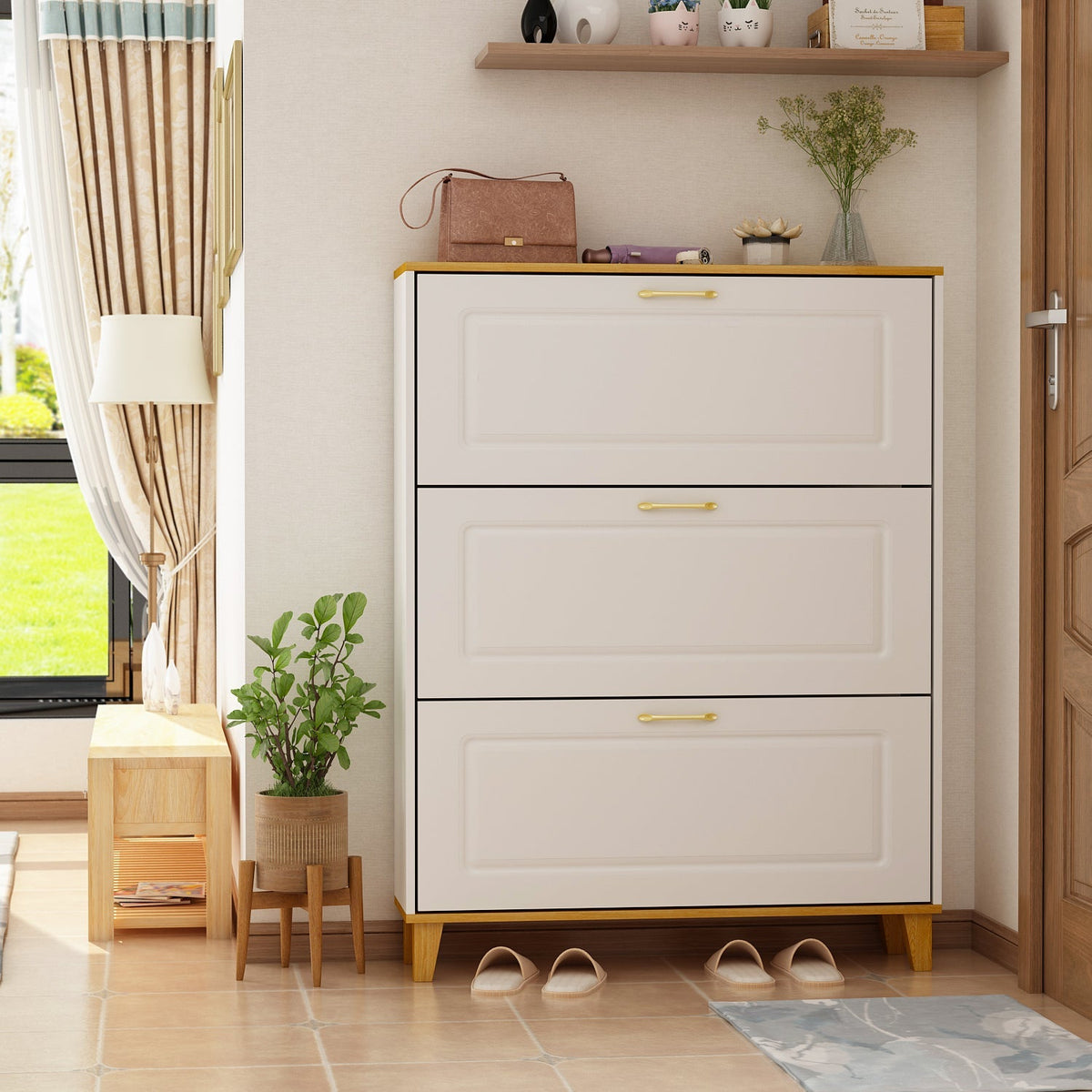
A white shoe cabinet keeps an entryway looking light and uncluttered, but it only works if it fits the space by the door. Before you choose one, measure the walkway and the front door's swing, then pick the depth: flip-down cabinets in our range are 9.3 to 9.5 inches deep, and pieces with doors and flat shelves are 13.7 to 15.7 inches deep. Check the pair count each listing gives, plan where wet shoes will dry, and anchor any tall or flip-door cabinet to the wall.
The five picks below, from our shoe cabinet collection, include three flip-down cabinets, one tall two-door cabinet and one shoe storage bench, all in white.
Key takeaways
- Walkway: add the cabinet's depth to about 36 inches of clear floor to get the hallway width you need.
- Door swing: keep the cabinet out of the front door's arc, with room for bins or doors to open.
- Depth: flip-down bins fit in under 10 inches; flat shelves need more depth but take boots.
- Clean white: two doormats and a boot tray do more for a white cabinet than any cleaner.
- Safety: anchor flip-door and tall cabinets; an open bin full of shoes moves weight forward.
Why choose a white shoe cabinet?
Entryways tend to be the darkest, narrowest part of a home, and a white cabinet reflects what light there is. It also blends with white doors, trim and baseboards, so a 4-foot-tall cabinet reads as part of the wall rather than a block of furniture.
The trade-off is that white shows what an entryway collects: mud splashes at shoe height, fingerprints around the handles and grit on the top. That is a planning problem more than a reason to avoid white. If you want a little warmth, a two-tone cabinet with a wood-tone top or legs breaks up the white and is more forgiving of small marks on top.
Measure the walkway and the door swing first
How much walkway should you leave?
A useful benchmark is 36 inches of clear width. The US Access Board's guide to the ADA standards says the continuous clear width must be at least 36 inches (32 inches minimum for short distances, such as doorways). Those rules cover public buildings, not homes, but the figure is a practical yardstick. Add it to the cabinet's depth:
| Cabinet depth (our picks) | Type | Hallway width for 36 in clear |
|---|---|---|
| 9.3 in | Flip-down | 36 + 9.3 = 45.3 in |
| 9.5 in | Flip-down | 36 + 9.5 = 45.5 in |
| 13.7 in | Bench with doors | 36 + 13.7 = 49.7 in |
| 15.7 in | Tall two-door with shelves | 36 + 15.7 = 51.7 in |
Measure at the narrowest point, from the baseboard rather than the wall, because the cabinet sits against the baseboard. In a hallway narrower than the table suggests, a flip-down cabinet is usually the only closed option that leaves a comfortable path.
Check the front door's swing
A hinged door sweeps a quarter circle as deep as the door is wide, so a 36-inch door needs a 36-inch arc of clear floor on its opening side. Open the door fully and mark where its edge passes; a cabinet inside that arc will stop the door or get dented by it. The better wall is usually the one the door does not open toward.
Then allow for the cabinet's own moving parts. Flip-down bins tilt out toward you, and our listings do not give the tilt-out distance, so stand at the spot and check you can open a bin without stepping into the door's path. On a 23.6-inch cabinet with two equal doors, each door is about 11.8 inches wide (23.6 ÷ 2), and swings that far into the room.
Flip-down or shelves: how deep should a white shoe cabinet be?
Depth depends on how the shoes sit. On a flat shelf a shoe lies front to back, so the shelf must be at least as deep as your longest shoe. In a flip-down bin the shoes stand at an angle, which is how these cabinets fit in under 10 inches. Our slim shoe cabinet guide explains the bin mechanism in detail.
| Type | Depth in our picks | Good at | Watch for |
|---|---|---|---|
| Flip-down bins | 9.3 to 9.5 in | Narrow halls; flat fronts that look like a slim white chest | Boots and very large shoes; bins tilt into the walkway |
| Doors and flat shelves | 15.7 in | Boots, heels and mixed sizes on adjustable shelves | Needs a wider hall; tall units must be anchored |
| Bench with doors | 13.7 in | A seat for putting shoes on | Holds fewer pairs |

If you own tall boots, decide where they go first. Flip-down bins suit flats, sneakers and low heels; adjustable flat shelves let you open one tall gap for boots, at the cost of the shelf next to it.
How many pairs will a white shoe cabinet hold?
Treat the listed pair count as a ceiling. Listings assume average-size shoes; large sizes, high-tops and winter shoes take more room. Our picks show the spread: the tall two-door cabinet is listed at 16 to 24 pairs depending on shoe type and size, and the narrow 3-flip cabinet at about 12, or 3 to 6 per bin.
Count only the shoes that live by the door, count boots separately, and plan on the low end of any range if your household wears large sizes. Our shoe cabinet buying guide walks through a full capacity count and compares every cabinet type.

Does a shoe cabinet need ventilation?
Some airflow helps, but drying shoes before they go in matters more, especially in a closed white cabinet where a damp patch or mildew spot would show. The US Environmental Protection Agency says that the key to mold control is moisture control, advises drying wet items within 24 to 48 hours, and suggests keeping indoor humidity below 60 percent, ideally between 30 and 50 percent.
None of the five picks lists louvers or vented doors, and the two larger cabinets are listed with closed backs. So leave wet or snowy shoes on a boot tray overnight before they go in, rotate everyday pairs, and wipe grit out of the bins now and then. If a musty smell appears, empty the cabinet, let it air open, and look for the source of damp.
How to keep a white shoe cabinet clean near muddy shoes
Stop the dirt at the mat. The EPA's lead guidance advises you to place doormats outside and inside all entryways and to remove shoes before entering. University of Georgia Extension recommends a grate-like scraper mat outside the entry door and an absorbent mat inside that traps soil and water below shoe level, and notes that around 30 to 40 percent of the contaminants inside a home come in from outdoors. It also suggests storing indoor shoes near the door, which is the job a shoe cabinet does.
Give wet shoes a landing spot. A boot tray or washable mat beside the cabinet keeps muddy pairs off the white base. A cabinet on legs or wheels lets you mop underneath; one with a plinth base sits flat on the floor, so wipe its bottom edge after wet days.
Clean the finish gently. All five picks are made of manufactured wood, some with solid wood parts. Wipe marks with a soft cloth dampened with water and a little mild soap, then dry the surface so water does not sit on edges and seams. Skip abrasive pads and harsh solvents, and test anything stronger inside a panel first. Wipe the handles and top weekly, and keep keys in a small tray rather than straight on the white top.

Anchor a tall or flip-door shoe cabinet
Shoe cabinets are tall for their depth, and flip-door cabinets add a second risk: a bin pulled open and loaded with shoes moves weight forward past the base, and a child can pull on or climb an open bin. The US Consumer Product Safety Commission's Anchor It campaign states that anchoring all furniture with drawers, doors, and shelves to the wall prevents tip-over injuries and deaths, and tells you to tug on the straps afterward to be sure they are secure.
Height divided by depth shows why the slim cabinets need it most: 47.2 ÷ 9.3 is about 5.1 for the 31.6-inch flip-down cabinet, 47.2 ÷ 9.5 about 5.0 for the 35.4-inch one, 41.7 ÷ 9.3 about 4.5 for the 22.4-inch 3-flip, and 70.9 ÷ 15.7 about 4.5 for the tall two-door. The bench is only 18.1 ÷ 13.7, about 1.3.
Read each listing and its User Manual tab before you assume what is in the box. The four cabinets below are listed with mounting or installation required, and none of their listings names a tip-restraint device, so have anti-tip straps or anchors for your wall type (drywall with studs, plaster or masonry) ready, and fix the cabinet before you load it. Our guide on how to anchor furniture to the wall applies to a shoe cabinet too. Put the heaviest shoes low, keep heavy objects off the top, and open one bin at a time.
White shoe cabinet buying checklist
- Measure the hallway at its narrowest point and subtract the cabinet depth; aim for about 36 inches clear.
- Keep the cabinet outside the front door's arc, with standing room for bins or doors.
- Count the pairs that live by the door and count boots separately.
- Choose flip-down bins for under 10 inches of depth, or adjustable shelves for boots.
- Plan a boot tray and two doormats, one outside and one inside.
- Decide on pure white or white with wood accents.
- Check what the listing says about mounting, and have anchors ready for your wall.
Our picks: five white shoe cabinets for different entryways
Sizes, pair counts and mounting notes come from the product listings. Capacity depends on shoe size and style.
35.4" White Flip-Down Shoe Cabinet with Wood Top and Legs
The two-tone pick: a white body with a light brown wood-tone top and solid wood legs that raise it off the floor. It measures 47.2" H x 35.4" W x 9.5" D and weighs 74.8 lb. Three flip-down compartments with shelves inside hold flats, sneakers and boots out of sight, and the internal dividers adjust for different sizes. It has metal handles and a closed back. Tip restraint as listed: mounting or installation is required; no tip-restraint device is named.
Best for: a wide stretch of entry wall where you want a landing spot on top for keys, a plant or a lamp.
Skip it if: you need a confirmed pair count. The title and the specifications give different figures, so choose a pick with a single listed capacity if that matters.
31.6" White Flip-Down Shoe Cabinet, Up to 24 Pairs
A plain, all-white cabinet with three pull-down compartments, each split into two levels by an internal divider, for up to 24 pairs. It measures 47.2" H x 31.6" W x 9.3" D and weighs 58 lb. The listing describes waterproof MDF with a smooth veneer surface that is easy to wipe clean and dry, a plus by the front door. It also comes in brown. Tip restraint as listed: mounting is required; no tip-restraint device is named.
Best for: the most pairs in the least depth.
Skip it if: your wall space is tight. The product title says 23.6 inches, but the specifications give 31.6" W, so measure for the wider figure. Boots will not suit the flip bins.
22.4" White 3-Flip Drawer Shoe Cabinet
The narrowest cabinet here, at 41.7" H x 22.4" W x 9.3" D and 40.26 lb. Each of the three flip drawers holds 3 to 6 pairs, for about 12 in total, and has a removable partition so you can adapt it to bigger shoes. It comes in white or black, and the listing says one person can assemble it. Tip restraint as listed: mounting or installation is required, with a freestanding installation type; no tip-restraint device is named.
Best for: a small entry or a bedroom, where about 12 pairs is enough.
Skip it if: you need room for a family's shoes or for boots.
23.6" Tall White 2-Door Shoe Cabinet on Wheels
The door-and-shelf pick, and the one for boots. It stands 70.9" H on a 23.6" W x 15.7" D footprint and holds 16 to 24 pairs on flat shelves behind two doors. The middle six shelves adjust, and the listing gives a shelf size of 7.3" H x 15.7" D. Four wheels lift it off the floor for cleaning, and two have brakes. It weighs 82 lb, has a closed back and comes in white or black. Tip restraint as listed: mounting or installation is required; no tip-restraint device is named. Keep the brakes on and anchor it anyway.
Best for: mixed footwear including boots and heels, in a mudroom, closet or wider hall.
Skip it if: your hallway cannot spare 15.7 inches of depth plus door swing, or you cannot fix it to the wall.
35.8" White Shoe Storage Bench with Cushion and 2 Doors (bench alternative)
If you would rather sit to put on shoes, this low bench is the alternative to a cabinet. It measures 18.1" H x 35.8" W x 13.7" D and weighs 43 lb. Two doors open onto adjustable shelves for at least 8 pairs under a thickly padded fabric cushion. Tip restraint as listed: the listing gives no mounting or tip-restraint details. Our storage bench guide covers seat sizes and corner layouts.
Best for: a smaller shoe count and a seat by the door.
Skip it if: you need more than about 8 pairs, or a listed weight capacity or seat height (the listing gives neither).
Compare the picks
| Pick | W x D x H (in) | Front | Inside | Pairs listed | Tip restraint (as listed) |
|---|---|---|---|---|---|
| 35.4" two-tone flip-down | 35.4 x 9.5 x 47.2 | 3 flip-down compartments | Shelves, adjustable dividers | Title and specs disagree | Mounting required; no device named |
| 31.6" flip-down | 31.6 x 9.3 x 47.2 | 3 flip-down compartments | Divider in each, two levels | Up to 24 | Mounting required; no device named |
| 22.4" 3-flip | 22.4 x 9.3 x 41.7 | 3 flip drawers | Removable partitions | About 12 | Mounting required; no device named |
| 23.6" tall 2-door | 23.6 x 15.7 x 70.9 | 2 doors, wheels | Adjustable flat shelves | 16 to 24 | Mounting required; no device named |
| 35.8" bench | 35.8 x 13.7 x 18.1 | 2 doors, padded seat | Adjustable shelves | At least 8 | Not listed |
All five need assembly; our flat-pack assembly guide helps if you have not built one before.
FAQ
Is a white shoe cabinet hard to keep clean?
Not if you stop the dirt before it reaches the cabinet. Use a scraper mat outside and an absorbent mat inside, give wet shoes a boot tray, and wipe the handles and top weekly with a soft, damp cloth and mild soap, then dry them.
How deep should a shoe cabinet be for a narrow hallway?
Flip-down cabinets are the slimmest; in our range they are 9.3 to 9.5 inches deep. With about 36 inches of clear walkway, that needs a hallway roughly 45 to 46 inches wide. A shelf cabinet 15.7 inches deep needs about 52 inches.
Do flip-down shoe cabinets need to be anchored?
Yes. In our range they are 4.5 to 5.1 times as tall as they are deep, and an open bin full of shoes shifts weight forward. The CPSC's Anchor It campaign advises anchoring all furniture with drawers, doors and shelves to the wall.
Can you put wet shoes in a shoe cabinet?
Let them dry first. The EPA advises drying wet items within 24 to 48 hours to prevent mold, and a closed cabinet slows drying. Leave wet pairs on a tray overnight, then put them away.
Compare sizes, depths and finishes across the full shoe cabinet collection before you choose.

Dejar un comentario
Este sitio está protegido por hCaptcha y se aplican la Política de privacidad de hCaptcha y los Términos del servicio.