










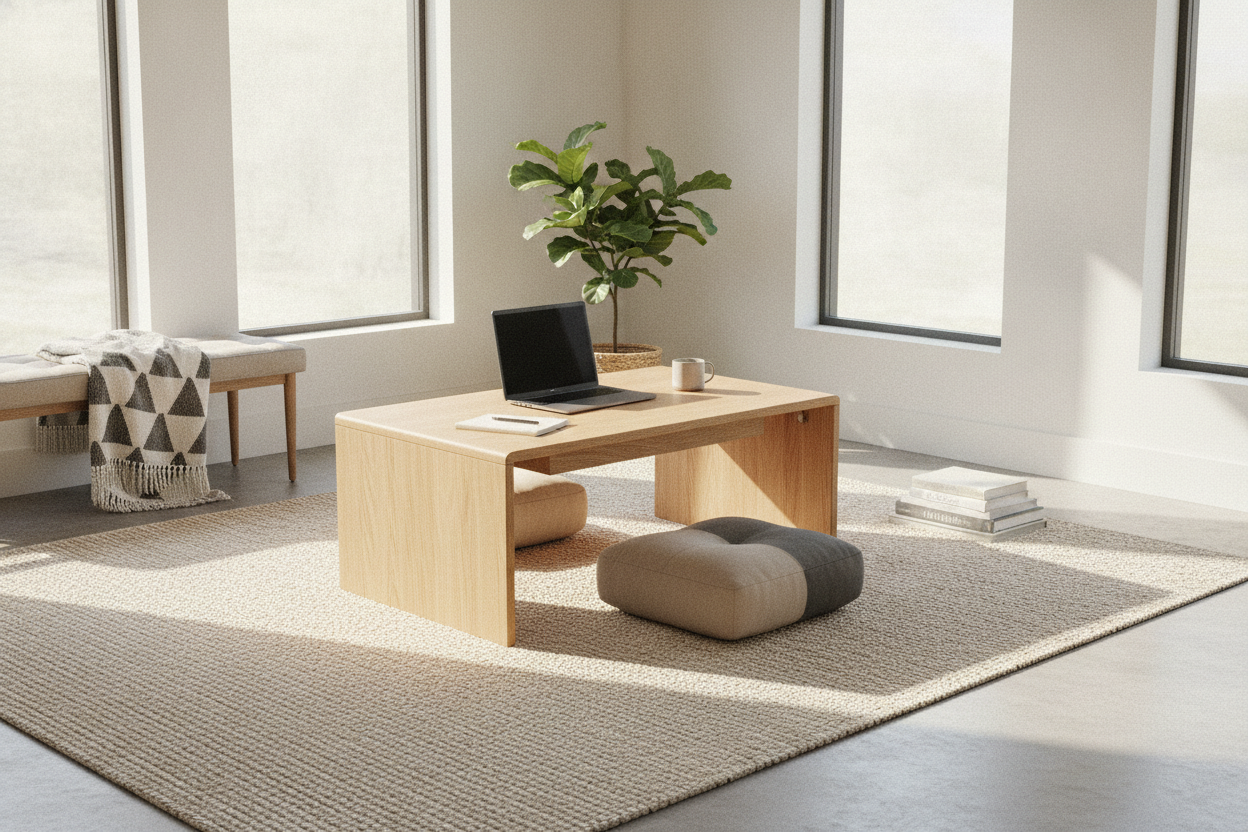
My lower back felt like it was made of dry twigs. I had spent nearly a thousand dollars on an ergonomic chair that promised to save my spine, yet there I was, slouching into a question mark shape by 2 PM every single day. One afternoon, out of pure desperation, I just slid out of the chair and onto the rug, laptop in hand. It was the first time in months my hips didn't feel like they were locked in a vice. That was my gateway drug into the world of floor desks.
Quick Takeaways
- Floor sitting encourages 'active sitting,' which keeps your core engaged and your hip flexors open.
- The first week is physically demanding; your body has to relearn how to support itself without a chair back.
- Proper monitor height is non-negotiable to avoid 'tech neck' when working at ground level.
- An adjustable height floor desk offers the most flexibility for different sitting postures like kneeling or cross-legged.
Wait, why is everyone working on the ground now?
It sounds like a regression to kindergarten, but the 'floor office' movement is exploding among remote workers who are tired of the literal and metaphorical rigidity of office life. For years, we were told that a standard writing computer desk was the only way to be productive. But those desks are designed for a 90-90-90 posture that most of us can't maintain for more than twenty minutes before we start to slump. The shift toward a minimalist floor desk setup is really about reclaiming mobility.
When you use a desk to sit on floor, you aren't stuck in one position. You are constantly micro-shifting. You move from a cross-legged position to a 90-90 stretch, to a deep squat, to kneeling. This is what physical therapists call 'the best posture is your next posture.' A floor sitting desk forces your stabilizer muscles to actually do their job. I noticed that when I stopped leaning against a chair back, my core strength improved without me ever hitting a gym. It’s a more primal, active way to spend your eight-hour shift, and it’s a far cry from the static, heavy furniture that usually clutters a home office.
The brutal first week of the 'floor office' transition
I’m not going to lie to you: the first three days of using a low desk for sitting on floor were miserable. I thought I was fit until I tried to sit on the ground for four hours. My shins fell asleep, my lower back throbbed, and I found myself staring longingly at my old rolling chair. This is the 'adaptation phase' that nobody mentions in the pretty Instagram photos of floor desk ideas. Your body has become adapted to the chair, and your muscles have likely shortened and weakened as a result.
To survive the transition to a sit on floor desk, you absolutely cannot just sit on the hard hardwood. You need a dedicated floor desk chair or at least a high-quality meditation cushion. I personally use a buckwheat hull zafu because it doesn’t compress like cheap polyester foam. If you try to use a floor computer desk without proper padding for your sit-bones, you'll quit within forty-eight hours. By day five, the 'new' soreness started to fade, replaced by a strange sense of openness in my hips that I hadn't felt since I was a teenager. It’s a ground desk reality check: your body is capable of this, it just needs to be coaxed out of its chair-shaped mold.
Sit, kneel, or squat: Nailing your floor desk height
Ergonomics don't disappear just because you're on the rug. In fact, floor desk height is even more critical because the margin for error is smaller. A low sitting desk that is too low will have you hunching over like a gargoyle. Most people think a floor table for studying can just be a coffee table, but coffee tables are usually 16 to 18 inches high—too tall for most people sitting directly on the floor and too short for those in a floor desk and chair setup. You want your elbows at a 90-degree angle, just like at a standing desk.
The biggest mistake I made with my floor sitting to standing desk transition was ignoring my neck. If your laptop is sitting directly on a small floor desk, you are looking down. This is a recipe for disaster. I eventually realized I needed to decouple my screen from my keyboard. Using a floor stand for TV monitor screens allowed me to keep my large 27-inch monitor at eye level while my hands stayed low on the floor office surface. This setup effectively eliminated the tension headaches I was getting during the first week of testing.
The magic of the floor-to-standing desk hybrid
If you aren't ready to commit to the floor 100% of the time, the floor to stand desk is the ultimate solution. I eventually upgraded to an ergonomic home office sit stand up desk that has a motor capable of dropping the surface almost to the floor. This allows for a floor sit stand desk experience where I can start my morning sitting cross-legged on a cushion, move to a kneeling position at 11 AM, and then transition to a full standing desk mode for my afternoon meetings.
An adjustable floor desk or a floor sit to stand desk is a massive upgrade over a static floor table study setup. It accommodates different body types—what works for a floor desk for students might not work for a 6-foot-tall adult. Having a floor desk adjustable height means you can fine-tune the surface to whether you are sitting on a thick cushion or directly on the carpet. It’s the most versatile floor desk setup I’ve found, especially if you have a large floor desk with storage that needs to accommodate multiple tasks throughout the day.
Should you actually buy one? (My final verdict)
After a month of testing, I’m a floor desk convert, but it’s not for everyone. If you have chronic knee issues or zero interest in a 'physical' workday, stick to your chair. However, for the minimalist floor desk enthusiast or someone who feels trapped by traditional furniture, it is a revelation. The best floor desk is one that encourages you to move, not one that locks you into a single spot. I’ve found that a floor desk for adults works best when paired with a variety of props—bolsters, cushions, and even a low stool.
If you’re starting out, don't buy the most expensive floor standing desk immediately. Start with a simple low floor desk or even a sturdy crate to see if your body likes the position. If you find yourself feeling more focused and less stiff, then invest in a high-quality floor desk with storage or a standing desk that goes to the floor. My home office feels twice as big now that I don't have a massive chair taking up the center of the room. It’s a cleaner, more intentional way to work.
Floor Desk FAQ
Is sitting on the floor better than a chair?
It’s not necessarily 'better' in a vacuum, but it encourages more movement. Most people find that a floor sitting desk helps with hip mobility and core engagement compared to a standard chair where you tend to collapse into the upholstery.
What is the ideal floor desk height?
For most adults, a floor desk height of 10 to 14 inches is the sweet spot. It depends entirely on whether you are sitting on a flat cushion, a tall bolster, or kneeling. The goal is to keep your shoulders relaxed and elbows at 90 degrees.
Can I use a floor desk for gaming?
Absolutely. A floor computer desk setup is actually very popular for gaming, especially if you prefer a 'command center' feel. Just ensure you have a floor desk chair with back support if you plan on long sessions, as gaming usually involves less movement than typing.

Dejar un comentario
Este sitio está protegido por hCaptcha y se aplican la Política de privacidad de hCaptcha y los Términos del servicio.