










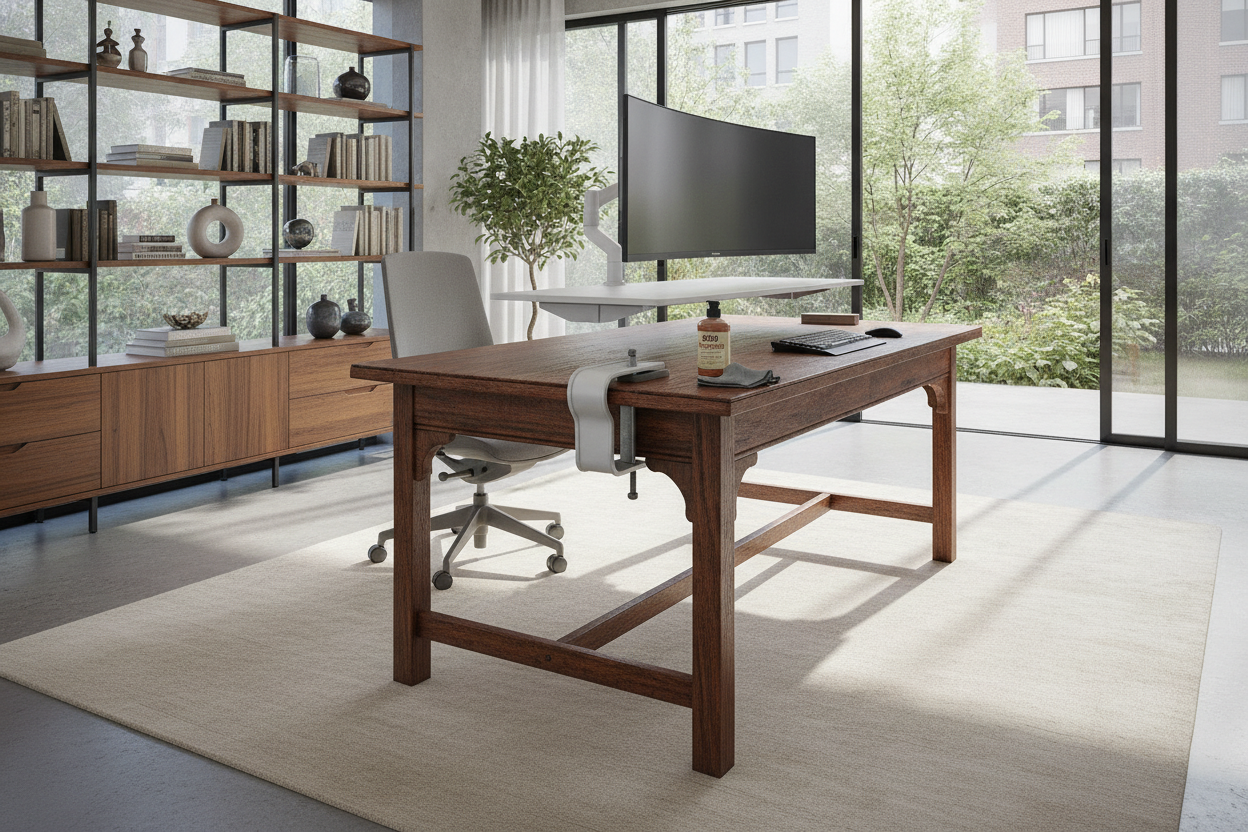
I spent three months scouring estate sales for the perfect mid-century teak table to serve as my workspace. When I finally found it, the wood grain was so beautiful I actually felt guilty putting a laptop on it. But after a few weeks of sitting for eight hours straight, my lower back started sending me some very aggressive feedback. I needed a clamp on standing desk, but the thought of tightening cold, industrial steel onto my 60-year-old heirloom felt like a betrayal.
- You don't have to sacrifice your room's aesthetic for ergonomics.
- Protective buffers like neoprene are non-negotiable for vintage wood.
- A standing desk clamp offers more surface area than a bulky riser.
- Wobble is inevitable but manageable if your base table is heavy enough.
The Dilemma: I Refuse to Buy Ugly Office Furniture
Most ergonomic gear looks like it was designed for a cubicle in a windowless office park. I’ve worked hard to curate a home that feels like a home, not a corporate satellite. Swapping out a traditional writing computer desk for a motorized frame with those generic T-shaped legs felt like giving up on my personal style. Those desks are functional, sure, but they have all the soul of a plastic printer tray.
The problem is that my vintage table is only 29 inches high. It’s great for dinner, but it’s a recipe for a slouching disaster during a long Zoom call. I needed the height, but I wasn't willing to move my beautiful teak piece into the guest room just to make space for a gray laminate monolith.
Enter the Clamp On Standing Desk (And My Initial Panic)
I eventually landed on a clamp-on converter. Unlike an adjustable standing tabletop desk that just sits on top and eats up every square inch of your workspace, the clamp-on style keeps the footprint small. It attaches to the back edge, leaving the rest of your table clear for your coffee, notebooks, and whatever else you hoard during the day.
But the anxiety was real. As I held the heavy metal bracket against the edge of the wood, I had visions of the grain splintering or the finish being crushed under the pressure. Most of these clamps are designed for cheap particle board, not delicate veneers. I spent a good twenty minutes just staring at the C-clamp before I dared to turn the knob.
How to Protect Your Wood Finish from the Clamp
If you are going to do this, do not trust the tiny foam pads that come in the box. They are usually about as thick as a piece of construction paper and will compress to nothing the second you apply real tension. I went to the hardware store and bought a small sheet of 1/8-inch neoprene and some heavy-duty felt furniture pads.
I cut the neoprene to fit the 'teeth' of the clamp perfectly. This creates a grippy, shock-absorbing layer that distributes the pressure. For the underside where the screw hits the wood, I used a wide felt pad. You want to tighten it just enough so the unit doesn't shift when you lean on it—don't go full-strength like you're trying to crush a walnut. I check the tension once a week to make sure it hasn't loosened or started to bite too deep.
The Wobble Test: Is It Actually Sturdy?
Let’s be honest: any time you extend a heavy monitor two feet above a table on a single metal pole, you’re going to get some movement. When I’m typing at a normal pace, it’s fine. If I’m in a flow state and hitting the keys like they owe me money, my monitor does a little rhythmic dance. It’s the trade-off for not having a four-legged motorized base.
The weight of your base table matters here. My teak table is solid wood and heavy, which acts as an anchor. If you try to put a heavy standing desk clamp on a flimsy flat-pack desk, the whole thing might tip over the moment you lean on the keyboard tray. It’s a physics game, and you want the heavy side to stay on the floor.
When You Should Probably Just Buy the Full Motorized Desk
I love my setup, but it’s a compromise. If you don’t already have a piece of furniture you’re obsessed with, don't put yourself through the stress of DIY protection. Honestly, if you're starting from scratch, an electric lift system standing desk is a much smoother experience. You get one-touch height memory and a much more stable surface for less effort.
But for those of us who would rather die than look at a gray metal leg in our living room, the clamp is a savior. It’s been six months, and I recently peeked under the neoprene. The wood is still perfect. No scars, no dents, and my lower back is finally on speaking terms with me again.
FAQ
Will a clamp-on desk work on a glass table?
Absolutely not. Don't even try it. The concentrated pressure of a C-clamp is the easiest way to shatter tempered glass into a million pieces. Stick to solid wood or high-quality plywood.
How much weight can these clamps actually hold?
Most are rated for about 25 to 35 pounds. That’s enough for a laptop, a monitor, and your arms, but don't try to sit on the keyboard tray. I keep mine to a single 27-inch monitor to minimize the shake.
Can I install this on a desk with a drawer?
Only if the drawer doesn't go all the way to the edge. You need at least 2-3 inches of 'lip' for the clamp to grab onto. If your desk has a decorative skirt or a flush drawer, the clamp won't have anything to bite.

Dejar un comentario
Este sitio está protegido por hCaptcha y se aplican la Política de privacidad de hCaptcha y los Términos del servicio.