










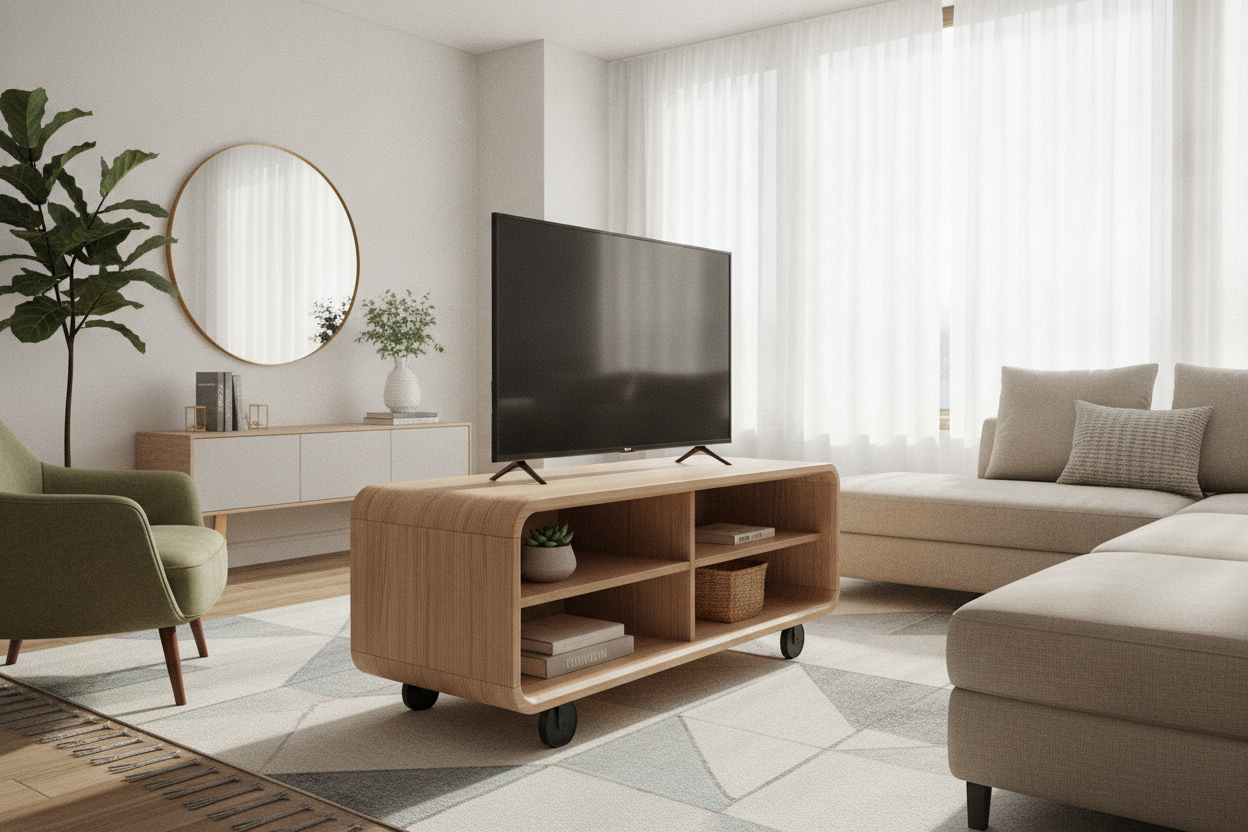
I used to spend my Sunday nights staring at my living room floor plan like it was a complex physics equation. My sofa was crammed against a radiator, and my favorite armchair was tucked into a dark corner, all because the television was anchored to the only 'big wall' with a cable jack. I was a slave to the floor plan. Then I bought a wheeled tv stand, and the room finally opened up.
Quick Takeaways
- Mobility breaks the 'one-wall' rule, allowing you to place furniture based on comfort, not screen location.
- Quality wood finishes prevent the piece from looking like a piece of office equipment.
- Cable management is the difference between a chic setup and a messy hazard.
- Rubberized casters are essential to protect hardwood floors from scratches.
The Tyranny of the 'TV Wall' (And Why I Rebelled)
Most living rooms are built around a single focal point. If you have a fireplace or a massive bay window, the TV usually competes for that spot. For years, I chose the TV. I blocked my natural light and forced a 12x15 room to feel like a narrow hallway just to keep the screen at eye level.
I finally realized that the screen didn't need to be a permanent architectural feature. By mounting my setup on a mobile base, I could push the TV into the corner when I had guests over or roll it in front of the window for a movie night. It felt like I’d suddenly gained ten square feet of usable space.
Yes, a Rolling Wood TV Stand Can Actually Look High-End
When most people hear 'mobile cart,' they think of those wobbly, gray metal towers from high school A/V clubs. But a rolling wood tv stand is a different beast entirely. It feels like furniture, not equipment.
I opted for a dark walnut finish that complemented my coffee table. When you invest in a solid wood TV stand, the natural grain and weight of the material ground the piece. It doesn't rattle when you move it, and it doesn't look like it belongs in a corporate boardroom. The wood adds a layer of 'home' to the tech.
Fighting Glare (and Winning) With a Wood Mobile TV Stand
My living room gets a brutal amount of western sun at 4:00 PM. In my old fixed setup, the glare was so bad I’d have to squint through an entire episode of whatever I was bingeing. I tried blackout curtains, but then I was just sitting in a dark cave on a sunny day.
With a wood mobile tv stand, I just give the unit a slight three-inch pivot. It takes two seconds. A wooden rolling tv stand gives you the flexibility to chase the best viewing angle without having to re-engineer your entire window treatment situation.
The Golden Rule of the Wooden Rolling TV Cart: Cable Management
The quickest way to make a wooden rolling tv cart look like a disaster is to have a 'tail' of five different wires dragging behind it. It’s a tripping hazard and it looks sloppy. I solved this by mounting a surge protector directly to the back of the rolling tv cart wood frame with heavy-duty adhesive strips.
Now, the TV, the soundbar, and the gaming console all plug into that single strip. Only one cord—the main power cable—actually leaves the stand. I use a braided cord sleeve to keep that one wire looking tidy. It makes the whole unit feel self-contained and intentional.
The Floor Factor: Do Casters Ruin Hardwoods?
This was my biggest fear. I have original oak floors, and the thought of plastic wheels digging grooves into the finish kept me up at night. The key is to skip the cheap, hard plastic wheels that come with budget kits. You want non-marking rubber or polyurethane casters.
If your floors are particularly soft—like pine or certain bamboos—you might be better off with stationary TV stands that sit on felt pads. But for most, a high-quality rubber wheel with a locking mechanism is perfectly safe. I’ve been rolling my 55-inch setup across my floors for a year and haven't seen a single scuff.
Frequently Asked Questions
Is a wheeled stand stable enough for a large TV?
As long as the base is wide and the weight capacity matches your screen, yes. Always check the specs—most solid wood units can easily handle 80 to 100 pounds. Just make sure to lock the wheels once you've found your spot.
How do I hide the wires if the stand is in the middle of the room?
Use a cable management box or mount a power strip to the back of the stand. This way, only one cord needs to run to the outlet, which you can cover with a low-profile floor cord protector if it's in a high-traffic area.
Can I add wheels to a regular TV stand?
I wouldn't recommend it unless the base is solid hardwood. MDF or particle board can't always handle the sheer force of casters being moved, and you risk the bottom 'blowing out' under the weight of the TV.

Leave a comment
This site is protected by hCaptcha and the hCaptcha Privacy Policy and Terms of Service apply.