










Armoires & Wardrobes




2-Year Warranty
Basic Warranty Terms
Products Covered: All furniture
Duration:
All furniture:2 years from date of delivery
Exception: The fabrics, seat cushions, leather covers, and LED lighting components are 1-year warranty and can be replaced at a minimal cost, provided the original warranty documentation is still available.
Accessory Warranty Terms: All purchased accessories are non‑refundable once ordered and delivered. We provide free re‑shipment replacement for any accessories damaged during transit. Accessories enjoy a 1‑year limited warranty commencing on the delivery date. This warranty does not cover defects resulting from improper installation, misuse, accidental damage, normal wear and tear, or unauthorized disassembly and modification.
Notice: This warranty policy is effective starting January 1, 2026, and applies exclusively to orders placed directly on the official FUFUGAGA website (fufugaga.com). Purchases from any third-party retailers, online marketplaces, or unauthorized resellers are not covered. The Warranty policy applies solely to the original purchaser from the official FUFUGAGA website.
*For more information, Warranty Policy .
Warranty Agreement and Restrictions
This limited warranty DOES NOT cover any loss and/or damage due to:
1. Improper Use.
2. Accident.
3. Neglect.
4. Acts of God. Relate to events outside human control, like flash floods, earthquakes, or other natural disasters.
5. Improper installation.
6. Improper maintenance and care. Using abrasive cleaners such as powders, bleach, ammonia, alcohol, or chlorine, or steel wool, or wire brushes.
7. Modification, or adjustment or repair.
8. Normal wear and tear from daily use.
Before You File a Warranty Claim
If you believe that you have a warranty claim, contact FUFUGAGA.com .
Email: customerservice@fufugaga.com
Hours:
Monday to Friday: 10a - 6p EST
Saturday to Sunday: 10a - 2p EST
Please be sure to provide all pertinent information regarding your claim, including a copy of your original order confirmation, confirm the item number & Qty of the defective item(s), a complete description of the problem, provide pictures or video evidence clearly showing the problem.
Product Details
Product Description
Details
Specs
Warranty
Reviews
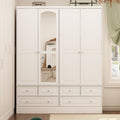
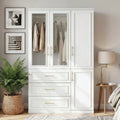
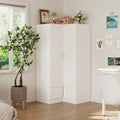
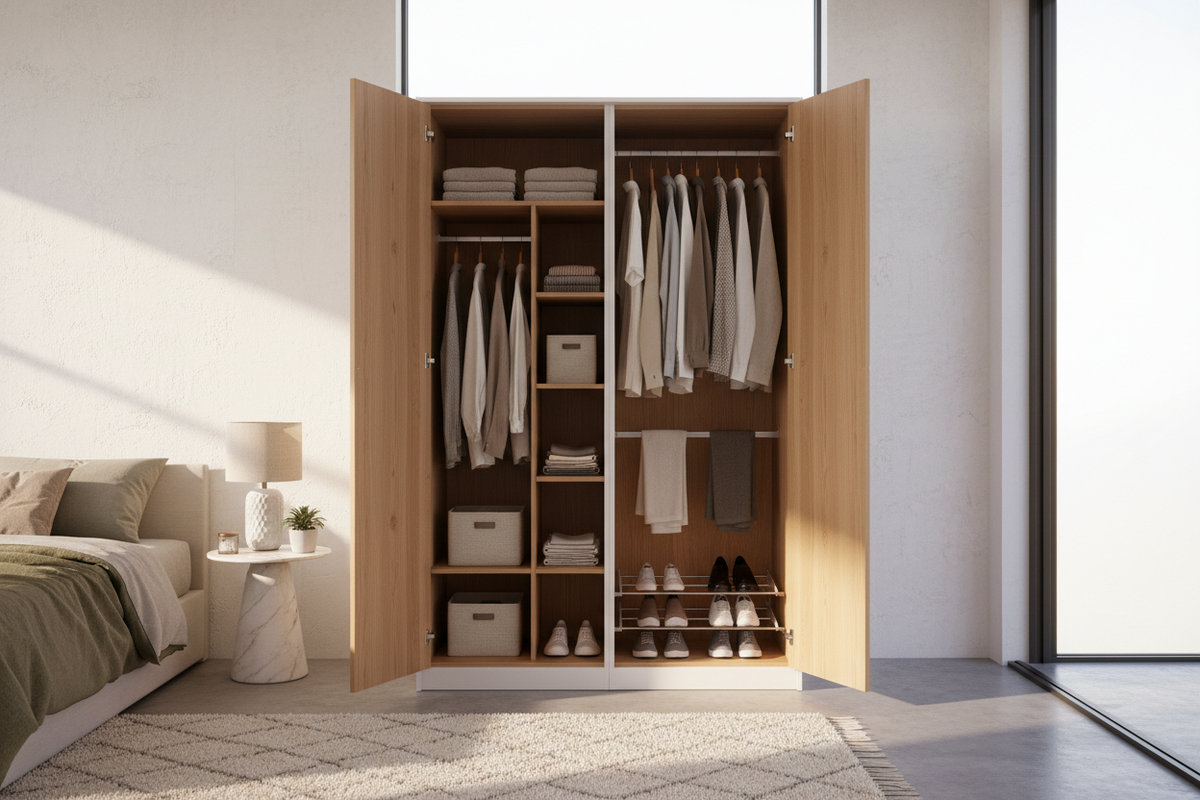
FUFU&GAGA armoires and wardrobes are freestanding closets for bedrooms, guest rooms and entryways, with a hanging rod, shelves and drawers behind closed doors. Most models stand about 71" to 75" tall and 19" to 20" deep, so the real decision is width: start with how much hanging space your clothes need, then choose the door style and finish that suit the room.
How to Choose an Armoire Wardrobe
Size: width first, then height and depth
Our wardrobes and armoires range from a 15.7" wide compact cabinet to a 129.9" wide multi-unit set. Use this table to match width to your storage needs and the bedroom space you have:
| Width | Typical layout | Best fit |
|---|---|---|
| 15.7"–35.6" | 2–4 doors, 1 hanging rod, shelves or 2–3 drawers | Small bedrooms, kids' rooms, entryways, extra closet space for one person |
| 47"–63.3" | 3–6 doors, 1–3 hanging rods, drawers | Primary bedrooms and shared storage |
| 66.9"–129.9" | Corner units and wardrobe sets, up to 10 doors | A full wall or an L-shaped corner that works like a closet |
Heights run from 63" to 94.5", with a median of 70.9". Tall versions with a top cabinet reach about 94", so measure your ceiling height first. Depth ranges from 11.8" on slim mirror cabinets to 35.4" on corner units; at the common 19"–20" depth, standard hangers fit without brushing the doors. Every model with a listed door type uses hinged doors, so leave room in front for the doors to swing open. For tape-measure details, see our wardrobe dimensions guide.
Inside: hanging rod, adjustable shelves and drawers
- Hanging space: one rod per 30"-wide section is typical, enough to hold shirts, jackets, dresses and suits. Most rods are rated about 30–35 lb, so check the listing before you load up heavy coats.
- Shelves: for folded clothes, sweaters, shoes, bags and baskets. Some models have adjustable shelves, so you can organize the interior around what you actually store.
- Drawers: many bedroom armoires add 2–6 drawers for socks, underwear, accessories and other everyday essentials, so you may not need a separate dresser.
Compact units are ideal for a kids' room or guest room, where they easily hold a week of outfits and other essentials. Beyond the bedroom, an armoire wardrobe is a practical, functional piece for an entryway (coats and shoes) or a home office (supplies and files behind closed doors).
Doors, LED lighting and finishes
- Mirrored doors: 15 models, including the Hylja series, have a full-length or central mirror, so you can check outfits without a separate dressing mirror.
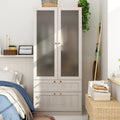
- Glass doors: the Skira series uses frosted glass to soften what's inside, while Rena glass-door armoires show off what you keep on display.
- LED lighting: 6 wardrobes have built-in lights that make dark corners easy to see.
- Materials and style: most are made of manufactured wood or solid plus manufactured wood. Some frames add metal or glass. Finishes include white, black, brown, beige and natural wood grain, with stylish fluted, slatted and rattan-panel designs to match your decor.
- Hardware: options range from gold-tone handles to solid wood and ceramic pulls.
Safety and Assembly
A tall armoire wardrobe filled with clothes is heavy; our models weigh from about 84 lb to 480 lb before you load them. 75 of the 77 models with full specifications include a tip-over restraint kit. Follow the U.S. Consumer Product Safety Commission's Anchor It! guidance and secure the unit to the wall, especially in homes with kids.
Wardrobes ship unassembled. Most listings suggest two people for assembly (a few large units suggest three) and basic tools such as a screwdriver. Assemble it in the room where it will stand, because a wide, fully built unit may not fit through a doorway.
Delivery, Returns and Warranty
Orders on fufugaga.com ship free to the 48 contiguous states and DC. Most in-stock orders leave our US warehouses within 48 hours and arrive in about 7–9 days. You also get 35-day returns on unused, unassembled items, a 2-year limited warranty, a 30-day price match and replacement parts if you ever need them.
More Help Choosing Wardrobes and Armoires
Not sure which type you need? Start with armoire vs. wardrobe: the key differences, see how to set up a bedroom with no closet, and learn how to organize a wardrobe once it's in place.
Armoires & Wardrobes FAQs
What is the difference between an armoire and a wardrobe?
Both are tall, freestanding cabinets for clothes. A wardrobe is built mainly for hanging, with a rod and a simple interior. An armoire traditionally mixes hanging space with shelves and drawers and often has more decorative doors, so it also works for linens or other household items. US retailers often use the two words interchangeably. Read our armoire vs. wardrobe guide for the full comparison.
What is a wardrobe with drawers called?
In the US, a wardrobe with drawers is usually sold as an armoire or a "wardrobe armoire." A piece with a hanging section on one side and a stack of drawers on the other is traditionally called a chifforobe, a blend of "chiffonier" and "wardrobe" used mostly in the South. Many FUFU&GAGA models combine a hanging rod with 2 to 6 drawers.
What size armoire wardrobe do I need for a bedroom?
Plan on about 30" of rod width per hanging section. For one person, a 31.5" to 47" wide unit usually covers daily clothes; couples and full closet replacements are better served by 59" to 63" or two matching units. Most of our models are 70.9" to 74.9" tall and about 19" to 20" deep. Check your ceiling height and door-swing clearance using our wardrobe dimensions guide.
Do armoires and wardrobes need to be anchored to the wall?
Yes. Tall clothing storage furniture can tip forward when doors and drawers are open or a child climbs it, and the CPSC recommends anchoring all furniture with drawers, doors or shelves. Nearly every FUFU&GAGA armoire includes a tip-over restraint kit. Attach it to a wall stud or use anchors suited to your wall type.
How are armoires delivered, and how hard is assembly?
Wardrobes arrive unassembled at your front door, with free shipping to the 48 contiguous states and DC. Most in-stock orders ship within 48 hours and arrive in about 7 to 9 days. Most models suggest two people and basic tools; the largest units suggest three. Assemble the wardrobe in the room where it will stand, since a finished unit may not fit through doorways.
Are armoires coming back in style?
Armoires never fully went away, and they're popular in apartments, older homes and rooms without built-in closets, where a freestanding closet adds storage without renovation. Current designs lean modern: white and wood-grain finishes, frosted or clear glass doors, full-length mirrors and LED lighting. Because they're freestanding, you can move them to a different room as your needs change.
Is it cheaper to buy or build a wardrobe?
For most people, buying a freestanding wardrobe costs less and is faster than building a custom built-in, which needs materials, carpentry and finishing. FUFU&GAGA armoires and wardrobes span compact two-door units to large multi-door sets, and even the largest typically cost a fraction of a custom built-in. A built-in can make sense if you own the home and want floor-to-ceiling storage that fits an unusual space.
Can I return an armoire if it doesn't fit?
Yes. Items bought on fufugaga.com can be returned within 35 days if they're unused, unassembled and in their original packaging. Shipping or processing fees may apply to change-of-mind returns, and damaged or defective items reported within 14 days are handled at no cost. To avoid a return, measure the wall, ceiling height and door clearance before you order.
Armoires & Wardrobes Guides & Ideas
Running Out of Closet Space? Freestanding Wardrobe vs Built-In Closets
A freestanding wardrobe beats a custom built-in when you rent, plan to move or need storage fast. Compare cost drivers, sizes, rod heights, doors and tip-over safety, plus five picks.

Armoire vs Wardrobe: Key Differences and Which to Choose
A wardrobe is built mainly for hanging clothes; an armoire mixes hanging space with shelves and drawers. Here's how they differ and which one fits your room.

Wardrobe Dimensions: Standard Sizes, Depth and Clearance Guide
Most freestanding wardrobes are 70" to 75" tall and 19" to 24" deep. Learn standard widths, hanging depth, door clearance and how to measure your room.

Bedroom With No Closet? How to Use an Armoire or Wardrobe Instead
No closet? A freestanding wardrobe or armoire is the closest thing to a built-in. Here's how to size it, choose the interior and plan the layout.

How to Organize a Wardrobe: Rods, Shelves, Drawers and the 70/30 Rule
Edit first, then give every category a zone: hang what wrinkles, fold what stretches, drawers for small items. Plus the 70/30 rule explained.