










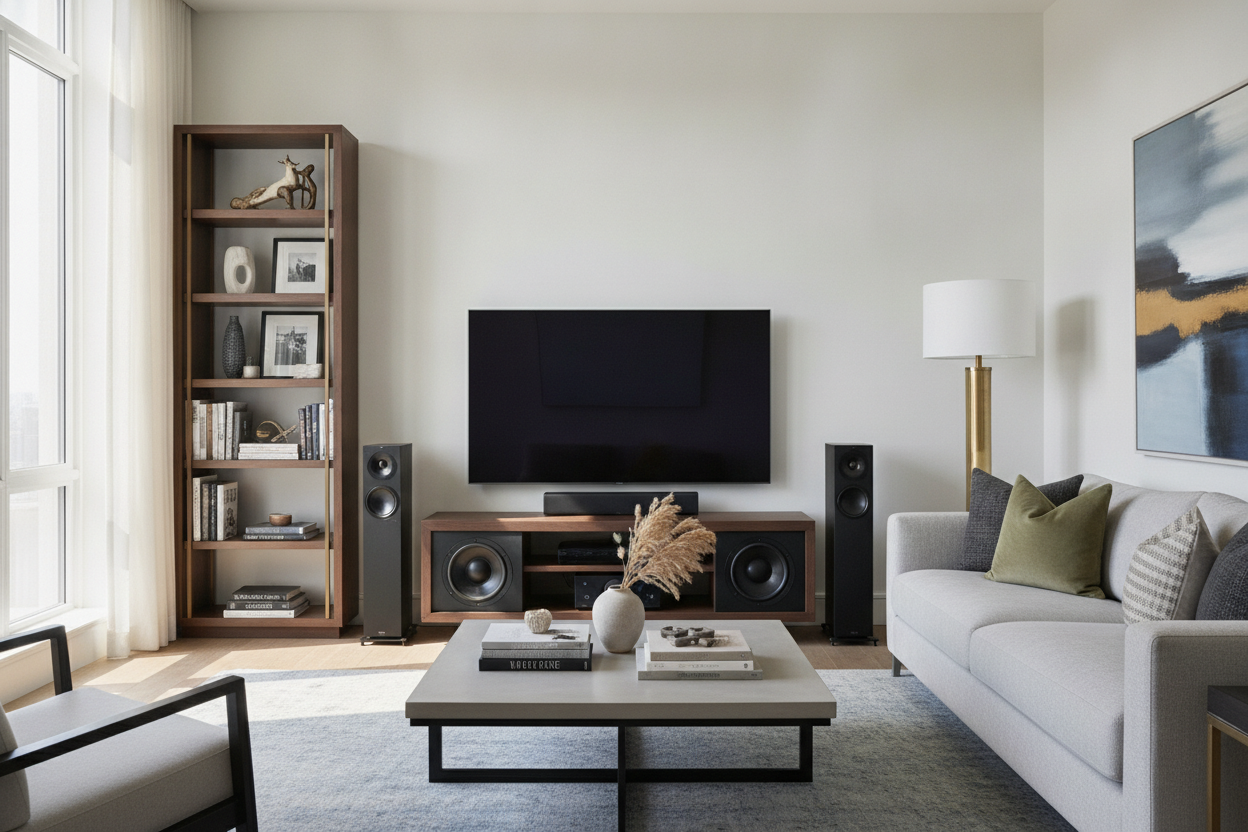
I spent three weeks staring at a tangle of HDMI cables and a 45-pound Denon receiver sitting on a moving box because I couldn't find a piece of furniture that didn't look like a black plastic coffin. It is the classic interior design standoff: you want the 4K Dolby Atmos glory, but you also don't want your living room to look like a 2004 RadioShack. Finding a tv stand home theater setup that balances aesthetics with actual technical requirements is harder than it should be.
- Depth matters: Most standard credenzas are 16 inches deep; a real receiver needs 18-20 inches plus room for cable bends.
- Airflow is life: If your cabinet doesn't breathe, your $1,000 amp will cook itself in six months.
- Center channel placement: Your most important speaker needs to be at ear level and unobstructed.
- Cable management: Look for internal channels, not just one measly hole in the backboard.
The Ugly Truth About Serious Audio Equipment
Let’s be real: most modern furniture is designed for a thin OLED screen and maybe a sleek soundbar. But if you are building an actual entertainment center for home theater, you aren't using a soundbar. You have a massive AV receiver that generates enough heat to warm a small apartment and a center-channel speaker the size of a microwave. Most standard 'media units' from big-box retailers are made of flimsy MDF with a depth of maybe 15 inches. Try stuffing a high-end Marantz in there and you'll have two inches of receiver hanging off the back like a bad haircut.
You need a dedicated home theater media cabinet that respects the dimensions of real gear. We are talking about internal shelves that can support 50+ pounds without bowing and a footprint that actually accommodates the depth of your equipment plus the rigid HDMI cables sticking out the back. I’ve seen too many people buy a gorgeous mid-century sideboard only to realize they have to leave the back panel off entirely just to get the doors to close. It’s not just about space; it’s about structural integrity and the realization that a home theater entertainment center has a job to do beyond just looking pretty.
Ventilation is Non-Negotiable (Don't Fry Your Gear)
The fastest way to kill a high-end receiver is to seal it inside a beautiful, airtight wooden box. These machines are essentially small computers that run hot—very hot. When you are scouting for home theater stands, you have to look for airflow solutions. This usually means slatted doors (often called 'louvered' doors) or perforated metal fronts. These allow the IR remote signals to pass through while letting hot air escape. If you fall in love with a solid-door unit, you better be prepared to install aftermarket cooling fans in the back panel.
I learned this the hard way after my last receiver started thermal-throttling during the climax of an action movie. I realized Your Receiver Is Too Deep (Why You Need a Home Theater Audio Cabinet) and too hot for the standard cabinet I’d shoved it into. A proper home theater media console will have ventilated shelves or at least enough clearance around the top of the unit for heat to dissipate. Don't let the 'clean look' of a solid wood cabinet fool you into a $600 repair bill. Look for designs that prioritize passive cooling through the bottom and out the back.
Taming the Spaghetti Monster Behind Your Screen
The back of a home theater console is usually a disaster zone of HDMI cords, speaker wires, and power strips. Cheap furniture usually gives you one tiny circular cutout in the center of the backboard. That is a joke. If you have a 7.1 system, you have at least 14 individual speaker wire leads, plus multiple HDMI inputs, an ethernet cable, and power. You need a home theater console table that features wide, horizontal cutouts or, better yet, a removable back panel.
My current setup uses a series of Velcro ties and internal cable channels built into the frame of the stand. This keeps the 'spaghetti monster' from peeking out the bottom of the unit. When you're shopping, check if the internal shelves have 'dog-ear' corners—small gaps at the back of the shelf that allow you to run wires between compartments without coming out the back of the unit. It sounds like a small detail, but it’s the difference between a professional-looking install and a messy heap of plastic wires visible from your sofa.
Blending the Cinema Vibe with Your Actual Decor
You don't want your living room to feel like a showroom. The goal is to integrate a tv stand with home theatre capabilities into your life, not build a shrine to electronics. I like to soften the 'tech' look by using the top of the console for more than just the TV. If your TV is wall-mounted above the stand, use the surface for a stack of coffee table books or a ceramic tray. This breaks up the long, flat plane of the furniture and makes it feel like part of the room's architecture.
If you're really struggling with the 'big black box' look of the speakers, consider a unit with acoustic fabric door inserts. They hide the gear completely but let the sound pass through perfectly. For those who still find the whole setup too industrial, I Refused a 'Home Theater' Vibe: Why I Bought a TV Stand With Bookshelves to blend the tech with a library feel. Adding a few organic shapes—like a trailing plant or a textured vase—next to a sharp-edged receiver goes a long way in making the space feel lived-in rather than just 'installed.'
Finding Room for the Non-Tech Stuff
A home theater media console shouldn't just be a rack for electronics; it needs to function as actual furniture. In my house, that means it also has to hold the overflow of board games, a few vinyl records, and the inevitable collection of remote controls. You want a mix of open and closed storage. Use the ventilated sections for the gear that gets hot, and use the solid drawers or cabinets for the stuff that just looks like clutter.
I’ve found that pieces like the 47 2W Sideboard With 4 Glass Door Large Capacity Cabinet Home Storage are great for the 'extra' stuff. While you wouldn't put a hot receiver behind glass without fans, it’s a perfect spot for your physical media collection or gaming controllers where you can see them but they aren't gathering dust. A good home theater setup is ultimately about balance—giving your tech the space it needs to perform while giving your living room the style it needs to be a place you actually want to hang out in.
Is a soundbar better than a full home theater stand?
A soundbar is easier, sure, but it can't touch the soundstage of separate speakers. If you care about audio, you need a stand that can house a real center channel and a receiver. Soundbars are for bedrooms; real theater setups are for the living room.
How much space should I leave above my receiver?
At least two to three inches. If you jam a receiver into a shelf with only a quarter-inch of clearance, you are begging for a hardware failure. Heat rises, and it needs somewhere to go.
Can I put my subwoofer inside the TV stand?
Generally, no. Subwoofers vibrate, and putting one inside a wooden cabinet will usually result in annoying rattles and muddy bass. Keep the sub on the floor, ideally in a corner or next to the stand.


Leave a comment
This site is protected by hCaptcha and the hCaptcha Privacy Policy and Terms of Service apply.