










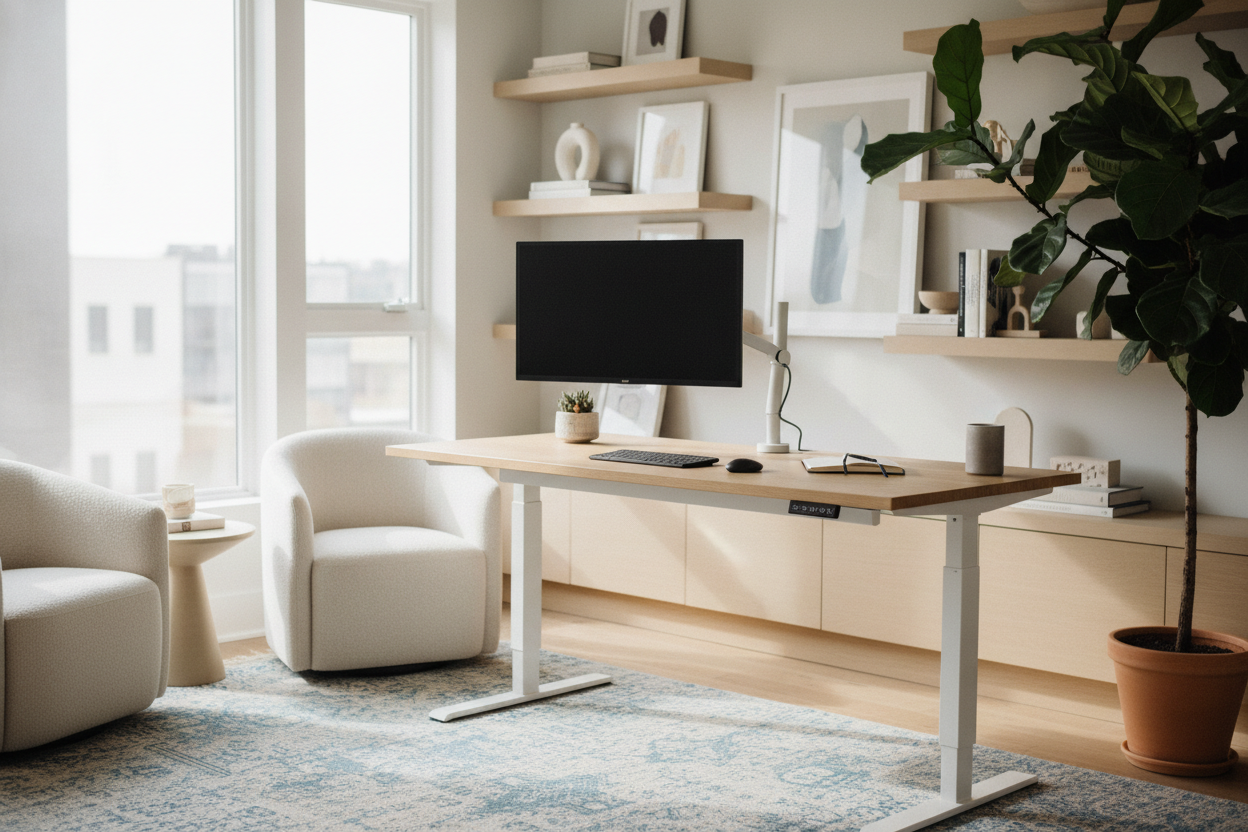
My living room used to be my sanctuary—a place of velvet pillows, warm lighting, and a total lack of productivity. Then 2020 happened, and suddenly my 800-square-foot apartment had to function as a corporate headquarters. I resisted buying a modern standing desk for a year because I didn’t want my living space to look like a soul-crushing cubicle farm. I tried the dining table (my back hated it) and the sofa (my neck hated it), before finally admitting I needed a real workstation.
The problem is that most office furniture is designed for commercial spaces where aesthetics go to die. When you drop a contemporary standing desk into a room filled with curated mid-century pieces, it sticks out like a sore thumb. I spent three months researching and two weekends of trial and error to figure out how to hide a motorized desk in plain sight. It is possible, but you have to break a few traditional office rules to make it work.
The Problem With Putting Office Furniture in Your Living Space
Most standing desk modern designs are built with utility as the only priority. You get cold steel legs, a plastic-looking laminate top, and those hideous black plastic grommets for cables. In a bedroom or a dedicated office, that’s fine. In your living room, it’s a visual disaster. The clash happens because your living room is full of soft textures, organic shapes, and warm wood tones, while most desks are all hard angles and industrial finishes.
I’ve seen people try to 'soften' the look by throwing a tablecloth over their desk, which just makes it look like a ghost is haunting your living room. The real trick isn't hiding the desk itself, but choosing one that shares the same design language as your coffee table or sideboard. You don't need to settle for a basic aesthetic just because you bought from a big box store; you can style your modern office desk using higher-end accessories and thoughtful placement to make it look intentional rather than temporary.
The biggest mistake I made initially was thinking I could just tuck it into a corner and it would disappear. It didn’t. It just looked like a piece of furniture that was being punished. To make a modern adjustable desk work in a shared space, you have to treat it like a piece of 'real' furniture, not just a tool you use for eight hours a day.
Rule 1: Stop Pushing It Against a Blank Wall
Our instinct is always to shove desks into corners or flat against a wall. This is a mistake in an open-concept living room. When a desk is pushed against a wall, it screams 'office.' Instead, I tried floating mine. I placed my modern adjustable desk directly behind my sofa, facing into the room. It essentially acts as a sofa table when it’s lowered to sitting height.
Floating the desk does two things. First, it allows you to look at the rest of your room (and maybe the TV) while you work, rather than staring at a blank piece of drywall. Second, it creates a physical zone for work without needing a wall to define it. If you have a large rug, make sure at least the front two legs of the desk are on the rug to anchor it to the rest of the seating arrangement.
If floating isn’t an option because of your floor plan, try anchoring it to a bookshelf. I once styled a client’s studio where we tucked a modern sit stand desk between two tall IKEA Billy bookcases. By surrounding the desk with books, plants, and art, the desk felt like a built-in feature of the library rather than a stray piece of tech. It’s all about context—if it looks like it belongs there, your brain stops seeing it as 'work.'
Rule 2: Your Cords Are Ruining the Illusion
Nothing kills a living room vibe faster than a 'black hole' of tangled power strips and USB cables. If you have a stand up workstation for desk use in your main area, cord management isn't optional; it's a requirement. Most people let their cables dangle from the back of the desk, creating a literal waterfall of electronic mess. It looks chaotic and messy.
I solved this by using a cable spine that matches the color of my desk legs. Every single wire—monitor power, laptop charger, desk motor—is routed into this one tube. For the power strip itself, don't just leave it on the floor. I mounted mine to the underside of the desk using heavy-duty command strips. Now, there is only one single cord running from the desk to the wall outlet. When the desk moves up and down, that one cord is the only thing that moves.
If you want to go a step further, hide that wall outlet behind a decorative woven basket or a large floor plant. When my desk is at sitting height, it looks just as clean as a traditional writing computer desk. You’d never know there’s a dual-motor system and a docking station hidden underneath. It took me about two hours of fussy cable-tying to get it right, but it was the single most impactful thing I did to save my living room’s aesthetic.
Rule 3: Pick a Top That Actually Matches Your Coffee Table
Material selection is where most people fail. If your living room is anchored by a beautiful walnut coffee table and oak floors, do not buy a white laminate modern office standing desk. The contrast will be jarring. I recommend choosing a solid wood top or a high-quality veneer that matches the dominant wood tone in your room. If you can’t match it exactly, go for a deliberate contrast—like a matte black top if you have a lot of industrial metal accents.
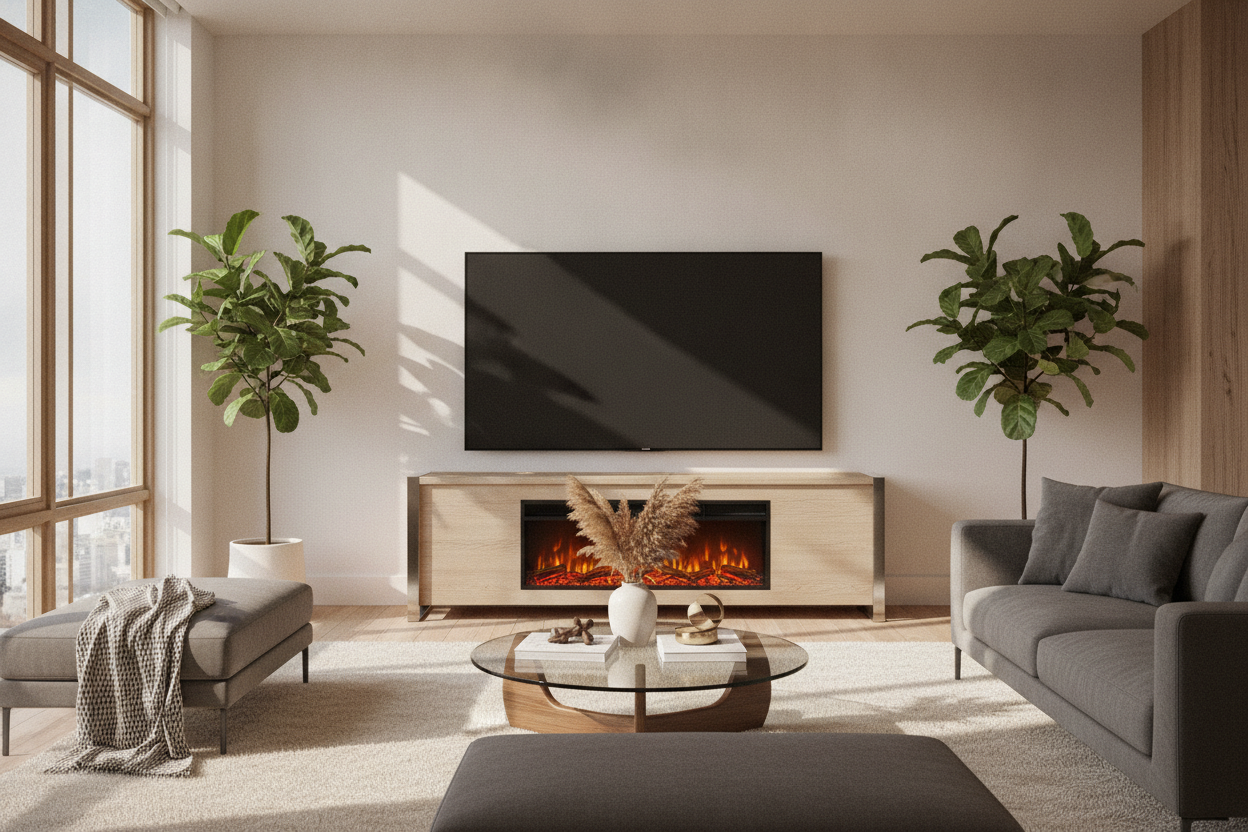
I personally went with a natural birch finish because it echoed the light tones of my media console. This creates a visual bridge between the 'work zone' and the 'relax zone.' If you’re struggling to figure out which finishes play well together, checking out a desk and storage combination guide can help you see how different textures interact. I’ve found that matte finishes always look more expensive and 'residential' than glossy ones, which tend to look like a high school computer lab.
Don't forget the chair, either. A giant ergonomic mesh 'gaming' chair is a living room killer. I use a high-end task chair with a fabric finish that looks like a standard dining chair from the back. It’s about compromise: I get the lumbar support I need, but I don't have to look at a neon-streaked racing seat every time I sit down for dinner.
The Setup I Actually Use (And How I Hide My Gear)
After testing four different setups, I finally landed on the Modern Electric Height Adjustable Desk With Dual Storage Modules And Pegboard Organizer. The reason this worked when others didn't was the built-in storage. Most modern adjustable standing desk models are just a flat surface, which means your pens, notebooks, and hard drives end up cluttering the top of the desk. In a living room, that clutter is visible from every angle.
This specific modern adjustable height desk has modules that hide the 'office' stuff. At 5 PM, I put my laptop in the drawer, hang my headphones on the side pegboard, and clear the surface completely. When it’s cleared off, it looks like a sleek console table. I even put a small table lamp and a ceramic vase on it in the evenings. The only downside? This thing is heavy. It’s built with serious steel, so don't plan on moving it around once you find a spot for it.
My biggest mistake was initially buying a desk that was too small (48 inches). I thought a smaller footprint would be less noticeable. In reality, it just looked cramped and messy because I had no room to actually work. Upgrading to a 55-inch model with integrated storage actually made the room look *cleaner* because everything had a home. It’s a bit of a paradox: sometimes a larger piece of furniture that functions well looks better than a small piece that creates clutter.
FAQ
Is a standing desk too loud for a living room?
Not if you buy one with a dual-motor system. Cheap single-motor desks sound like a coffee grinder and can be heard from the next room. High-quality motors are a low hum that won't even wake up a sleeping cat on the sofa next to you.
Can I put a standing desk on a rug?
Yes, but avoid high-pile shag rugs. The desk needs a stable, level surface to prevent wobbling when it’s at full height. A low-pile rug or a hard floor is best. If you must use a thick rug, consider using furniture cups under the legs to keep it from sinking unevenly.
Will a standing desk damage my hardwood floors?
Most come with leveling glides that are plastic or rubber, which are safe. However, because these desks are heavy (especially the motorized ones), I always recommend sticking felt pads to the bottom of the feet. It makes it easier to micro-adjust the position without scratching the finish on your floors.

Leave a comment
This site is protected by hCaptcha and the hCaptcha Privacy Policy and Terms of Service apply.