










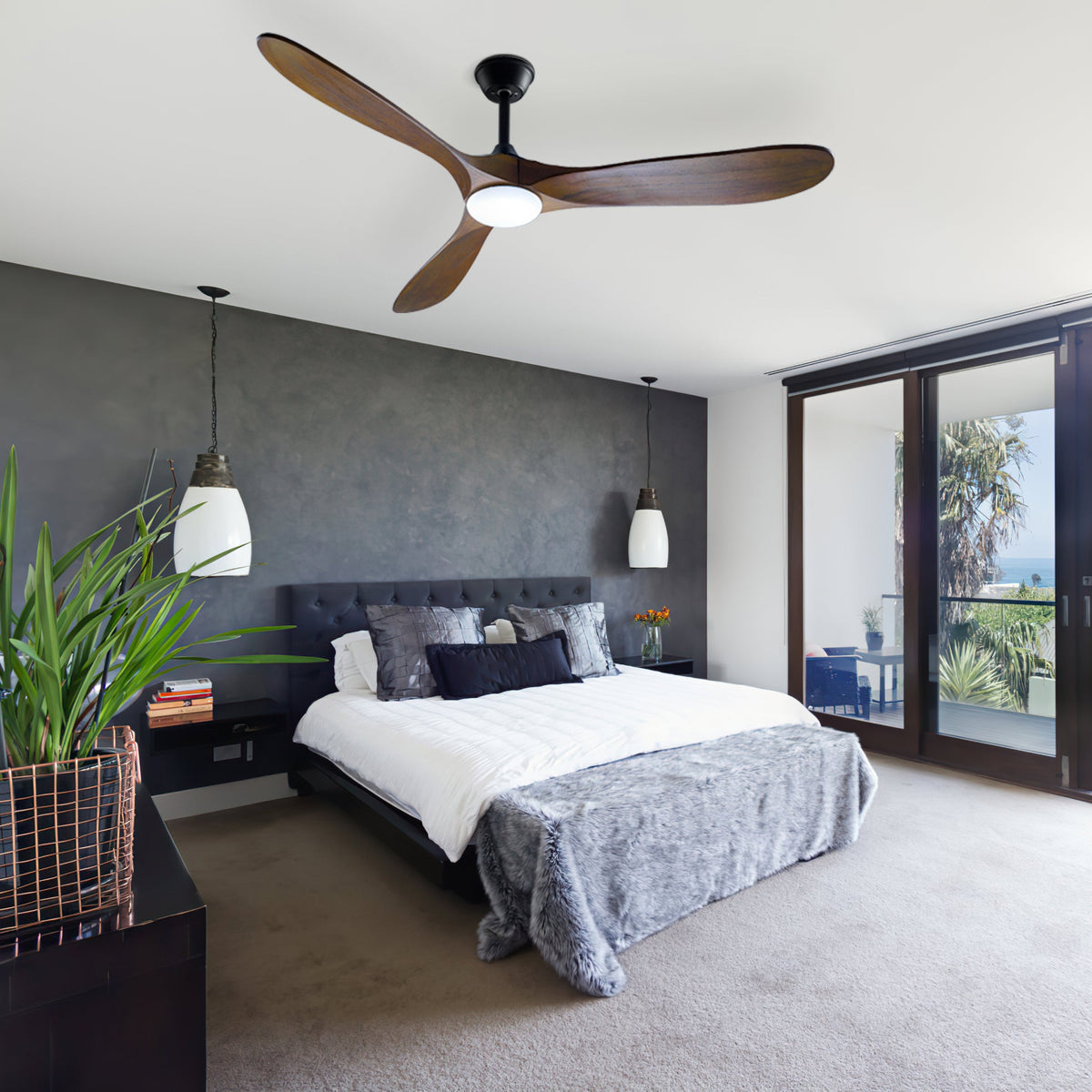
To find what size ceiling fan you need, measure the room's floor area and match it to blade span. ENERGY STAR suggests 29 to 36 inches for rooms up to 75 square feet, 36 to 42 inches for 76 to 144 square feet, 44 inches for 144 to 225 square feet, and 50 to 54 inches for 225 to 400 square feet. Its chart stops there; This Old House puts rooms over 400 square feet at 60 inches or larger, or suggests more than one fan.
Then hang the fan at least 7 feet above the floor, with the blades 18 inches or more from the walls. This ceiling fan size guide covers size, height, airflow, motors, lights, outdoor ratings and the electrical box, and ends with five picks from the FUFU&GAGA ceiling fan collection.
Key takeaways
- Room size: multiply length by width. A 12 x 12 ft bedroom is 144 sq ft, the top of the 36 to 42 inch row.
- Height: the fan at least 7 ft above the floor, ideally 8 to 9 ft, with blades at least 8 inches below the ceiling.
- Walls: 18 inches from blade tips to any wall, so the room must be at least blade span plus 36 inches wide.
- Location rating: damp rated for bathrooms, wet rated for a patio or front porch.
- Box: hang it only from an electrical box listed for ceiling fans, installed by a licensed electrician.
What size ceiling fan do I need? Fan size by room size
Ceiling fan size means blade span, the diameter of the circle the blade tips sweep. ENERGY STAR says spans range from 29 to 54 inches, with 52 inches the most popular. The table combines its chart, which cites the American Lighting Association, with two other guides; they differ slightly in the middle row.
| Room area | Example rooms | ENERGY STAR fan size | Other sources |
|---|---|---|---|
| Up to 75 sq ft | Laundry rooms, 7 x 10 ft (70 sq ft) | 29 to 36 in | Same |
| 76 to 144 sq ft | 10 x 12 ft (120), 12 x 12 ft (144) | 36 to 42 in | Same |
| 144 to 225 sq ft | 12 x 15 ft (180), 15 x 15 ft (225) | 44 in | 44 to 50 in (This Old House); 50 to 54 in around 225 sq ft (UF/IFAS) |
| 225 to 400 sq ft | 15 x 20 ft (300), 20 x 20 ft (400) | 50 to 54 in | Same |
| Over 400 sq ft | 20 x 24 ft (480), great rooms | Not covered | 60 in or larger, or several fans (This Old House) |
Sources: ENERGY STAR ceiling fan basics, the University of Florida IFAS Extension fact sheet on ceiling fans and This Old House.
Quick answers: is it the right size?
- 42 or 52 inch? A 42-inch fan fits 76 to 144 sq ft; a 52-inch fan fits 225 to 400 sq ft.
- Is a 52 inch fan too big for a 12 x 12 room? By these charts, yes: 144 sq ft calls for 36 to 42 inches, 44 at most.
- What size fan for a 20 x 20 room? That is 400 sq ft, the top of the 50 to 54 inch row.
- Is a 60 inch fan too big for a living room? Not in a living room over about 400 sq ft; it is too big for a 12 x 15 ft room.
To measure a fan, go tip to opposite tip. On a three-blade fan, measure from the center to one tip and double it.
Ceiling height: how high to hang a fan and the right downrod length
ENERGY STAR says to mount a ceiling fan in the middle of the room, at least 7 feet above the floor, and 8 to 9 feet above the floor for optimal airflow if the ceiling height allows. The UF/IFAS fact sheet, citing the U.S. Department of Energy, adds that blades should be at least 8 inches from the ceiling.
A downrod is the pipe between the ceiling bracket and the motor. Standard mounts include a 3 to 5 inch downrod, and ENERGY STAR lists longer ones from 6 inches for a 9 ft ceiling to 120 inches for a 20 ft ceiling. The table subtracts the target fan height from the ceiling height:
| Ceiling height | Target fan height | Space above the fan | What it means |
|---|---|---|---|
| 7 ft | 7 ft minimum | 0 in | Too low: no fan can meet the 7 ft rule |
| 8 ft | 7 ft minimum | 8 to 12 in | Flush mount or hugger fan |
| 9 ft | 8 ft | About 12 in | Standard mount or 6 inch downrod |
| 10 ft | 8 to 9 ft | 12 to 24 in | Longer downrod |
| 12 ft | 8 to 9 ft | 36 to 48 in | Extended downrod |
For the right downrod length, subtract the fan's own mount-to-blade height (in its manual) from the third column. ENERGY STAR calls a fan with blades 10 inches or less from the ceiling a hugger (also sold as low profile fans), says huggers suit ceilings under 8 feet, and notes they do not move as much air. A light kit hangs lower, so count it too.
Sloped or vaulted ceilings need a sloped mount, and This Old House says to keep fans at least 18 inches from walls or sloped ceilings. Check that the listing says sloped-ceiling compatible.
How far should a ceiling fan be from the walls?
ENERGY STAR and UF/IFAS both give at least 18 inches from the blade tips to any wall. So the room must be at least blade span plus 36 inches wide: 96 inches (8 feet) for a 60-inch fan, 77 inches (about 6.4 feet) for a 41-inch fan. For long rooms and open spaces, This Old House suggests several smaller fans along the room instead of one large fan.
Airflow: CFM and CFM per watt
CFM is cubic feet of air moved per minute. CFM per watt measures airflow efficiency, and the higher the number, the more efficient the fan, per UF/IFAS. ENERGY STAR's key product criteria rate efficiency as a weighted CFM/W across several speeds and standby; for a standard fan between 36 and 78 inches the minimum is 2.63 x D - 26.83, so about 131 CFM/W for a 60-inch fan (2.63 x 60 - 26.83).
Listing airflow numbers are the seller's figures, not an ENERGY STAR test, and none of our fans claims ENERGY STAR certification. Compare listed CFM between fans of the same size. More blades do not necessarily move more air: UF/IFAS says pitch, blade length, motor design and speed all matter.
DC vs AC motors
Conventional ceiling fans use AC induction motors. The Appliance Standards Awareness Project notes that the most efficient fans use brushless DC motors, which can cut power consumption in half, compared with about 10% for an improved induction motor. Every pick below has a reversible DC motor with five or six fan speed settings and a remote. Check the manual before planning a wall control for a DC fan.
Fan direction in summer and winter
ENERGY STAR says to run the fan counterclockwise in summer, so you feel cool air and a wind-chill effect. In winter, reverse the motor and run it clockwise at low speed; the gentle updraft forces warm air near the ceiling down into the room. A fan does not lower the room temperature, but UF/IFAS says you can usually raise the thermostat by up to 4 degrees Fahrenheit with no loss of comfort. Fans cool people, not rooms, so turn the fan off when nobody is there to use less energy.
Lights, pull chains, remote controls and wall controls
ENERGY STAR's page on ceiling fan accessories says a light kit can be integrated, included or sold separately. Standard controls are pull chains on the housing (two with a light) and a reversing switch; remote controls and wall controls are the alternatives. A conventional dimmer switch can make a fan motor hum, and for a fan with a light, choose a control that runs each function separately.
"Smart" varies by listing. Among our picks, one fan uses an iOS and Android app, one accepts a smart receiver sold separately, and the rest use a remote with a timer. If you want voice control, look for it in the listing.
Outdoor use: damp rated vs wet rated fans
Yes, outdoor spots need a rated fan. ENERGY STAR says to buy a damp rated fan (UL listed with a damp rating) for a bathroom or other humid location, and a UL wet rating where the fan may come in direct contact with water, such as a patio or front porch. These fans use sealed or moisture-resistant motors, rust-resistant housings, stainless steel hardware and all-weather blades.
Every fan in our current range lists a dry location rating or none, so none of them is for outdoor areas, covered patios or bathrooms. Choose a fan whose listing states a damp or wet rating.
Installation: the fan-rated electrical box
ENERGY STAR's installation and usage tips say to use a UL-listed metal box marked "For Use With Ceiling Fans," that replacing a ceiling fixture will most likely mean replacing the box, and that the fan should be anchored to a ceiling joist if possible. Ceiling fans can weigh as much as 50 pounds.
An EC&M Code Q&A on the 2017 NEC summarizes section 314.27(C): the box must be listed and marked for a ceiling fan, a box for a fan over 35 lb must be marked with its maximum weight, and a fan over 70 lb needs support independent of the box. Our picks weigh 12 to 21.38 lb.
If an installed fan wobbles, ENERGY STAR says to check that all connections are tight, then use a balancing kit. Installing one is overhead electrical work, not a casual DIY job. Hire a licensed electrician to replace or add a box, run wiring, add a switch or a circuit, and follow the manual and local code.
Ceiling fan buying checklist
- Work out square footage and pick the blade span from the size table.
- Confirm the room is at least blade span plus 36 inches wide.
- Confirm the proper height: at least 7 ft above the floor, with blades 8 inches or more below the ceiling.
- Work out the downrod length and check what the fan includes.
- For a sloped ceiling, confirm sloped-ceiling compatibility in the listing.
- For a bathroom, patio or porch, confirm a damp or wet rating.
- Choose a light, remote, app or wall control.
- Confirm a fan-rated box and book a licensed electrician.
Our picks
Five fans from the FUFU&GAGA range, each with a reversible DC motor and a remote. Room sizes use the table above, and facts come from each listing.
59.8" three-blade ceiling fan with dimmable LED light
The all-rounder: a 59.8-inch span, three walnut-finish wood blades and an integrated LED that dims and switches between three colors. The listing gives a 38 W DC motor, six speeds, three timer settings and up to 7,680 CFM at an airflow efficiency of 202. It includes 5.9 and 9.84 inch downrods and weighs 13.5 lb.
Best for: a living room or large bedroom over about 400 sq ft that needs a fan and its main light.
Skip it if: the room is under about 225 sq ft, you want app control, or it is for a porch (it is dry rated). The LED cannot be replaced by the user.
60" three-blade ceiling fan without light
Three solid wood blades in a walnut finish, a 59.8-inch span and a 13 degree pitch. The listing gives six speeds, a remote with a timer, a downrod, ETL and UL listing, 15 lb, and a 17.7 inch body height. A smart receiver, sold separately, adds phone control.
Best for: a large room that already has overhead lighting.
Skip it if: you need a light, or your ceiling is 8 feet: with a 17.7 inch body, its lowest point would hang about 78 inches above the floor (96 - 17.7 = 78.3).

65" eight-blade ceiling fan
The largest in the range: a 65-inch span with eight removable solid wood blades, black on one side and woodgrain on the other. The listing gives up to 9,500 CFM at an airflow efficiency of 190, five speeds, a remote with a timer, ETL listing, a 17.7 inch body height and 21.38 lb.
Best for: great rooms and open plans well over 400 sq ft with 9-foot or higher ceilings.
Skip it if: the room is under 400 sq ft, you need a light, or it is for a covered patio: the listing gives no location rating.
59.8" black propeller ceiling fan
A modern, all-black look: three solid walnut blades finished in black, a 59.8-inch span and a 13 degree pitch. The listing gives up to 4,640 CFM, six speeds, a remote that also reverses direction, a 7.9 inch downrod, adjustable hanging length, ETL listing and 15 lb.
Best for: a large living room or bedroom that wants a black fan with no light.
Skip it if: you want it outdoors. Its product name says outdoor, but the specs list a dry location rating, so treat it as an indoor fan. It also has the lowest listed airflow of the 60-inch picks.

41" smart ceiling fan with app control and dimmable LED
The pick for smaller rooms: 41 inches, three solid wood blades and a 22 W integrated LED that dims and tunes from warm to cool white. It runs from the remote or a Bluetooth app on iOS and Android. The listing gives six speeds, up to 170 RPM, 110 V and 12 lb.
Best for: bedrooms and home offices of 76 to 144 sq ft.
Skip it if: the room is larger than about 144 sq ft, or you need voice assistant control, which the listing does not mention.
Compare the picks
| Fan | Blade span | Speeds | Light | Control | Room size by our table |
|---|---|---|---|---|---|
| 59.8" with LED light | 59.8 in, 3 blades | 6 | Dimmable LED | Remote, timer | About 400 sq ft and up |
| 60" without light | 59.8 in, 3 blades | 6 | None | Remote, timer; receiver sold separately | About 400 sq ft and up |
| 65" eight-blade | 65 in, 8 blades | 5 | None | Remote, timer | Over 400 sq ft |
| 59.8" black propeller | 59.8 in, 3 blades | 6 | None | Remote | About 400 sq ft and up |
| 41" smart | 41 in, 3 blades | 6 | Dimmable, tunable white | Remote and app | 76 to 144 sq ft |
Note: the listings for the 59.8-inch fan with light, the 60-inch and the 65-inch rate them for great rooms larger than 18 x 20 ft (360 sq ft), and the propeller fan for rooms up to 18 x 20 ft. The size chart puts 60 inches above 400 sq ft, so a room of 225 to 400 sq ft is a closer match for 50 to 54 inches.

FAQ
What is the standard size of a ceiling fan?
There is no single standard. ENERGY STAR's chart runs from 29 inches for rooms up to 75 sq ft to 54 inches for 400 sq ft, and 52 inches is the most popular size. Choose by square footage.
What is the recommended ceiling fan height for a 10 foot ceiling?
Aim for the fan to sit 8 to 9 feet above the floor, which leaves 12 to 24 inches below the ceiling. Size the downrod to the fan's own drop from its manual.
Are 3 or 4 blade ceiling fans better for a bedroom?
Blade count alone does not decide it. UF/IFAS says more blades do not necessarily move more air. Choose by blade span for the room, then by style and controls.
Is a 7 foot ceiling too low for a ceiling fan?
Yes. ENERGY STAR's minimum is 7 feet above the floor, which leaves no room for the fan on a 7-foot ceiling, and UF/IFAS says fans work best with ceilings of 8 feet or higher.
Measure the room, check the height, then compare spans, lights and controls in our ceiling fan collection.



Leave a comment
This site is protected by hCaptcha and the hCaptcha Privacy Policy and Terms of Service apply.