










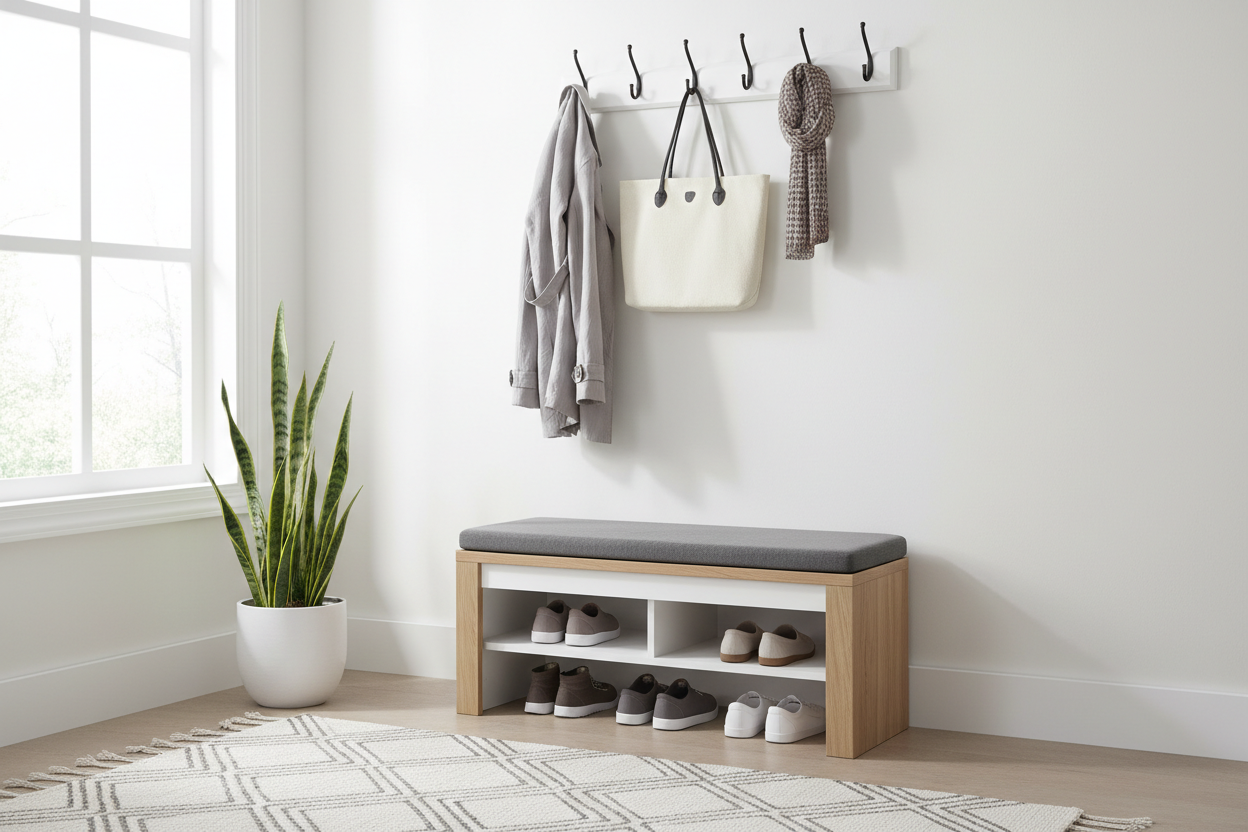
The hallway is the most traversed yet often the most neglected thoroughfare in a home. It sets the tone for the rest of the house, but when that space is barely wide enough for two people to pass, functionality usually takes a backseat to simply being able to walk through the door. The challenge isn't just finding furniture; it's finding furniture that respects the limited footprint of a corridor while still hiding the inevitable pile of shoes, bags, and dog leashes. This is where the specific engineering of a slim hallway storage bench becomes essential, bridging the gap between a welcoming entryway and a cluttered obstacle course.
Most standard furniture is too deep for tight entryways. A typical bench depth ranges from 16 to 20 inches. In a hallway that might only be 36 to 40 inches wide, a standard bench eats up half your walking path, creating a claustrophobic tunnel effect. You need a solution that hovers around the 10 to 13-inch mark in depth, offering a perch to tie laces without forcing you to turn sideways to shimmy past it.
My Battle with the "Corridor Squeeze"
I learned the hard way that dimensions on a website don't always translate to how a piece feels in a room. Years ago, living in a Victorian-era terrace house, the entryway was long, charming, and impossibly narrow. I ordered a beautiful oak bench that looked perfect online. Once assembled, it was a disaster. It physically fit, but visually and practically, it choked the space. I found myself hip-checking the corner of it every time I came in with groceries.
That mistake led me on a hunt for a true slimline storage bench. I eventually swapped the bulky oak piece for a metal and wood combination that was only 11 inches deep. It didn't look like much in the store, but in that hallway, it was transformative. It provided just enough surface area to sit for a moment and used vertical height rather than floor depth for storage. The difference of five inches reclaimed the walkway and stopped the daily bruising of my hips.
Critical Dimensions: Depth vs. Comfort
When shopping for this specific furniture, tape measures are non-negotiable. You must measure the width of your hallway at its narrowest point—usually where the baseboards or a radiator protrude. A comfortable walkway requires a minimum of 30 inches of clearance, though 36 inches is ideal. If your hall is 42 inches wide, your bench cannot exceed 12 inches in depth if you want to maintain a spacious feel.
You might wonder if a 10 or 12-inch bench is actually sittable. While you won't be lounging on it for hours to read a book, it is perfectly adequate for the momentary act of putting on or taking off shoes. The key is stability. Because a slim hallway storage bench has a narrow footprint, it can be prone to tipping if not designed correctly. Look for units that come with wall-anchoring hardware, or those with a heavy, low center of gravity.
The Trade-off: Storage Volume
Going slim means you lose cubic footage. You won't be storing bulky winter boots or large backpacks inside a slimline storage bench. You have to adjust your expectations regarding capacity. These units excel at holding low-profile sneakers, flats, and sandals. If you need to store high-top boots, look for a bench with an open bottom shelf rather than an enclosed cabinet, allowing the boots to sit on the floor underneath the seat.
Design Styles That Trick the Eye
In small spaces, visual weight is just as important as physical size. A solid, boxy wooden chest can make a narrow hall feel heavy and closed off. To combat this, look for designs that incorporate negative space.
Benches with legs, rather than a solid base that sits flush with the floor, allow light to pass underneath. This makes the floor area visible, tricking the brain into perceiving the room as larger than it is. Metal frames with thin profiles are excellent for this. They offer the necessary structural integrity to hold a person's weight without the visual bulk of thick timber slabs.
Another clever option is the "floating" bench. If you are handy with DIY projects, mounting a sturdy plank or a shallow cabinet directly to the wall studs eliminates legs entirely. This keeps the floor completely clear, making vacuuming easier and maximizing that sense of openness.
Material Durability in High-Traffic Zones
Entryways take a beating. Mud, grit, wet umbrellas, and heavy grocery bags are daily occurrences. The material of your bench needs to withstand this abuse. While velvet or linen upholstery looks luxurious, it is a risky choice for a high-traffic slimline storage bench unless you choose a performance fabric treated for stain resistance.
Solid wood or high-quality laminate are generally the safest bets. They can be wiped down easily. If you crave the comfort of a cushion, opt for a loose seat pad that can be removed and washed, or a leather surface that develops a patina rather than looking dirty over time. Metal is also incredibly durable but can feel cold; pairing a metal industrial frame with a warm wood top strikes a nice balance between durability and welcoming aesthetics.
Maximizing the Utility of a Small Bench
Since the storage inside the bench is limited, organization becomes paramount. If your bench features open cubbies, they will quickly look messy if you just toss items in. Use baskets that fit the cubby dimensions perfectly to create a drawer effect. This hides the visual clutter of mismatched shoes and dog toys.
For flip-top benches, the internal space is often a narrow trough. This can become a black hole for keys and gloves. Use small internal dividers or boxes to compartmentalize the space. This prevents you from having to dig through a pile of wool scarves to find the dog's waste bags.
Don't forget the vertical space above the bench. Since the bench itself is low, the wall above it is prime real estate. Installing a row of hooks or a shallow wall shelf mirrors the width of the bench and draws the eye upward, creating a cohesive "drop zone" without encroaching on the walkway.
Is Custom the Only Way?
Sometimes, the market just doesn't provide the exact dimensions you need. If you have an unusually tight corner or an obstruction like a radiator, modifying existing furniture or building from scratch might be the answer. Many homeowners have found success hacking shallow kitchen wall cabinets (which are typically 12 inches deep) by reinforcing them to bear weight and adding a finished top. This allows for a custom fit without the custom furniture price tag.
Ultimately, a narrow entryway doesn't have to mean a lack of organization. By prioritizing depth over width and selecting materials that lighten the visual load, a slim hallway storage bench can turn a cramped corridor into a functional, welcoming entrance.
Frequently Asked Questions
What is the minimum depth for a hallway bench to still be functional?
For a bench to be usable for sitting, 10 to 12 inches is generally the minimum depth. While this is narrower than a standard chair, it provides enough support for a quick perch to tie shoes. Anything shallower than 10 inches becomes a shelf rather than a seat.
How do I prevent a tall, narrow bench from tipping over?
Narrow furniture has a higher center of gravity, making stability a concern. It is highly recommended to secure the bench to the wall using L-brackets or furniture straps, especially if you have children or if the bench sits on thick carpet which can cause wobbling.
Can I use a TV stand or bookshelf as a hallway bench?
You can, provided the structure is reinforced to hold human weight. Most bookshelves and TV stands are not designed to support a sitting person (typically 200+ lbs). If you repurpose these items, ensure they are made of solid wood or metal, or add internal bracing to prevent sagging or collapse.

Leave a comment
This site is protected by hCaptcha and the hCaptcha Privacy Policy and Terms of Service apply.