










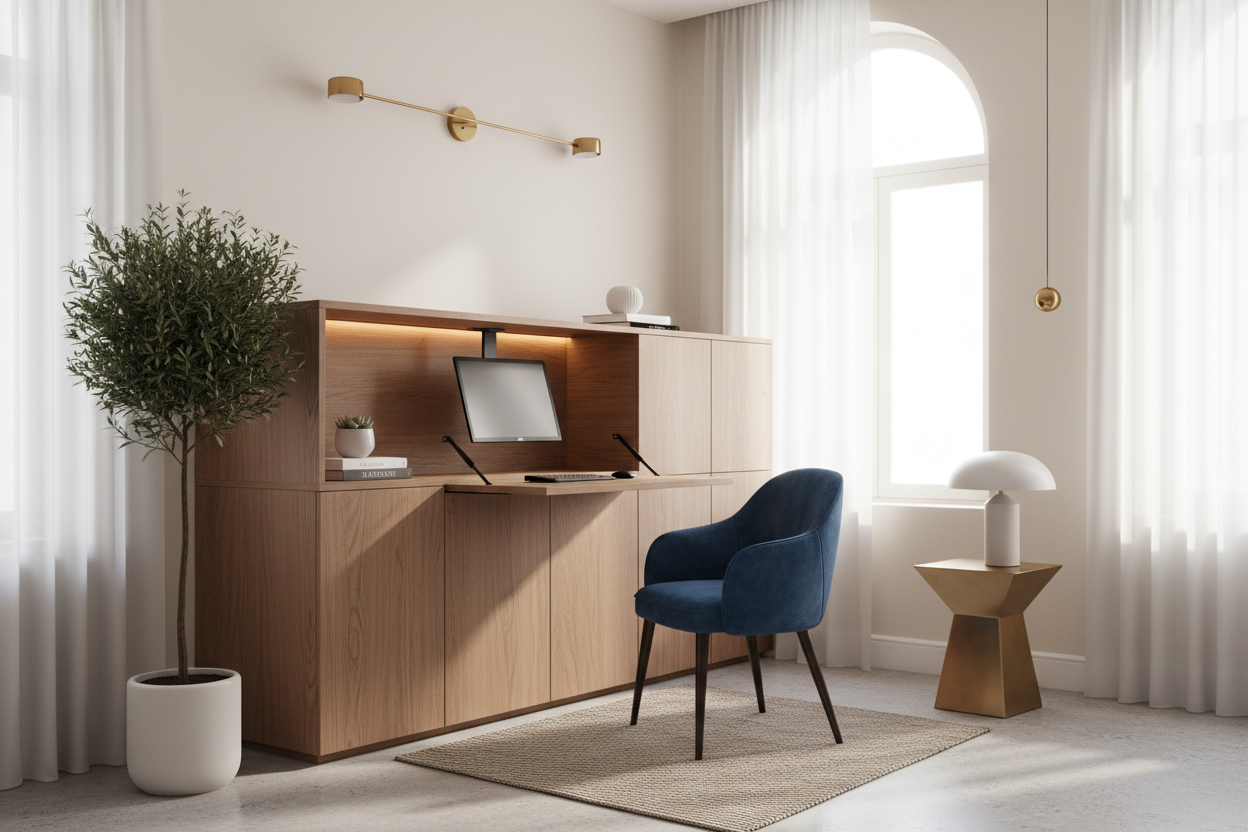
We have all experienced the dreaded creep of work life into our personal sanctuaries. One minute you are answering emails at the dining table, and six months later, that table is buried under monitors and tangled cables. The design dilemma isn't just about finding a place to sit; it is about reclaiming your square footage once the clock strikes five. A well-executed pop up home office allows you to maintain the visual integrity of your living room or bedroom while offering a fully functional workspace that vanishes on demand.
Quick Decision Guide: Key Features to Look For
- Mechanism Quality: Look for heavy-duty gas pistons or smooth-gliding hinges. If it squeaks or resists now, it will fail within a year.
- Visual Weight: In small spaces, opt for legs with a slender silhouette or wall-mounted floating units to keep the floor visible, making the room feel larger.
- Surface Durability: High-pressure laminate (HPL) or sealed solid wood withstands coffee rings and mouse friction better than standard wood veneers.
- Cable Management: A true pop-up solution must have integrated channels. If you have to unplug everything to close the unit, you won't use it.
Mastering the Layout and Flow
When I walk a client through a floor plan, the first thing we look for is 'dead equity'—corners, alcoves, or transition spaces that aren't pulling their weight. However, placing a pop up station requires more than just fitting it into a gap. You must consider the swing radius. Whether you are choosing a secretary desk that folds down or a mobile unit that expands, ensure you have at least 36 to 48 inches of clearance behind the chair for comfortable movement.
Material Selection: Cohesion is Key
The biggest mistake homeowners make is treating office furniture as a separate entity from their home decor. If your living room features warm walnut tones and brass accents, your workspace shouldn't be industrial grey metal. To achieve a high-end, built-in look, match the finish of your pop up unit to your existing cabinetry or flooring. Solid wood offers longevity and can be refinished, but high-quality engineered wood is often more stable against humidity changes, preventing the warping that can jam folding mechanisms.
Ergonomics vs. Aesthetics
There is often a tug-of-war between comfort and style in transient workspaces. A bulky ergonomic task chair rarely fits the vibe of a curated living room. The solution lies in 'hybrid seating.' Look for dining chairs with upholstered buckets and lumbar support, or low-profile office chairs that can tuck completely under the desk surface when the station is collapsed.
Lighting the Transient Zone
Overhead recessed lighting is rarely enough for focused work and often casts shadows on your keyboard. Since floor space is at a premium, avoid floor lamps. Instead, utilize clamp-on architectural lights that can be stored inside the desk unit, or install a wall sconce with an adjustable arm above the station. This creates a focal point when the desk is open and serves as ambient accent lighting when the office is 'closed.'
Lessons from My Own Projects
I learned the hard way that 'compact' does not always mean 'functional.' On a recent project for a client in a pre-war apartment, we installed a gorgeous, wall-mounted drop-leaf desk. It looked stunning closed—like a piece of abstract art.
However, I overlooked the depth of the work surface. We selected a unit that was only 14 inches deep. Once the client opened their laptop, there was zero room for a notepad, a coffee cup, or even proper wrist support. They ended up perched awkwardly, elbows hovering in the air. We had to rip it out and replace it with a unit featuring a telescoping surface that extended to 22 inches. The lesson? Always measure your 'active' workspace requirements, not just the 'stored' dimensions. Also, check the finish for fingerprints; matte black looks chic in photos but is a nightmare if you use hand lotion.
Conclusion
Integrating a workspace into your home doesn't require sacrificing your aesthetic. By focusing on high-quality mechanisms, cohesive materials, and smart lighting, you can design a space that works hard by day and disappears by night. It is about creating a boundary between your professional and personal life, even if they share the same square footage.
Frequently Asked Questions
How much weight can a wall-mounted pop up desk hold?
This depends heavily on the installation. A unit anchored into wall studs can typically support 50-70 lbs, which is sufficient for a laptop and monitor. However, never lean your full body weight on a cantilevered desk unless it has additional support legs.
What is the best way to hide a monitor in a pop up setup?
If you use a large external monitor, look for a 'secretaire' style cabinet with a deep upper hutch. Alternatively, use a monitor arm that allows the screen to be pushed flat against the back wall or tucked sideways when the desk is closed.
Can I use a pop up office for a desktop computer tower?
Generally, no. Pop up offices are designed for mobile technology (laptops and tablets). Tower PCs require significant ventilation and space that these compact units rarely provide. If you must use a tower, place it on the floor beside the unit, but be mindful of cable routing.

Leave a comment
This site is protected by hCaptcha and the hCaptcha Privacy Policy and Terms of Service apply.