










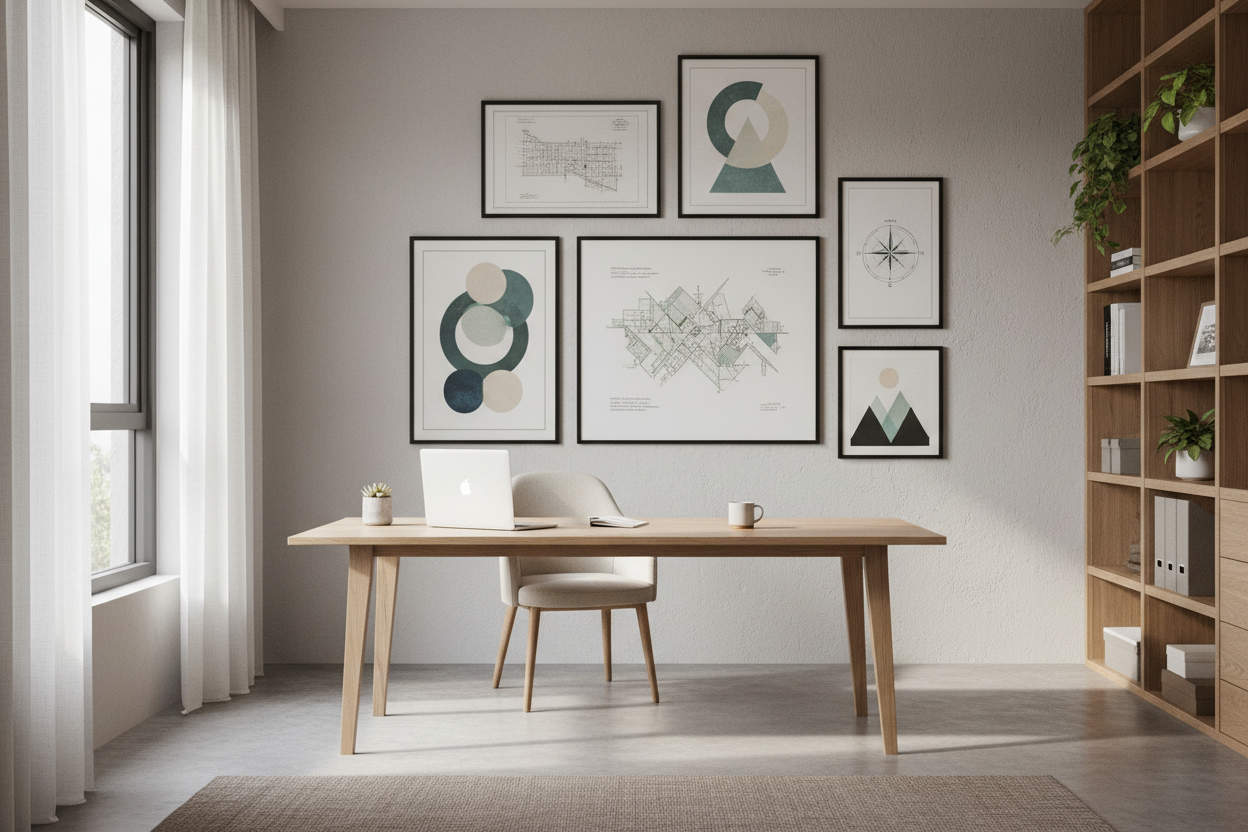
There is a specific kind of fatigue that comes from staring at a blank, beige wall behind a computer monitor for eight hours a day. In my years designing workspaces, I have found that the visual environment directly correlates with cognitive endurance. The solution isn't just filling space; it is about intentionally selecting home office prints that anchor the room and influence your mood. Whether you are battling echo in a minimalist room or trying to create a professional backdrop for video calls, the art you choose serves a functional purpose beyond mere decoration.
Quick Decision Guide: Selecting Art for Workspaces
Before you start browsing galleries or online shops, consider these four pillars to ensure your wall art for home office actually works for the space:
- Scale and Proportion: The artwork should span roughly two-thirds to three-quarters the width of the furniture piece it hangs above (usually the desk or a credenza).
- Glare Management: If the art is visible on video calls or faces a window, opt for matte finishes or canvas rather than glass-framed prints to avoid distracting reflections.
- Color Psychology: Cool tones (blues, greens) promote focus and calm, while warm tones (oranges, reds) stimulate creativity and energy.
- Acoustics: Canvas prints or tapestry-style art for home office can help dampen sound in rooms with hard flooring.
Establishing the Atmosphere with Color and Subject
When selecting artwork for home office, you are essentially programming the vibe of your workday. I often advise clients to avoid overly chaotic abstracts if their work requires deep, analytical focus. In these scenarios, landscape photography or minimalist line art serves better to rest the eye without overstimulating the brain.
The Psychology of Hue
If you are in a creative field, high-contrast home office paintings can act as visual caffeine. However, for high-stress roles, look for pictures for home office featuring biophilic designs—botanical prints or serene horizons. These images tap into our innate connection to nature, lowering cortisol levels even when you are crunching numbers.
Placement Strategy and Visual Weight
The most common error I see is hanging wall art for office at home too high. In a workspace, you are seated 90% of the time. Therefore, the center of the artwork should be at eye level from a seated position, not a standing one. This creates a sense of intimacy and ensures the art is enjoyed by you, the user, rather than just people walking past the doorway.
Creating a Zoom-Ready Backdrop
If you are looking for home office pictures for wall areas visible behind you during video conferences, curation is key. A gallery wall can look cluttered and distracting on a webcam. A better approach is usually one or two large-scale statement pieces. This provides a clean, sophisticated background that communicates professionalism without screaming for attention.
Materiality: Canvas vs. Framed Prints
The finish of your prints for home office matters as much as the image itself. In rooms with aggressive overhead lighting or large south-facing windows, standard glass frames are a nightmare. They become mirrors.
For high-light areas, I almost exclusively specify gallery-wrapped canvas or paintings for home office with a matte varnish. If you prefer the elegance of a frame, spend the extra budget on non-reflective museum glass. It renders the glazing invisible and protects the art home office setups require from UV fading.
My Personal Take on Home Office Prints
I learned a hard lesson about home office wall art during a project for a tech executive a few years ago. We installed a stunning, high-gloss photography print directly behind her desk. It looked incredible in person. However, the first time she turned on her ring light for a board meeting, the print turned into a giant reflector, beaming a blinding light right back into the camera lens.
We had to swap it out immediately. Now, whenever I source home office prints, I actually test them with a flashlight to mimic task lighting. It’s a small, unpolished detail, but checking how the texture of the print interacts with your specific desk lamp or window position saves you the hassle of repacking and returning art that looks good in the shop but fails in the studio.
Conclusion
Your workspace should be a container for your best thinking. By carefully selecting the scale, material, and subject matter of your wall decor, you move beyond simple decoration and into environmental design. Treat your walls as tools for focus, and the aesthetic appeal will naturally follow.
Frequently Asked Questions
Should home office art match the rest of the house?
Not necessarily. Your office is a distinct zone with a specific function. While it shouldn't clash violently with adjacent rooms, you have the freedom to choose home office pictures for wall decor that is more stimulating or specific to your professional persona than what you might hang in a living room.
What is the best size for art above a desk?
A good rule of thumb for wall art for home office is to select a piece that is 50% to 75% of the width of the desk. If the desk is 60 inches wide, aim for a print (or a set of prints) that spans about 30 to 45 inches. This maintains visual balance so the furniture doesn't look like it's drowning the art, or vice versa.
Can I mix personal photos with professional art?
Yes, but be mindful of placement. I recommend keeping personal family photos on the desk or on a side wall (your "private view") and keeping the main artwork for home office walls (the "public view" or background) more neutral and professional, especially if you host video calls.

Leave a comment
This site is protected by hCaptcha and the hCaptcha Privacy Policy and Terms of Service apply.