










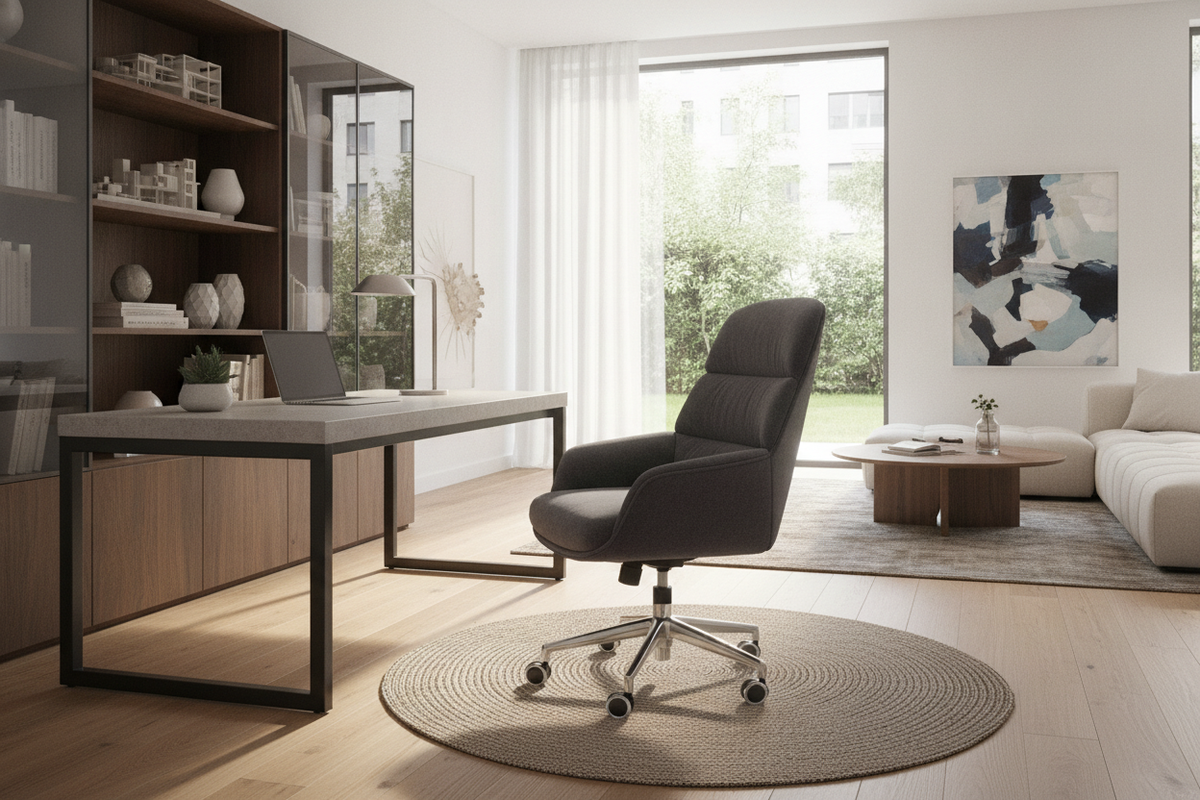
A well-selected desk chair with arms and wheels serves as the functional anchor of any productive workstation. Selecting the right model requires balancing mechanical versatility, surface protection, and proper spatial alignment with your existing office furniture. Evaluating the relationship between armrest articulation, caster mobility, and under-desk dimensions allows you to establish an efficient and organized layout.
Core Mechanics of Desk Chairs with Arms and Wheels
The foundational mobility and structural support of an office chair on wheels with arms depend on how its base, swivel core, and upper frame interact under regular movement.
Five-Star Wheelbase Geometry and Rolling Stability
Mobile task seating standardizes on a five-star base structure to provide omnidirectional stability during reclining and shifting. The geometric spread of the five radiating legs prevents tipping while distributing user weight evenly across the floor. Bases manufactured from molded composite nylon provide lightweight agility, while polished aluminum or welded steel bases offer a lower center of gravity and increased structural rigidity for long-term daily use.
Armrest Structural Configurations and Support Types
Armrests serve distinct functional roles depending on their adjustability and frame connection points:
- Fixed Loop Arms: Continuous loops attached to both the seat pan and backrest. These offer stable structural bracing and sleek visual lines but cannot adjust to match varying desk heights.
- Height-Adjustable T-Arms: Centrally mounted posts that slide vertically, allowing you to align forearm elevation with the desktop surface to prevent shoulder strain.
- 3D and 4D Articulating Arms: High-adjustability brackets that slide forward, backward, pivot inward or outward, and shift in overall width to accommodate diverse typing and writing angles.
- Flip-Up Arms: Hinged arm structures that swing backward, enabling the chair to tuck fully under low-apron desks or provide unobstructed movement for dynamic tasks.
Caster Mobility: Matching Wheel Materials to Flooring Surfaces
Choosing the correct caster type preserves flooring surfaces while maintaining effortless gliding motion across work zones.
Hard-Surface Polyurethane and Rubber Casters
Smooth surfaces such as natural hardwood, engineered laminate, ceramic tile, and polished concrete require soft-tread casters. Polyurethane and thermo-plastic rubber wheel coatings provide a cushioned grip, preventing high-friction skidding, surface scratching, and abrasive wear without requiring supplemental floor mats.
Hard Nylon Twin-Wheel Casters for Carpets and Rugs
Standard hard composite nylon casters are engineered specifically for low-pile commercial carpets and tightly woven area rugs. The dense plastic twin-wheel design cuts through textile fibers rather than sinking into the weave, reducing rolling resistance when moving between adjacent storage units or filing stations.
Dimensional Footprint and Under-Desk Clearance Planning
Ensuring your seating fits under the desk surface prevents collisions with framing aprons, drawer boxes, and modesty panels.
Armrest-to-Apron Height Clearances and Knee-Well Width
Before selecting a mobile task chair, measure the vertical distance from the floor to the lowest structural point beneath your desktop. When desks feature shallow pencil drawers or heavy perimeter trim, fixed armrests may collide with the front lip. Verify that the minimum adjusted armrest height sits safely below this perimeter line. Additionally, calculate the internal knee-well width between desk pedestals to ensure the overall width of the chair base can swivel freely without knocking into storage side panels.
Turning Radius and Walkway Clearances in Compact Rooms
A rolling chair requires a functional floor zone that accommodates not only the five-star diameter but also the push-back distance when rising from the seat. Plan for an open clearance zone behind the desk edge to allow effortless ingress, egress, and full 360-degree rotation without grazing nearby walls or credenzas.
Material Selection and Structural Longevity
The choice of upholstery and internal padding influences breathability, tactile comfort, and overall room aesthetics over years of continuous use.
Breathable Mesh vs. Padded Upholstery and Faux Leather
Tensioned elastomeric mesh backrests promote constant airflow, making them well-suited for warm environments or extended work sessions. Conversely, high-density molded foam cushions upholstered in textured fabric or smooth faux leather offer plush contouring and refined executive presence. When planning your layout, exploring guidance on styling an office desk and chair set can help harmonize tactile upholstery finishes with surrounding cabinetry.
Frame Composition: Reinforced Nylon vs. Steel and Aluminum
Internal frame composition dictates durability and stability. Structural nylon frames provide engineered flexibility that responds to dynamic posture changes, whereas steel and cast aluminum sub-frames deliver maximum longevity and solid anchoring for mechanical tilt mechanisms and gas cylinders.
Pairing Mobile Task Chairs with Workstation Desks and Storage
Integrating a mobile chair into a comprehensive workstation layout ensures seamless transitions between computing, paperwork, and accessing archives.
Harmonizing with Storage-Integrated Workstations
For dedicated home offices, pairing your rolling chair with an office desk with integrated storage cabinet establishes a cohesive command center where supplies remain within arm's reach. In larger professional suites or front-office environments, positioning an adjustable chair behind an L-shaped executive desk counter ensures smooth transit across multiple active service zones.
Corner Desk and Multi-Monitor Workstation Layouts
Expansive dual-surface setups require responsive wheel mobility to glide between typing and writing stations. Placing a smooth-rolling task chair in the central curve of a modern minimalist computer corner desk allows effortless pivoting across multiple monitor screens while preserving open floor space in compact rooms.
Assembly Guidelines and Long-Term Chair Care
Proper assembly and routine upkeep maintain smooth mechanical performance and quiet rolling over time:
- Cylinder and Base Seating: Ensure the pneumatic gas lift cylinder is seated straight and pressed firmly into the center hub of the star base before installing the seat pan.
- Fastener Tightening: Periodically inspect and retighten armrest bolts and under-seat mechanism screws to eliminate wobble and mechanical creaking.
- Caster Stem Maintenance: Inspect caster wheel housings periodically to clear accumulated dust, thread, or hair that could obstruct rotation and cause floor scuffing.

Leave a comment
This site is protected by hCaptcha and the hCaptcha Privacy Policy and Terms of Service apply.