




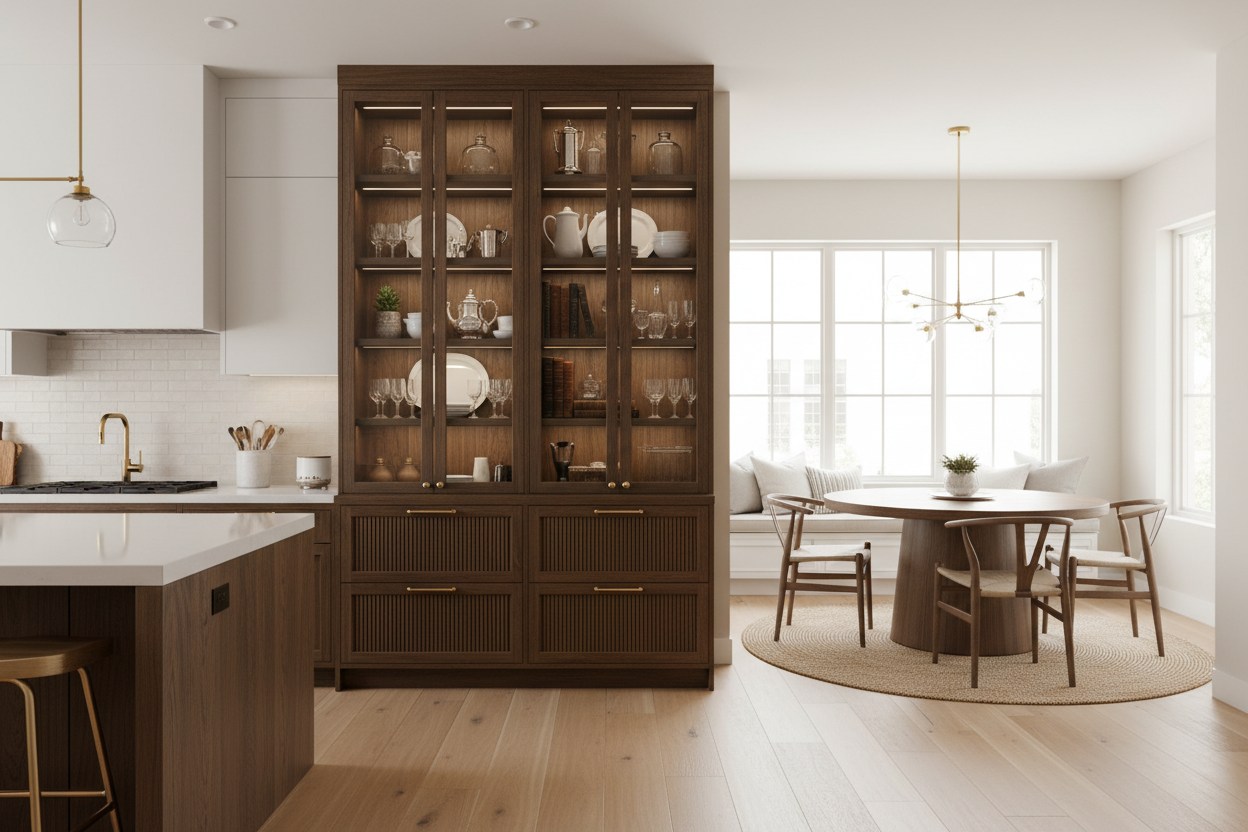
A kitchen display cabinet is a cabinet with glass doors that shows off dishes, glassware and serving pieces while keeping them free of dust. A freestanding one should be about 13 to 20 inches deep so the walkway in front stays at least 36 inches wide, sit away from the range, use tempered glass, and be anchored to the wall. Plan on displaying roughly a third of what you store and hiding the rest behind solid doors or in drawers.
This guide answers whether you can buy ex-display kitchen cabinets, then shows how to choose and style a freestanding display cabinet: glass door types, depth and clearance, lighting, what to display, dust and anchoring. It ends with five picks from the FUFU&GAGA pantry cabinets collection.
Key takeaways
- Depth: 13 to 20 in is typical for freestanding kitchen display cabinets; check the walkway that's left.
- Clearance: the NKBA recommends walkways of at least 36 in and work aisles of at least 42 in for one cook.
- Glass: clear glass shows everything; frosted, reeded or patterned glass hides clutter.
- Balance: display about a third, hide the rest, so the glass section stays tidy.
- Safety: tempered glass and an anti-tip kit fixed to a stud.
Can you buy display kitchen cabinets?
Yes. When people search for "kitchen displays" or "display kitchen cabinets", they often mean ex-display kitchens: the complete showroom kitchens that dealers and manufacturers sell off when they update their floor. A showroom display kitchen usually includes the cabinetry and sometimes the countertops, appliances and sink, and it can cost less and arrive sooner than a new custom kitchen.
It is a good deal only if it fits. Before you commit, check:
- Measurements: compare the cabinet run, height and corner layout with your room. Changing a kitchen to fit costs money.
- Condition: look for scratches, chipped edges, worn hinges and drawer runners, and water marks around the sink base.
- What's included: appliances, countertops, panels, handles and fillers. Missing pieces can be hard to match later.
- Removal and installation: who takes it out of the showroom, who transports it and who installs it.
- Warranty: showroom pieces are often sold "as is". The FTC explains that a seller can exclude implied warranties by marking a product "as is" where state law allows, so get any promises in writing.
If you only want a place to show dishes and glassware, a freestanding kitchen display cabinet is far simpler: no renovation, and it moves with you. The rest of this guide covers that option.
Built-in glass uppers vs a freestanding display cabinet
Glass-front kitchen cabinets come two ways. Built-in uppers with glass inserts replace solid cabinet doors in your existing kitchen cabinets. A freestanding display cabinet, such as a hutch, buffet with glass doors or pantry cabinet with a glass section, is a piece of furniture that stands on its own.
| Built-in glass uppers | Freestanding display cabinet | |
|---|---|---|
| Installation | Part of a remodel or door replacement | Assemble, place, anchor |
| Typical depth | Matches your wall cabinets | About 13 to 20 in |
| Storage | Display only, above the counter | Display plus drawers, closed cabinets or a counter |
| Lighting | Usually hardwired | Often plug-in LED |
| Renters | Not practical | Moves with you |
| Look | Matches the kitchen | Furniture-like, can contrast |
In the UK, a freestanding hutch is often called a kitchen dresser; in the US, "hutch" or "buffet and hutch" is the usual term.
Which glass doors work best in a kitchen?
The glass you choose decides how much you see, how much you hide and how often you clean. Tempered glass is the safer choice for any cabinet door, because it breaks into small pieces rather than sharp shards.
| Door type | What you see | Hides clutter? | Best for |
|---|---|---|---|
| Clear glass | Everything, in full color | No | Matching dishware, glassware, a curated display |
| Frosted glass | Soft shapes and light | Yes | Busy households, mixed everyday items |
| Reeded or ribbed glass | Blurred vertical lines | Mostly | Modern and transitional kitchens |
| Patterned or textured glass | Distorted, decorative view | Yes | Industrial or farmhouse style |
| Mirrored glass | A reflection of the room | Fully | Adding light and depth to a small kitchen |
| Metal mesh or grid | Contents through an open grid | Partly | Farmhouse and industrial looks, airflow |
Hinged glass doors open wide for cleaning and loading; sliding glass doors need no swing space, which helps in a galley kitchen. Our 59" sideboard display cupboard with mesh doors is an example of the grid look if you want texture rather than glass.
How deep should a kitchen display cabinet be?
Depth depends on the space in front of the cabinet, not the cabinet itself. The NKBA's Kitchen Planning Guidelines recommend a walkway at least 36 inches wide, and a work aisle at least 42 inches wide for one cook or 48 inches for multiple cooks, measured between counter frontage, tall cabinets and appliances. A freestanding cabinet opposite a counter is one of those boundaries.
To check fit, measure from the front of your counter (or the wall) to the opposite wall, then subtract the cabinet's depth. If the result is at least 42 inches in a cooking zone, or 36 inches in a walkway, the cabinet fits. The cabinets in our picks below are 13.8 to 19.7 inches deep. Allow extra room in front for hinged doors to open, and compare the interior depth with your largest plate or platter.
| Where it goes | Clear space to keep in front | Cabinet depth that usually works |
|---|---|---|
| Opposite a counter where one person cooks | 42 in or more | 13 to 16 in |
| Opposite a counter where two people cook | 48 in or more | 13 to 16 in |
| Kitchen walkway or breakfast nook | 36 in or more | Up to 20 in |
| Open-plan kitchen-dining wall | 36 in from chairs or traffic | 15 to 20 in |
Where should a display cabinet go in the kitchen?
Place display units away from grease zones such as the range and cooktop, ideally on a different wall, so the glass doesn't need constant cleaning. A wall near the dining table, an end wall, or the space beside a pantry works well, and in an open-plan room the cabinet can bridge the kitchen and dining area.
- Keep it out of direct sun. The Canadian Conservation Institute advises against putting glass in a sunny place or under spotlights where it can get very warm, and recommends shelves free of vibration, so avoid the wall shared with the dishwasher or fridge if you can.
- Keep the front clear of the fridge door, oven door and dishwasher door swings.
- Put it near an outlet if it has plug-in LED lighting, and plan where the cord will run.
Kitchen cabinet display ideas: what to put inside
The best kitchen display cabinets mix form and function. Treat the shelves like a living room bookshelf rather than a pantry, and the cabinet looks collected rather than crammed.
- Everyday white dishware stacked in short, even piles.
- Glassware grouped by type: wine glasses on one shelf, tumblers on another.
- Serving pieces: stackable ceramic bowls, cake stands, pitchers, wooden cutting boards, copper cookware.
- Cookbooks stacked flat as a pedestal for a bowl or small plant.
- A few non-kitchen objects: a small framed print leaned against the back panel, a trailing plant on top.
- A coffee or tea station: mugs and canisters behind glass, the machine on the counter section.
How to style a kitchen display cabinet
- Pick a palette. Two or three colors, such as white, wood and one accent, read as calm.
- Vary heights. Put tall pieces at the back and sides, low pieces in front.
- Group in odd numbers. Clusters of three or five look more natural than rows.
- Mix materials. Ceramic, glass, wood and metal add texture.
- Leave space. Empty space around each group keeps the display from looking crowded.
- Hide the rest. Plan hidden storage directly below the display for cereal boxes, plastic containers and appliances.
A useful rule of thumb is to give about a third of your storage to display and keep two-thirds closed. A cabinet that looks great on day one can fill with snack boxes within months if it has no closed storage. For more on spacing and grouping, see how to arrange a display cabinet.
Lighting, dust and cleaning
Interior lighting adds depth and highlights the pieces inside, and it turns the cabinet into soft ambient light in the evening. Freestanding cabinets usually use plug-in LED strips; some let you switch colors or brightness. Keep bulbs and strips from sitting directly against glassware.
Glass doors keep dust off what's inside, but the doors themselves collect kitchen film. Wipe them regularly with a damp cloth, avoid abrasive cleaners, and follow the care instructions for your cabinet. Cabinets placed away from the range need cleaning far less often.
Kitchen display cabinet buying checklist
- Clearance: at least 42 in of work aisle (48 in for two cooks) or 36 in of walkway left in front.
- Depth: 13 to 16 in opposite a counter; up to 20 in on an open wall.
- Glass type: tempered; clear for curated displays, frosted or patterned for everyday items.
- Door style: sliding doors in narrow spaces; hinged doors where there's room to open them.
- Display-to-storage split: about one-third glass, two-thirds closed doors or drawers.
- Shelf rating: check the per-shelf weight limit before loading stoneware.
- Lighting: plug-in LED with an outlet nearby.
- Counter space: an open middle section if you want a coffee or microwave station.
- Anti-tip kit: included, and fixed into a wall stud.
Our picks: kitchen display cabinets from FUFU&GAGA
These five freestanding cabinets combine glass display with closed storage, from a full hutch to a low glass sideboard.
63" Modern Kitchen Pantry Storage Cupboard with Hutch, Drawers and Microwave Shelf

A buffet and hutch in one: transparent glass doors on top display tableware with an adjustable shelf behind them, an open middle section holds a microwave, toaster or coffee maker, and four large drawers keep utensils and linens out of sight. It works like a traditional kitchen dresser in a 15.7-inch depth.
Key facts: 74.8" H x 63" W x 15.7" D, 33 lb per shelf, four drawers on metal slides (25 lb each, interior 6" H x 22" W x 12" D), adjustable shelves, water- and scratch-resistant surfaces, finished back, tipover restraint included, brown, white or wood.
Best for: a kitchen wall that needs display, an appliance station and drawers. If you plan to run a microwave in it, read our guide to microwave clearance in a pantry cabinet.
61.4" Modern White Food Pantry Cabinet with Glass Door and Wine Storage

Two glass doors and transparent side panels create a bright display area at the top, four open shelves in the center keep cookbooks and everyday items handy, and the base adds drawers, closed cabinets and wine cubbies. The slim 15-inch depth suits narrower kitchens.
Key facts: 78.7" H x 61.4" W x 15" D, glass doors and glass side panels, four open center shelves, two drawers, three closed cabinets, built-in wine cubbies, adjustable shelves, tipover restraint included, white.
Best for: combining a dish display, pantry storage and wine in one piece.
47.2" Modern Natural Wood Food Pantry Cabinet with Sliding Glass Doors
The upper section has sliding tempered glass doors, so nothing swings into a narrow aisle, plus top and side vents for air circulation. Below, two wood-door cabinets with an adjustable shelf hold dry goods and cookware. At 51.2 inches tall, the top doubles as a landing spot for a coffee maker or fruit bowl.
Key facts: 51.2" H x 47.2" W x 19.7" D, cabinet interior 19.1" H x 15" D, sliding tempered glass doors, top and side vents, adjustable shelf, anti-tip hardware included, natural finish.
Best for: galley kitchens and tight aisles where hinged doors would get in the way.
55.1" Modern Black Sideboard Display Case with LED Lighting & Full Glass Design

Glass on all four sides gives a 360-degree view of glassware or fine dinnerware, two sets of double glass doors open to a glass shelf in each compartment, and built-in LED strips light the display. At only 13.8 inches deep it is the slimmest pick, and its top works as a serving surface.
Key facts: 31.5" H x 55.1" W x 13.8" D, glass on all sides, glass shelves rated 50 lb each, built-in LED lighting, water- and scratch-resistant, tipover restraint included, black.
Best for: showcasing glassware where floor space and depth are tight.
47.2" Black Sideboard Buffet Cabinet with LED Lights and Glass Doors
Half display, half hidden storage: two glass doors on the left open to two shelves lit by multi-color LED strips, and a wood-grain door on the right conceals two more shelves. It puts the display-to-storage balance into one compact piece.
Key facts: 37.4" H x 47.2" W x 16.1" D, 6" feet, two lit display shelves plus two concealed shelves, 22 lb per shelf, multi-color LED, tipover restraint included, black with brown wood-grain door.
Best for: small kitchens and breakfast nooks that need both display and closed storage.
Compare the picks
| Product | Size (H x W x D) | Standout feature | Best for |
|---|---|---|---|
| 63" buffet and hutch | 74.8 x 63 x 15.7 in | Glass hutch, microwave space, 4 drawers | All-in-one kitchen wall |
| 61.4" pantry with glass display | 78.7 x 61.4 x 15 in | Glass sides, wine cubbies | Dishes, pantry and wine |
| 47.2" sliding-door pantry | 51.2 x 47.2 x 19.7 in | Sliding tempered glass, vents | Narrow aisles |
| 55.1" glass display sideboard | 31.5 x 55.1 x 13.8 in | All-glass, LED, 50 lb shelves | Glassware showcase |
| 47.2" half-glass sideboard | 37.4 x 47.2 x 16.1 in | Lit display plus hidden shelves | Small kitchens |
Safety: anchor it and load it low
A tall kitchen display cabinet full of dishes is top-heavy, and kitchens are where children climb to reach things. The CPSC's Anchor It! campaign says anchoring all furniture with drawers, doors and shelves to the wall prevents tip-over injuries and deaths. All five picks include tip-over restraint hardware; fix it into a stud, put heavy stoneware on the lowest shelves, and keep within each shelf's weight rating. Our guide to anchoring furniture to the wall walks through the hardware for different wall types.
FAQ
What are cabinets with glass doors called?
They're usually called glass-front cabinets or display cabinets. A tall freestanding one with drawers or closed doors below is a hutch (a kitchen dresser in the UK), a glass cabinet built mainly for collectibles is a curio cabinet or vitrine, and a low one is a glass-door sideboard or buffet. Wall cabinet doors made to hold glass are often sold as glass-ready doors.
Are kitchen cabinets with glass doors in style?
Yes. Glass-front cabinets remain a popular way to break up a wall of solid doors, and textured options such as reeded, fluted and frosted glass have widened the choice. They suit modern, transitional, rustic and traditional kitchens. The look lasts best when the display is curated and everyday clutter has closed storage nearby.
Does a display cabinet make a small kitchen feel smaller?
Usually the opposite. Glass doors read lighter than solid doors, and lit shelves add depth, so a slim glass-front cabinet often makes a small kitchen feel more open. The catch is depth: keep at least 36 inches of walkway, or 42 inches in a work aisle, so the cabinet doesn't crowd the room.
What should I display on top of kitchen cabinets?
Keep it simple and light: a few large pieces, such as baskets, pitchers, a trailing plant or a row of matching jars, look better than many small items. On a freestanding display cabinet, avoid heavy objects on top; they raise the center of gravity, so anchor the cabinet and keep weight low.
Want to compare more sizes and styles? Browse our full pantry cabinets collection. FUFU&GAGA orders ship free to the contiguous US, most in-stock orders leave our US warehouses within 48 hours, and unused, unassembled items can be returned within 35 days.

Leave a comment
This site is protected by hCaptcha and the hCaptcha Privacy Policy and Terms of Service apply.