




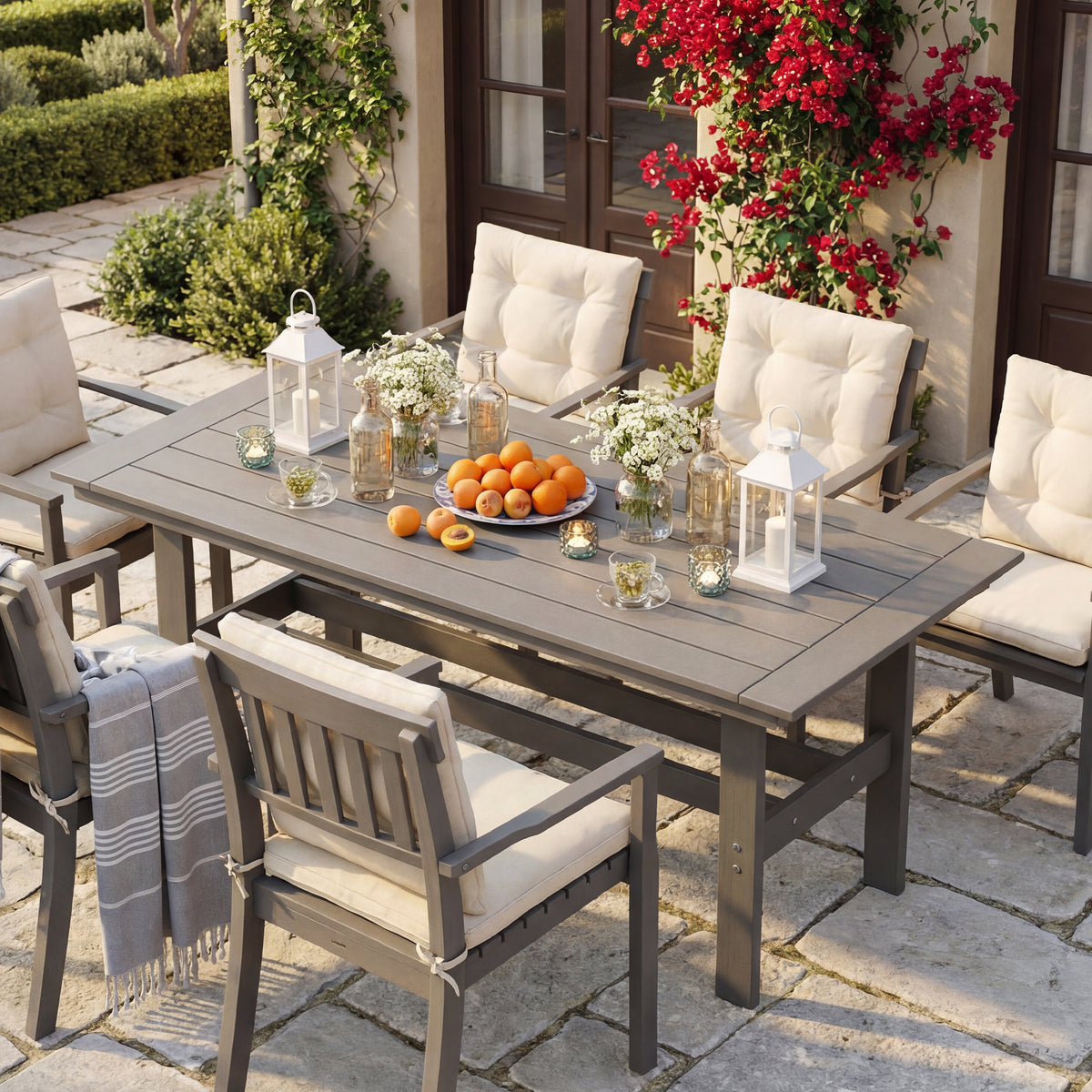
HDPE outdoor furniture is made from high density polyethylene (HDPE), a rigid, low-maintenance plastic that never needs staining or sealing; how well it holds its color depends on the UV additives the maker uses. It trades the light weight and low cost of molded plastic for heft and easy care: most pieces just need mild soap, water and a rinse.
If you want outdoor dining sets that stay outside through the seasons, this guide covers what HDPE is, how it compares with other materials, how to size a table, chairs and umbrella, and six durable pieces from the FUFU&GAGA outdoor kitchen and dining collection.
Key takeaways
- All-weather is not a rating: it means the material does not rot or need a finish. Dirt, mildew, heat and wind still need attention.
- Space per diner: plan at least 24 inches of table edge per person and 32 to 44 inches behind each seat, per NKBA kitchen planning guidelines.
- Our 70.9-inch table seats 6 comfortably; the arithmetic for 8 falls just under the 24-inch minimum. Our 47.2-inch round table suits 4 to 5.
- Umbrellas: all of our HDPE tables in this guide list a 2-inch umbrella hole, so check the pole diameter before you buy.
What is HDPE outdoor furniture?
HDPE stands for high density polyethylene. The Polymer Science Learning Center at the University of Southern Mississippi explains that polyethylene with no branching on its carbon chain is called linear polyethylene, or HDPE, and that linear polyethylene is much stronger than the branched kind. The U.S. EPA lists HDPE bottles for milk and water among common plastic packaging, which is why HDPE furniture is often described as made from recycled jugs.
For furniture, makers mold or extrude high density polyethylene HDPE into solid boards (often sold as poly lumber) and build tables, chairs and benches from them. Some is molded with a wood-grain texture to look like real wood, like our teak-look chairs below. Several of our listings say UV inhibitors are built into their HDPE, and some say it is recycled and recyclable.
Is HDPE furniture similar to poly lumber brands?
Often, yes. "Poly" and "poly lumber" are trade names for plastic furniture boards, and a listing that names HDPE tells you the actual resin. Compare what each listing states (top and frame material, inner frame, weight capacity, care and warranty) rather than brand names.
What does "all-weather" honestly mean?
"All-weather" and "weather resistant" are product descriptions, not a tested standard. For HDPE, our listings use them to mean no staining or sealing, and resistance to fading, cracking, rot and moisture; our round table listing says its UV-stabilized HDPE handles sun, rain and snow, and our 20-inch chair listing calls its HDPE waterproof and non-porous. Those are the durability claims to compare when furniture has to face the elements. What all-weather does not mean:
- Clean forever. Dirt, pollen and mildew still collect on the surface.
- Cool to the touch. In direct sun, darker plastics can get hot. Guidance from the CPSC, summarized by the City of St. Louis health department, lists bare metal and dark-colored plastics and rubber among surfaces that can get hot enough to burn a child's skin. Check seats by hand on sunny days.
- Wind-proof. None of the listings in this guide gives a wind rating.
HDPE vs wood, metal, resin wicker and polypropylene
This table is a general guide to outdoor furniture materials. Cost tiers are relative, without prices, and every product varies, so read the listing.
| Material | Upkeep | Weight | Heat in sun | UV and color | Cost tier |
|---|---|---|---|---|---|
| HDPE (poly lumber) | Soap and water; no stain or sealer | Heavy for its size (our HDPE tables list 96 to 99.2 lb) | Dark colors can get hot | Holds color when UV-stabilized; check the listing | Mid to high |
| Wood (teak, cedar, pine) | Clean and refinish on a schedule | Medium to heavy | Not on the CPSC hot-surface list | Weathers to gray without a finish | Low (pine) to high (teak) |
| Metal (aluminum, steel) | Wipe; touch up chips in the coating | Light (aluminum) to heavy (steel, iron) | Bare metal can burn | Depends on the coating | Low to high |
| Resin wicker | Brush dirt out of the weave; cushions need care | Light to medium, by frame | Varies with color | Depends on the strand material | Mid |
| Molded polypropylene | Wash; replace when brittle | Very light | Dark colors can get hot | Depends on additives | Low |
Wood's upkeep is the biggest difference. The USDA Forest Products Laboratory's Wood Handbook chapter on finishing lists a service life of 1 to 3 years for a water-repellent preservative on exterior wood, which then fades to gray, and 2 to 3 years for a tinted clear finish. Those figures are for exterior wood in general, not furniture, but they show why wood needs a refinishing routine and HDPE does not. The trade-off is weight and price: HDPE is harder to move and usually costs more than molded plastic.
How do you clean and maintain HDPE furniture?
Low maintenance is the main reason to buy HDPE. Follow each listing's care line first, since they differ:
- Routine: rinse with a hose, or wash with mild soap and water and a soft cloth, then rinse. Our listings say to avoid abrasive cleaners and harsh chemicals, so skip scouring pads that leave scratches.
- Mildew spots: the U.S. EPA's mold guide says to scrub mold off hard surfaces with detergent and water and dry completely. It also warns never to mix chlorine bleach with cleaners that contain ammonia.
- Seasonal: tighten screws, check leveling feet, rinse more often near salt spray, and brush off heavy snow, since our tables list a 250 lb weight capacity.
What size outdoor dining table do you need?
Outdoor dining tables come in rectangular, square and round shapes. Size the table by the number of guests, then check the floor space with chairs pulled out. Two planning guides give the numbers:
- The NKBA Kitchen Planning Guidelines (guideline 9) allow a 24-inch wide by 18-inch deep knee space for each seated diner at a 30-inch high table. Guideline 8 recommends 32 inches from the table edge to a wall or obstruction where no one passes behind, 36 inches to edge past a seated diner and 44 inches to walk past.
- Dimensions.com gives a place setting width of 24 inches minimum and 30 inches optimum, total clearance behind a table of 36 to 60 inches, and a table height of 28 to 32 inches.
The arithmetic for our 70.9-inch and 47.2-inch tables
| Table | Seats, with the math | Floor space with 32 in behind seats | With 44 in to walk past |
|---|---|---|---|
| 70.9 x 32.7 in rectangle | Long side: 70.9 / 24 = 2.95, so 2 per side; 1 at each 32.7 in end = 6. Eight needs 3 per side at 23.6 in each, just under the 24 in minimum. | (70.9 + 64) x (32.7 + 64) = 134.9 x 96.7 in, about 11.2 x 8.1 ft | (70.9 + 88) x (32.7 + 88) = 158.9 x 120.7 in, about 13.2 x 10.1 ft |
| 47.2 in round | Edge length: pi x 47.2 = about 148.3 in. At 30 in each: 4.9, so 4 comfortably (5 at 29.7 in each). At 24 in: 6 on paper, tight. | 47.2 + 64 = 111.2 in square, about 9.3 x 9.3 ft | 47.2 + 88 = 135.2 in square, about 11.3 x 11.3 ft |
This is why some 70.9-inch tables are sold as "6 to 8 persons": eight fit only below 24 inches each. Plan for six if you want elbow room. For six at a round table, 6 x 30 = 180 inches of edge means a table about 57 inches across (180 / 3.14), which is why our 47.2-inch round table suits 4 to 5.
What height should a patio dining table be?
Dimensions.com gives 28 to 32 inches, and the NKBA seating guideline is written for 30-inch tables, so 32 inches is at the top of the range. Our HDPE tables measure 29.4 and 29.5 inches. Check the seat-to-tabletop gap: a 17-inch seat at a 29.4-inch table leaves 12.4 inches.
Choosing outdoor dining chairs: seat width, arms and benches

Seat width. The chairs here have seats 17 to 20 inches wide and overall widths of 17 to 24 inches. Wider chairs with arms add comfort but use more of each 24 inches.
Arms. Armchairs are better for lingering; armless chairs pack tighter. Two checks: the overall chair width times the number of chairs per side must fit the table (2 x 24 = 48 inches fits our 70.9-inch side, 3 x 24 = 72 inches does not), and the arm height must clear the table apron if you want to push chairs in. Our 70.9-inch HDPE table lists 26.8 inches from the floor to the table bottom, so a 24-inch arm clears it by 2.8 inches.
Bench vs chairs. A bench seats kids and casual groups more flexibly, and a low one can tuck under the table when not in use, depending on where the table legs sit. A backless bench gives less support. A 63-inch bench fits along a 70.9-inch table side with 7.9 inches to spare and, at 24 inches per person, seats 2 comfortably (63 / 24 = 2.6), 3 if they squeeze.
Cushions. None of the HDPE chairs here include cushions. Slatted seats let rain run through; if you add cushions for extra comfort, bring them in during heavy rain.
Umbrella hole and umbrella size

Each HDPE table here lists a 2-inch umbrella hole, so the pole must be 2 inches or less in diameter, and the umbrella still needs its own weighted base. Umbrellas with thicker poles stand beside the table instead.
To shade the tabletop plus the 18 to 24 inch sitting zone from Dimensions.com when the sun is high, add 36 to 48 inches to each table dimension:
- 47.2-inch round table: 47.2 + 36 to 48 = 83.2 to 95.2 inches, so a round canopy of about 7 to 8 feet.
- 70.9 x 32.7 inch table: 106.9 to 118.9 by 68.7 to 80.7 inches. A rectangular canopy of about 9 to 10 by 6 to 7 feet covers that, while a round canopy would need a diameter equal to the diagonal, about 127 to 144 inches (10.6 to 12 feet).
Shade moves as the sun drops, so coverage shrinks in late afternoon. Close the umbrella when the wind picks up.
Are heavy HDPE pieces better in wind?
Heavier pieces are harder to blow around: the listings give 99.2 lb for the 70.9-inch table, 96 lb for the round table and 48 lb for the bench. Since no listing gives a wind rating, treat strong winds as you would with any material: take umbrellas down, and before a big storm follow Ready.gov's hurricane advice to bring in outside furniture.
HDPE dining set buying checklist
- Count diners and allow at least 24 inches of table edge each.
- Measure the patio: table plus 32 inches on each seated side, or 44 inches where people walk behind.
- Confirm the listing names HDPE for both the top and the frame.
- Compare chair width x chairs per side with the table length.
- Check arm height against the table's floor-to-bottom clearance.
- Match seat height to table height: our 29.4 to 29.5 inch tables pair with 16 to 17 inch seats.
- Check the umbrella hole size against the pole you plan to use.
Our picks: HDPE outdoor dining tables, chairs and a bench
These six pieces are HDPE per their listings and combine into sturdy patio dining sets; each is sold separately and needs assembly (see our flat-pack assembly guide).
70.9-inch HDPE 6-person outdoor dining table
A rectangular table with an HDPE top and frame, 29.4 inches high, 70.9 inches wide and 32.7 inches deep, with 26.8 inches from the floor to the table bottom. The listing gives seats for 6, a 2-inch umbrella hole, a 250 lb weight capacity and a product weight of 99.2 lb, in gray, black, navy or brown. Chairs are not included.
Best for: families who host 6 for dinner and want a table that stays out all season.
Skip it if: you regularly seat 8, or your patio is under about 8 feet deep once chairs are pulled out.
47.2-inch HDPE round outdoor dining table
This round table is 47.2 inches across and 29.5 inches high, with a UV-stabilized HDPE top and frame, a 2-inch umbrella hole, leveling legs for uneven ground, a 250 lb weight capacity and a 96 lb product weight. The listing does not state a seat count; the arithmetic above suggests 4, or 5 with slim chairs.
Best for: smaller patios, decks and poolside corners where a round table keeps everyone in the conversation.
Skip it if: you need it in a color other than gray, or you want to seat 6 every week.
24-inch HDPE dining armchairs, set of 2
Slatted armchairs with wide arms and a curved back for lasting comfort. Each chair is 34 inches high and 24 inches wide, with a seat 16 inches high, 20 inches wide and 20 inches deep, arms at 24 inches and a 360 lb capacity per chair. Colors match the 70.9-inch table: gray, black, navy or brown.
Best for: comfortable seating at the long sides or ends of the 70.9-inch table.
Skip it if: you want three chairs per side on a 70.9-inch table (3 x 24 = 72 inches will not fit), or your table apron sits lower than 24 inches.
20-inch armless patio dining chairs, set of 2
Armless side chairs with a slatted back, 34 inches high and 17 inches wide, with a seat 17 inches high, 17 inches wide and 20 inches deep and a 360 lb capacity per chair. The title and description call the material HDPE made from recycled plastic; the spec sheet simply says plastic. Colors are gray, black, navy or brown.
Best for: fitting more people around the round table, or mixing with armchairs at the ends.
Skip it if: you want arms to lean on through long dinners, or you need the spec sheet to confirm the material before you buy.
23-inch teak-look HDPE armchairs with wide arms, set of 2
For a warm wood look without the refinishing, these armchairs have a teak-color wood-grain finish on HDPE. Each is 36 inches high, 23 inches wide and 26 inches deep, with a seat 17 inches high and 19 inches wide and a 350 lb capacity per chair. Wide, cup-ready arms keep a drink beside you. The listing says to avoid abrasive cleaners and that the chairs are GRS certified.
Best for: a wood look that mixes with gray or black tables, and relaxed meals with a drink at hand.
Skip it if: you need the arms to slide under the table apron: the listing's arm height figure is unclear, so measure before you plan on tucking them in.
63-inch HDPE outdoor bench

A backless bench 63 inches long, 16.9 inches deep and 13.7 inches high, with a UV-stabilized HDPE exterior, a plastic inner frame, a 650 lb capacity and a 48 lb product weight. It comes in gray.
Best for: one long side of the 70.9-inch table with kids, or extra seating along a garden wall.
Skip it if: adults will sit at the table for long meals: the 13.7-inch seat is 3.3 inches lower than our 17-inch chairs, which leaves a 15.7-inch gap to a 29.4-inch tabletop, and there is no back.
Compare the picks
| Pick | Size | Capacity (listing) | Best for |
|---|---|---|---|
| 70.9-inch table | 70.9 x 32.7 x 29.4 in | 250 lb, seats 6 | Dinners for 6 |
| 47.2-inch round table | 47.2 in across, 29.5 in high | 250 lb | Small patios, 4 diners |
| 24-inch armchairs (2) | 24 in wide, seat 20 in | 360 lb each | Comfortable long meals |
| 20-inch side chairs (2) | 17 in wide, seat 17 in | 360 lb each | Round table, tight spaces |
| 23-inch teak-look armchairs (2) | 23 in wide, seat 19 in | 350 lb each | Wood style, no refinishing |
| 63-inch bench | 63 x 16.9 x 13.7 in | 650 lb | Kids, flexible seating |
Two simple dining sets: for 6, the 70.9-inch table with two sets of the 24-inch armchairs and one set of side chairs at the ends. For 4, the round table with two sets of side chairs. If you are also planning an outdoor kitchen nearby, our outdoor kitchen cabinets guide covers materials and layout. Browse the full outdoor kitchen and dining collection for more.
FAQ
What does HDPE stand for in outdoor furniture?
HDPE stands for high density polyethylene, a linear (unbranched) form of polyethylene that is much stronger than the branched kind. In outdoor furniture it is formed into solid boards, often with UV additives, and it does not need paint, stain or sealer.
How long does HDPE outdoor furniture last?
There is no independent standard lifespan for HDPE furniture, and figures you see online come from sellers. Longevity depends on UV additives, hardware, care and sun exposure. Check the warranty and keep it clean and tight.
Can HDPE furniture stay outside in winter?
Usually, yes. Our listings describe their HDPE as resistant to rot and moisture, and our round table listing says it handles sun, rain and snow. Brush off heavy snow, since our tables list a 250 lb capacity, check hardware in spring, and bring cushions and umbrellas inside.
Does HDPE furniture get hot in the sun?
It can. CPSC guidance, as summarized by the City of St. Louis, lists dark-colored plastics and bare metal among surfaces that can get hot enough to burn skin. Lighter colors, an umbrella over the table and a quick hand check before kids sit down all help.

Leave a comment
This site is protected by hCaptcha and the hCaptcha Privacy Policy and Terms of Service apply.