










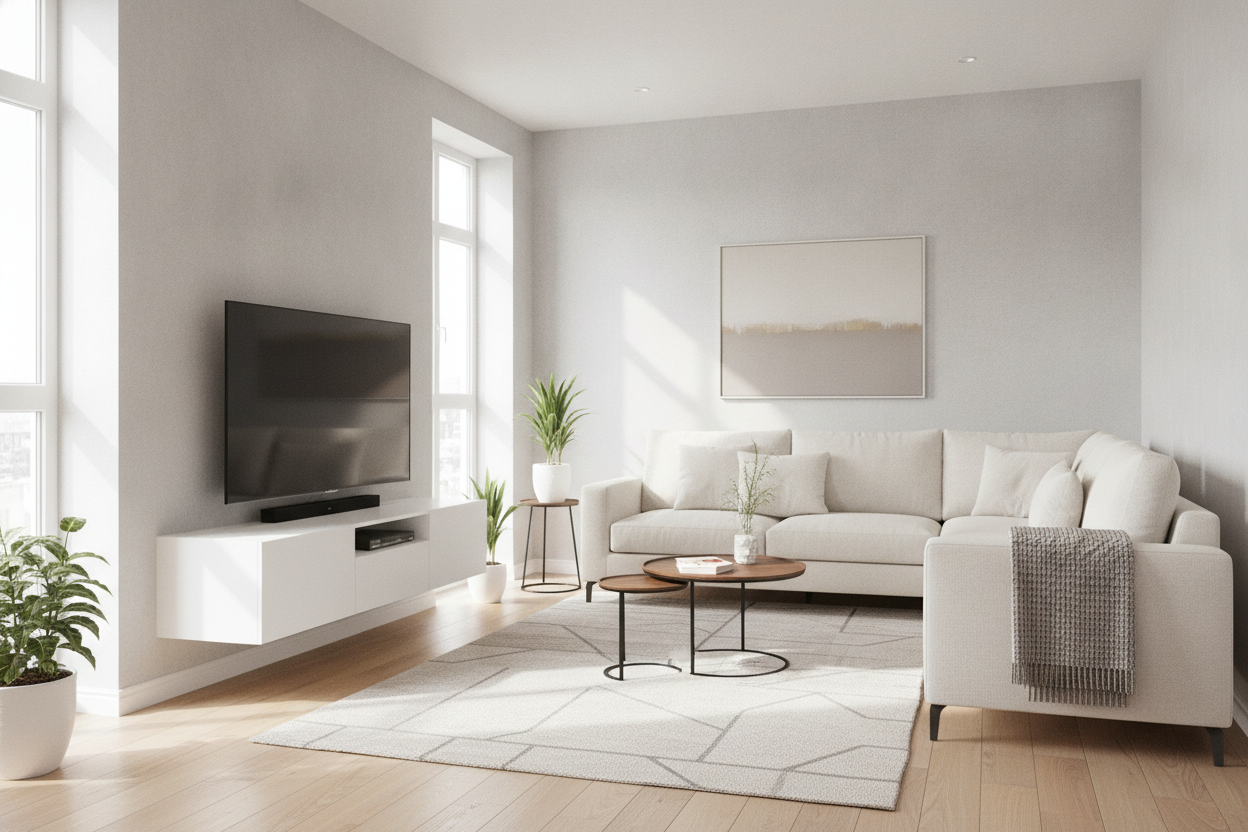
I spent three years shuffling around a massive, 60-inch oak sideboard that I bought because I thought I needed 'serious storage.' In reality, that bulky box just collected dust bunnies and made my 250-square-foot living area feel like a walk-in closet. Every time I walked past it to get to the kitchen, I had to do a weird sideways shimmy. It was the visual equivalent of wearing a heavy winter coat in a sauna.
The breaking point came when I realized I hadn't opened the bottom cabinets of that console in six months. I was sacrificing precious floor real estate for a pile of old HDMI cables and a Wii I haven't touched since 2012. I decided to ditch the footprint entirely and mount a 55 inch floating tv stand. It was the best layout decision I've made since moving in.
- Reclaimed Floor Space: Seeing the baseboards continue under the furniture makes a room feel instantly wider.
- Easier Cleaning: You can actually run a vacuum or a Roomba under the unit without moving a 100-pound cabinet.
- Modern Aesthetic: It creates a clean, 'built-in' look that makes a rental feel like a custom home.
- Cable Management: Most floating models are designed specifically to hide the 'spaghetti' of wires behind the unit.
The Day I Realized My Floor Console Was the Enemy
My old living room setup was a classic mistake. I had a 55-inch screen sitting on top of a unit that sat flush against the floor. In a small apartment, floor space is the most valuable currency you have. When you put a solid block of wood on the ground, your eye stops right at the front of that furniture. It creates a hard boundary that shrinks the room. I spent weeks scrolling through traditional Tv Stands, trying to find one with taller legs to 'lighten' the look, but even then, the legs just created more obstacles for my vacuum.
I realized that the 'heaviness' of the room wasn't coming from my clutter—it was coming from the furniture itself. The floor console acted like an anchor, but not the good kind. It anchored the room in a state of permanent cramped-ness. I needed something that felt like it was part of the architecture, not just another piece of luggage I was hauling around. That is when I pivoted to the wall-mounted approach. The goal was simple: I wanted to see my floor again.
Why the Floating Route is the Ultimate Small-Space Hack
The secret to small-space design is 'negative space.' When you can see the floor extend all the way to the wall, your brain registers the entire square footage of the room. A floating console tricks the eye into thinking the area is significantly larger because the floor isn't 'interrupted.' I found that I Spent Months Hunting For A 55 Inch Tv Stand That Wasnt Hideous, and the struggle was real. Most of what I found was either cheap-looking particle board that would sag in a week or massive units meant for suburban mansions.
When I finally landed on a 55-inch model that matched my screen width, the transformation was immediate. It wasn't just about the physical inches saved—it was the visual relief. Suddenly, the wall didn't look like it was leaning in on me. I opted for a unit with a slim profile, about 10 inches deep. This was enough to hold my soundbar and a few decorative items without sticking out so far that it became a head-bonking hazard. If you are working with a narrow living room, that depth is the difference between a clear walkway and a constant bruise on your hip.
Getting the Proportions Right for a Mid-Size Screen
Proportions are where most people mess up. A 55-inch TV actually measures about 48 inches wide. If you buy a 48-inch stand, it looks like a hat that is two sizes too small. You want the console to be at least a few inches wider than the screen on both sides to create a balanced 'frame.' This visual weight distribution prevents the TV from looking like it's about to tip the shelf over.
I also learned that mounting height is everything. There is a specific reason Why Your New Tv Stand For 55 Inch Tv Probably Feels Too Short if you just eyeball the height. You want the center of your TV at eye level when you are seated. I mounted my console about 12 inches off the floor, which left enough room for the screen to sit comfortably above it without making me crane my neck. It creates a cohesive 'media zone' rather than just a screen hanging in a void.
Is a Floating TV Stand for 55 Inch TV Actually Sturdy?
The number one question I get is: 'Is that thing going to rip out of the wall and crush my PlayStation?' It’s a valid fear. Most of these units are made of MDF or thin plywood, and if you just use the plastic anchors that come in the box, you are asking for a disaster. Drywall is basically compressed chalk; it cannot hold 40 pounds of furniture plus a TV and electronics on its own.
Here is the truth: you must find the studs. Most modern apartments have wood or metal studs spaced 16 inches apart. I used a $20 stud finder and made sure at least two of the main mounting screws went directly into the wood. If your studs don't line up perfectly with the mounting holes, don't panic. You can use 1/4-inch toggle bolts (the ones with the metal wings) for the secondary holes. I’ve had my setup for a year now—including a cat that thinks the console is a launching pad—and it hasn't budged a millimeter. If you are worried about weight, look for a unit with a 'cleat' mounting system. It distributes the weight across a longer horizontal strip of wood, making it much more stable than individual brackets.
What to Do With the Space Underneath
Once you have that glorious gap between the furniture and the floor, the temptation is to fill it immediately with 'stuff.' Resist that urge. If you shove six wicker baskets under there, you’ve just built a floor console again, but with extra steps. I kept mine mostly clear to maintain that airy feeling. I placed one low-profile snake plant on the left side and a single woven pouf on the right for extra seating when friends come over.
If you have a massive wall and feel like a 55-inch unit looks too lonely, you might want to look at something like the 110 Floating High Gloss Tv Stand With Led Light. It’s a beast of a unit that spans a much larger area, which is great for filling a 'dead' wall without adding the bulk of a floor-standing cabinet. For my small space, though, keeping it compact was the key. The 'floating' effect works best when there is enough empty space around the unit to let it breathe. My living room finally feels like a place where I can relax, not just a storage unit for my electronics.
FAQ
Can I mount a floating TV stand on a rental wall?
Yes, but you will have to patch the holes when you move. It is no different than hanging a heavy mirror. Just keep the drywall plugs and a small tub of spackle handy for move-out day.
How do I hide the wires?
Most floating stands have a 'wire management' hole in the top and bottom. If you can't run wires behind the wall, use a paintable cable raceway. It’s a plastic strip that sticks to the wall and hides the cords; once you paint it the same color as your wall, it virtually disappears.
What is the weight limit for these things?
Most 55-inch models are rated for 50-70 pounds. A modern 55-inch LED TV usually weighs around 30-35 pounds, so as long as you are secured into studs, you have plenty of overhead for a soundbar and some decor.

Leave a comment
This site is protected by hCaptcha and the hCaptcha Privacy Policy and Terms of Service apply.