










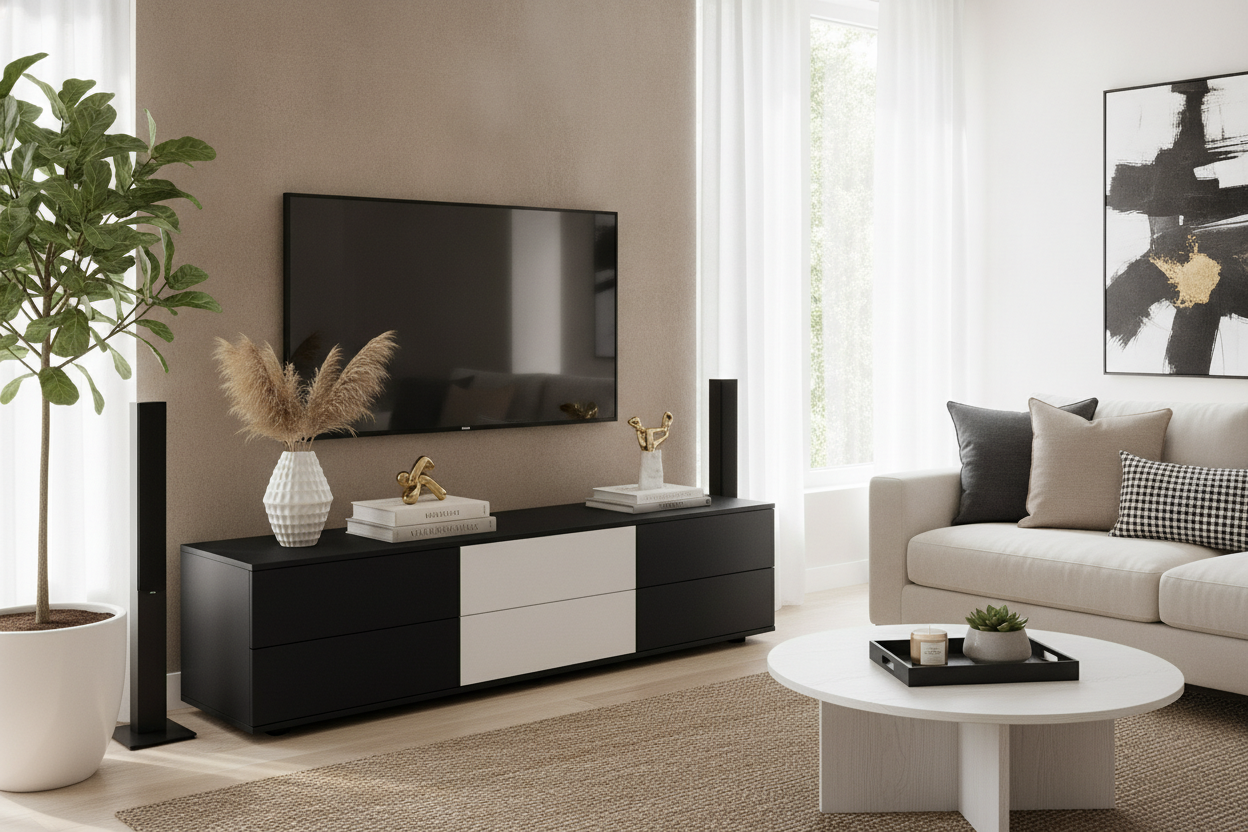
I remember staring at my first 'modern' living room setup and realizing it looked less like a home and more like a Best Buy waiting room. I had bought a black and white tv stand thinking it was the peak of sophistication, but against my gray walls, it just felt cold. It is a common trap: you want clean lines, but you end up with a space that feels like it belongs to a bachelor who only eats protein shakes and owns zero books.
- Avoid ultra-glossy finishes to keep the room from looking like a tech showroom.
- Layer in organic textures like terra cotta, linen, or woven seagrass.
- Use matte black accents to ground the white surfaces without adding glare.
- Introduce at least one wood element to 'thaw' the high-contrast look.
The 'Tech Showroom' Trap (And Why High Contrast Goes Wrong)
The problem with modern black and white tv stands is the starkness. When you put a 65-inch black rectangle (your TV) on top of a bright white base, it creates a visual strobe effect that’s hard on the eyes. If you go too heavy on the high-gloss lacquer, you are also dealing with why modern white furniture sometimes looks cheap—it reflects every single LED from your router and every speck of dust like a spotlight.
High contrast is a bold move. In a room with zero other textures, a black and white media console screams for attention in all the wrong ways. It’s loud, it’s rigid, and it’s clinical. To make it work, you have to stop treating it like a piece of tech and start treating it like a piece of furniture that needs to be 'dressed.'
Soften a Black and White TV Console With Unexpected Textures
I have found that the only way to save a white and black tv console is to mess it up a little. Not with actual mess, but with 'organic friction.' Think a trailing Pothos plant in a matte clay pot or a stack of vintage books with worn, linen spines. The goal is to break up those long, hard horizontal lines with something that looks like it grew in the dirt.
If you have a sleek white black tv stand, the sharp corners need to be softened. I usually throw a chunky knit basket on the floor next to it to hide extra throw blankets. The juxtaposition of the smooth, manufactured finish of the stand against the rough, hand-woven texture of a basket makes the whole corner feel intentional rather than sterile.
Rethinking the Classic White TV Stand With Black Top
A white tv stand with black top is actually a genius design hack for hiding the 'black hole' of a turned-off television. Since the top surface is dark, the TV blends into the furniture rather than floating awkwardly above it. It creates a continuous vertical line that makes the screen feel less like a massive appliance and more like a part of the architecture.
When you browse different tv stands, look for matte or wood-grain black tops rather than glass. Glass tops are a nightmare for fingerprints and static-clung dust. I like to style these by leaning a small, framed sketch against the wall next to the TV. It overlaps the black top and the white wall, bridging the gap between the furniture and the rest of the room.
Bridging the Gap: Why Wood Tones Are Your Secret Weapon
Wood is the secret sauce that makes high-contrast furniture liveable. I once traded a dusty black console for a lighter setup and immediately realized the room felt hollow. Adding a walnut tray or a couple of oak candle holders on a black and white tv stand changes the entire energy. It pulls the piece back from 'futuristic lab' to 'actual living room.'
Even if it is just a small wooden bowl for your remotes, that hit of medium-toned wood (like white oak or walnut) provides a middle ground between the extreme white and extreme black. It gives the eye a place to rest. Without it, the contrast is so high it can actually make your living room feel smaller because the furniture is 'cutting' the space into harsh slices.
How to Style a Black and White Entertainment Center Without Clutter
Large units like a black and white entertainment center can get overwhelming fast. My personal rule is the 70/30 rule: 70% of the shelves should be functional or empty space, and 30% should be 'the pretty stuff.' If you use a black and white entertainment center with overhead cabinets, use that closed storage to hide the ugly tech—the mesh routers and the tangled HDMI cables.
For the open shelves, avoid using only black or white decor. If you put a white vase on a white shelf, it disappears; put it on a black shelf, and it’s a siren. Instead, use tonal colors like sage green, terracotta, or navy. This makes the white and black entertainment center feel like a curated gallery rather than a storage unit for a 2012 bachelor pad. Keep your 'tech' items tucked away so the furniture can actually breathe.
FAQ
Does black and white furniture show more dust?
Yes, especially the black surfaces. Glossy black is the worst offender for showing every fingerprint and dust mote. I keep a microfiber cloth tucked in a drawer for a quick 10-second wipe-down before guests arrive.
Can I mix metals with a black and white stand?
Absolutely. Brushed brass or antique gold looks incredible against black. I would avoid too much chrome or polished silver, as it can make the whole setup feel a bit too cold and '80s office' for a cozy home.
How do I hide cables on a white stand?
Use white cable raceways or zip-tie the black cables to the back of the black legs or supports so they disappear. Never let a black power cord dangle across a white panel; it’s the fastest way to make expensive furniture look cheap.

Leave a comment
This site is protected by hCaptcha and the hCaptcha Privacy Policy and Terms of Service apply.