









How to tell if a dresser is good quality, in short: open every drawer and check that it glides smoothly on metal slides, stops before it falls out and holds a real weight rating; then look at how the case is joined, whether the back panel is solid and fixed in place, what the panels are made of, and whether a tip-over kit is included. A good quality dresser feels stable when you push it, keeps even gaps around the drawer fronts and comes with clear specs and a warranty.
Whether you are buying furniture online, in a showroom or at an estate sale, this guide turns those checks into a spec checklist, explains solid wood vs. manufactured wood honestly, and shows what each spec looks like on real listings in the FUFU&GAGA dressers and chests collection.
The Quick Quality Checklist
| Spec to check | Better | Red flags |
|---|---|---|
| Drawer Glide Type & Extension | Metal ball-bearing or roller slides; full extension | Bare wood-on-wood runners that stick; drawers that sag when open |
| Drawer Safety Stop | Yes | Drawers pull straight out and drop |
| Largest Drawer Weight Capacity | A stated rating, higher on deep drawers | No rating at all |
| Main Wood Joinery Method | Dovetail, mortise and tenon, dowels, or reinforced joints with metal cam fittings | Staples and glue only |
| Finished Back | Yes, fixed panel that squares the case | Flimsy back held by a few nails |
| Material | Solid wood, plywood or MDF with a durable finish | Low-density board with peeling edges |
| Tipover Restraint Device Included | Yes | No kit and no anchoring instructions |
| Interlocking Drawers | A bonus on tall pieces | Not a deal-breaker if the unit is anchored |
1. Drawer Glides: Ball-Bearing, Roller or Wood
Drawers are the part of a dresser you use every day, so drawer glides are the first place quality shows. Pull each drawer all the way out and push it back in.
- Ball-bearing metal slides: the smoothest and usually the strongest option; steel balls roll in a track, and many are full extension, so you can reach the back of the drawer. The 31.5" natural rattan 5-drawer chest uses ball-bearing slides with a 55 lb rating on the largest drawer.
- Roller glides on metal slides: common on flat-pack dressers, quiet and easy to replace. Many open about three-quarters of the drawer depth rather than fully.
- Wood slides: traditional on solid wood furniture. Well-made wood runners can last for decades, but cheap ones stick in humid weather.
In the FUFU&GAGA range, nearly every dresser uses metal slides: 29 combine roller glides with metal slides, 4 use ball-bearing slides and one uses wood slides. Whatever the type, the drawer should run straight without wobbling side to side.
2. Drawer Safety Stop and Weight Capacity
A drawer safety stop keeps the drawer from coming all the way out and landing on your feet. 57 of the 77 FUFU&GAGA dresser listings state one. You should feel a firm stop, not a loose clunk.
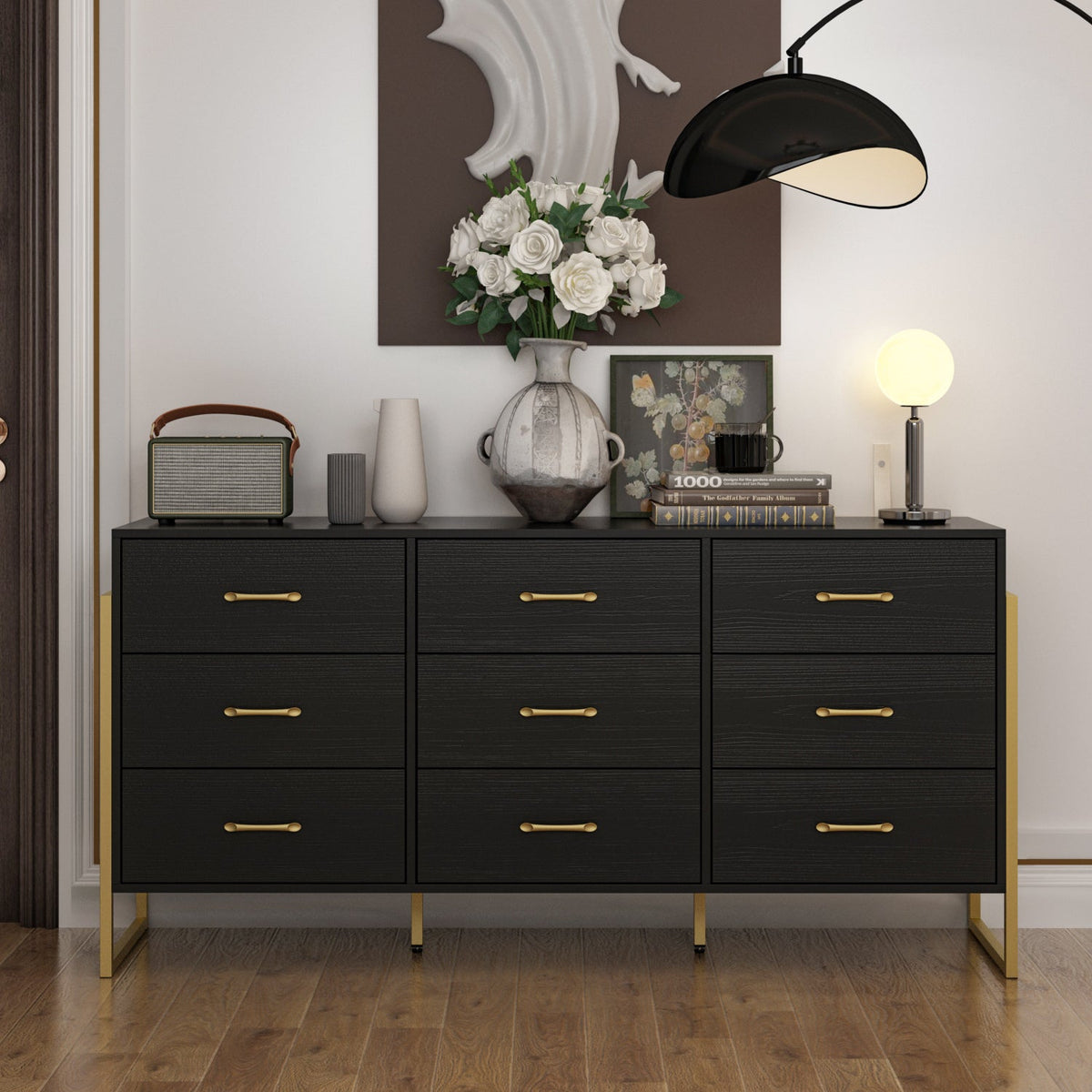
The "Largest Drawer Weight Capacity" spec tells you how much the biggest drawer is designed to carry. In our range it runs from 11 lb on shallow display drawers to 55 lb on deep ones. Folded jeans and sweaters add up quickly, so for everyday clothes favor a higher rating on the big drawers; save the low-rated shallow drawers for accessories. The 63" rustic white 9-drawer dresser is rated at 55 lb, and the 61.4" black 9-drawer dresser at 40 lb.

Also look at the drawer box. Drawer bottoms should be thick enough not to flex when you press the middle, and the bottom should sit in a groove rather than be stapled to the underside.
3. Joinery: How the Case and Drawers Are Held Together
Joints decide whether a dresser stays square after years of drawers being slammed. Classic quality joinery includes:
- Dovetail joints on drawers, where interlocking "tails" and "pins" join the drawer front to the sides. Dovetails are noted for resisting being pulled apart, which is exactly the force a drawer front takes (dovetail joint).
- Mortise and tenon joints on frames and legs.
- Dowel, rabbet and biscuit joints, which add glue surface and alignment.
Most flat-pack furniture, including most of the FUFU&GAGA range, uses basic butt joints held by cam locks, dowels and screws so you can assemble it at home. That is not automatically lower quality, but it does mean assembly matters: tighten every cam fully, do not over-drive screws into MDF and add the back panel before loading drawers. A few models list a rabbet joint, such as the 63" 8-drawer double dresser with high-gloss drawers, which also lists kiln-dried wood. Check underneath and inside the case for corner blocks or metal brackets that stop the frame from racking.
4. The Back Panel
The back panel is easy to ignore, but it is a big part of a dresser's structural integrity: it keeps a wide case from leaning into a parallelogram. A good back is fixed into a groove or screwed along the edges, not just tacked on with a few nails. A "Finished Back" spec means the back is painted or laminated like the rest of the piece, so the dresser can face into the room or work as a room divider; 59 FUFU&GAGA listings state a finished back.
5. Quality Materials: Solid Wood vs. Manufactured Wood
Solid wood is the traditional mark of quality furniture. Hardwoods like oak and maple are dense and durable, can be sanded and refinished, and solid wood furniture from good quality wood can age beautifully and generally outlasts particle board. Solid wood construction also costs more and moves slightly with seasonal humidity. Ask the manufacturer or check the spec sheet for which parts are solid: on many pieces the frame, legs or top are solid wood while drawer boxes and sides use other materials.
Manufactured wood is not a red flag by itself. The main types are:
- Plywood: thin layers glued with the grain crossed; strong and stable, often used for backs and drawer bottoms.
- Medium density fiberboard (MDF): wood fibers pressed with resin into dense, smooth panels. It is more uniform than natural wood and denser than plywood or particle board, but it can swell if soaked and holds screws poorly at the edges (MDF overview).
- Particle board: larger wood chips and resin; the lightest and least durable of the three.
- Veneer: a thin layer of real wood glued over a core. Good veneer over plywood or MDF is normal in high end furniture; a thin veneer that is peeling at the edges is a red flag.
In the US, composite wood panels (hardwood plywood, MDF and particleboard) and finished goods containing them must meet formaldehyde emission limits and be labeled TSCA Title VI compliant (EPA). Most FUFU&GAGA dressers combine solid wood with MDF, 62 list MDF as the manufactured wood type and 4 list particle board. If you want an all-solid piece, the 47.2" solid wood chest of drawers arrives fully assembled.
How to spot real wood
- Grain pattern: real wood grain, whether straight grain or swirling figure, continues over the edge onto the side and never repeats exactly; a repeating, printed grain pattern is a laminate.
- Edges and underneath: look at an unfinished edge or check underneath the top. Visible fibers or chips mean MDF or particle board.
- Weight: heavier furniture often signals solid wood or dense panels, though MDF is heavy too. Most 63" FUFU&GAGA 9-drawer dressers list an overall weight of about 107–143 lb, and the 70.9" models about 193–198 lb.
6. Stability and Tip-Over Safety
Push gently on the top corner of an assembled dresser. A well built one does not wobble or rack. Then check the safety specs:
- Tipover Restraint Device Included: 57 of the 70 FUFU&GAGA listings with safety data include a kit. Federal rules for clothing storage units (STURDY Act, incorporating ASTM F2057) require stability testing and a packaged anti-tip device for free-standing units 27" or taller and at least 30 lb made after September 1, 2023 (CPSC).
- ASTM F2057: some listings state compliance directly, such as the 31.5" white 6-drawer tall chest.
- Interlocking drawers: an interlock lets only one drawer open at a time, which reduces the forward weight shift. It is rare on bedroom dressers; anchoring matters more.
Whatever you buy, anchor it. Our step-by-step guide on how to anchor furniture to the wall covers studs, drywall anchors and straps.
7. Finish and Hardware
Run your hand over the top and drawer fronts. A quality finish is smooth and even, with no rough spots, drips or bare edges. Handles and knobs should be metal or solid wood and attached with screws through the drawer front, not glued on. Drawer fronts should line up with even gaps all around.
Buying Old Furniture: Used and Vintage Dressers
Vintage furniture and antique furniture from estate sales can be great value if the bones are good, and many vintage pieces were built from natural materials with a timeless design. The same principle applies as with new pieces: check the drawers, joints and back panel first. Look for dovetail joints, solid wood, a maker's mark inside a drawer and original hardware. Surface scratches can be refinished and loose joints repaired; water damage, a musty smell, swollen particle board or a cracked frame are reasons to walk away. Ask about the piece's history and inspect the entire piece, including the back and underside, before you pay. An older solid wood dresser that has been refinished well can be worth bringing home.
Red Flags Before You Buy
- No specs for drawer glides, weight capacity or materials.
- Drawers that drop, scrape or wobble when open.
- A back panel of thin board held by a few nails.
- Peeling veneer or chipped edges showing low-density board.
- No tip-over kit or anchoring instructions.
- No warranty or replacement parts. FUFU&GAGA furniture bought on our site has a 2-year limited warranty and a replacement parts service.
The same logic works for other furniture pieces, from dining tables to upholstered furniture: judge construction first and looks second. Quality pieces show it in the details. Use the checklist above on any dresser listing, then compare the specs side by side in our dressers and chests collection. If size is your next question, see our standard dresser dimensions guide.
FAQ
How can you tell if furniture is high quality?
Check construction before looks: smooth drawers on metal slides, strong joints, a solid back panel, dense materials, an even finish and stable footing. Clear specs and a real warranty are good signs too.
What is the 2/3 rule in furniture?
It is a proportion guideline: a piece should be about two-thirds the size of what it relates to. For example, a coffee table about two-thirds the length of the sofa, or a mirror about two-thirds the width of the dresser below it.
What should I look for when buying a dresser?
Measure your space first, then check drawer glides, drawer weight capacity, joinery, back panel, materials and whether a tip-over kit is included. Match the drawer sizes to the clothes you actually store.
How do I know if my dresser is worth money?
Older solid wood dressers with dovetail joints, a maker's mark, original hardware and good condition tend to hold value. Mass-produced particle board pieces usually do not. An appraiser or a local antique dealer can give a real estimate.



Leave a comment
This site is protected by hCaptcha and the hCaptcha Privacy Policy and Terms of Service apply.