










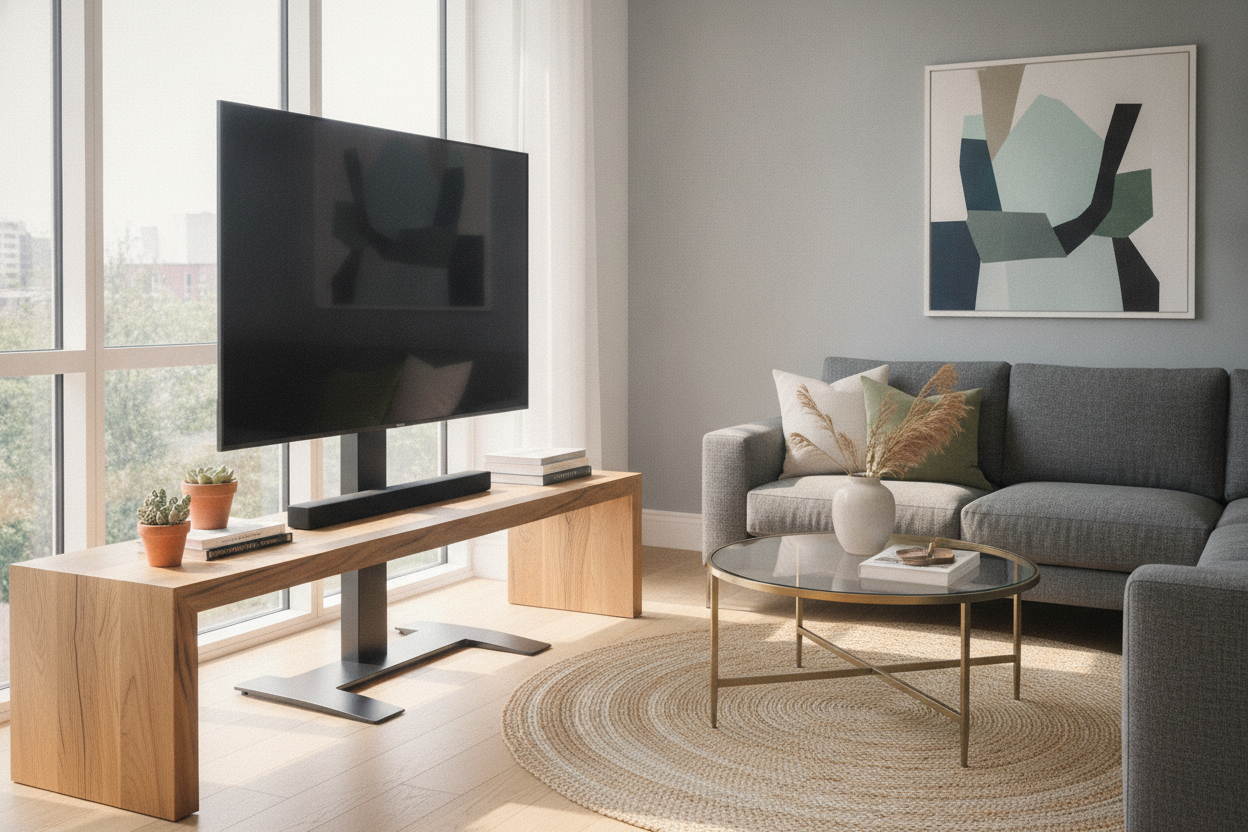
I remember the exact moment I realized I had a problem. I’d just spent six months hunting for a pristine, 1960s teak credenza on Marketplace, and my brand-new 65-inch OLED arrived the next day. I unboxed the screen, went to attach the factory legs, and my heart sank. The legs were positioned at the extreme corners of the display, and they were exactly two inches wider than my beautiful vintage wood. I was staring at a $1,500 screen that wouldn't even sit on its intended home.
I didn't want to drill into my plaster walls—renting is fun, isn't it?—and I certainly wasn't going to let the edges of my TV hang precariously over the side of the teak. I needed a stand for tv on table that actually looked like it belonged in a grown-up's living room. After three hours of scrolling, I found the solution: a heavy-duty central VESA mount that replaced those flimsy plastic 'chicken feet' entirely.
Quick Takeaways
- Factory TV legs are often too wide for vintage or narrow furniture.
- A central VESA-mounted base concentrates weight safely in the middle of your console.
- Swivel functionality is a massive perk for open-concept living rooms.
- Tempered glass bases provide the necessary weight to prevent tipping.
The Problem With Modern Flatscreen Feet
Most TV manufacturers seem to assume you’re living in a showroom. They design these ultra-wide, spindly legs that require a massive footprint. Unless you have a modern TV stand with cabinets specifically built to handle a 60-inch-wide stance, you're going to have overhang. It looks messy, and more importantly, it's a tipping hazard waiting to happen.
Beyond the size, these factory legs are almost always made of cheap, textured plastic. They scratch delicate wood finishes the second you try to nudge the TV an inch to the left. I've seen too many people forced into a panic tv table buy just because their new screen wouldn't fit on the perfectly good furniture they already owned. It’s a waste of money and a waste of perfectly good wood.
Why I Ditched the Factory Plastic
The moment I realized I needed a replacement table stand for tv was when I saw the slight bow in the middle of a cheaper console I used to own. When weight is distributed to the far edges, the center of your furniture isn't doing any work. By switching to a central pedestal, you’re putting the load exactly where the furniture is strongest. For my antique teak piece, this was non-negotiable.
If you're dealing with a screen larger than 55 inches, you can't just grab the cheapest mount you find. You need something substantial. I ended up looking for a table top TV stand 75 inch base even though my TV was smaller, just to ensure the steel gauge was thick enough to prevent wobbling. It’s about peace of mind. I don't want my screen to shimmy every time someone walks heavy-footed past the media center.
How to Pick the Right Stand for TV on Table Setup
When you're shopping, ignore the marketing fluff and look at three things: VESA compatibility, base material, and height adjustability. VESA is just the standard measurement for the four holes on the back of your TV. Most 'table stand tv' options support everything from 200x200 to 600x400, but check your manual anyway. I once bought a stand that was 'universal' only to find my specific Sony model had a weird recessed mounting area.
Go for a tempered glass base. It sounds counter-intuitive—isn't glass fragile?—but in this context, it's about mass. A heavy glass base lowers the center of gravity. Also, look for a swivel feature. Being able to turn the screen 30 degrees toward the dining table while I’m eating, then back to the sofa for a movie, is a luxury I didn't know I needed. It makes the whole room feel more functional without moving a single piece of furniture.
Managing the Cable Chaos (The Unexpected Bonus)
One thing I didn't expect was how much cleaner my 'tv equipment stand' looked once I got rid of the factory legs. Most central pedestals have a hollow column or clips in the back. I managed to tuck two HDMI cables and the main power cord directly behind the pillar, making them invisible from the front. It’s a level of cable management you just can't get with those wide-set legs.
If you’re someone who hates seeing a 'www tv stand' aesthetic—you know, the one where wires look like a plate of black spaghetti—this is the easiest fix. Of course, if you prefer a look where everything is completely enclosed, you might opt for a sleek entertainment center high gloss unit. But for those of us who love our open-leg vintage furniture, a central column is the only way to keep things tidy.
Before You Upgrade Your Base (Read This)
Before you commit to a new stand for tv equipment, do a quick sanity check. First, measure the depth of your table. Some heavy-duty bases are quite deep (11-13 inches), and you don't want the base itself hanging off the front. Second, check the weight capacity. Most steel stands handle up to 80 or 100 pounds easily, which is plenty for modern LED screens, but older plasmas might be too heavy.
Finally, check the height. One mistake I made was mounting the TV too high on the pillar, which created a 'neck-strain' situation. Most good stands let you choose from 3-4 height positions. Aim for the middle of the screen to be at eye level when you're seated. Trust me, your chiropractor will thank you.
FAQ
Will a universal stand fit any TV?
Almost any modern flat screen will work as long as it has VESA mounting holes on the back. Just check the weight limit and the VESA pattern (like 400x400mm) against the stand's specs.
Are these stands stable enough for homes with pets?
Yes, provided you choose one with a heavy tempered glass or steel base. They are often more stable than the flimsy plastic legs that come in the box because the center of gravity is much lower.
Do I need special tools to install a table stand?
Usually, no. Most come with an Allen wrench. You'll just need a standard Phillips head screwdriver to attach the brackets to the back of your television.

Leave a comment
This site is protected by hCaptcha and the hCaptcha Privacy Policy and Terms of Service apply.