










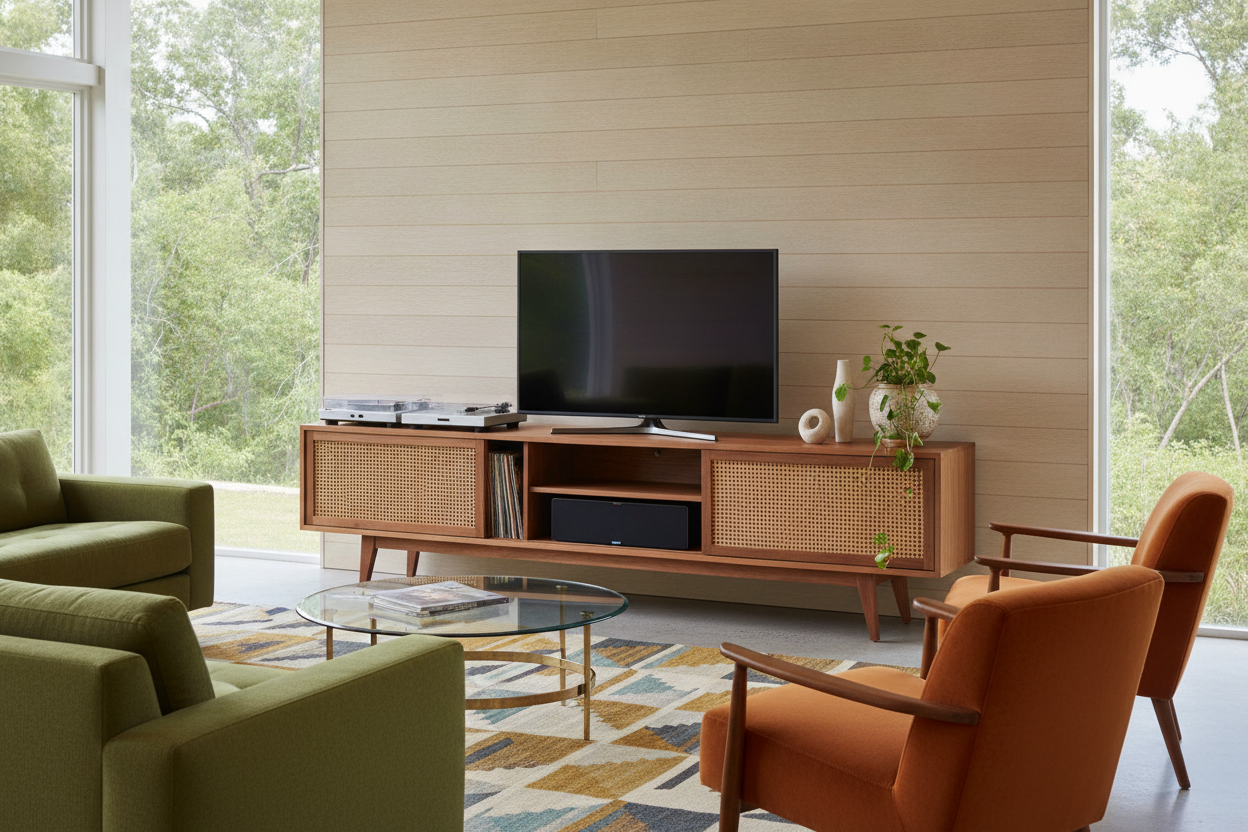
I spent three months scouring vintage shops for the perfect walnut coffee table, only to realize my living room still felt cluttered and cheap. The culprit wasn't the furniture; it was the tech creep. Between the chunky soundbar, the blinking Wi-Fi router, and the gaming console that looks like a futuristic skyscraper, my 1960s aesthetic was dying a slow death under a pile of black plastic.
Buying a mid century modern tv stand 70 inch wasn't just about finding a place to put the screen. It was a strategic move to reclaim my visual peace. I needed something wide enough to anchor the wall and smart enough to hide the gear without making my remote control useless.
- Slatted doors allow sound and IR signals to pass through while hiding the mess.
- A 70-inch width is the golden ratio for 55-inch and 65-inch televisions.
- Solid wood legs are essential—don't trust flimsy plastic pegs with a heavy console.
- Cable management cutouts are the difference between a clean look and wire spaghetti.
The Problem With New Tech in a Retro Room
We all want that Don Draper living room vibe, but Don Draper didn't have to deal with a mesh router system or a soundbar that looks like a tactical baton. Most modern electronics are designed with a cold, industrial aesthetic that clashes horribly with the warm wood tones and organic curves of mid-century design. When you place a sleek 65-inch OLED on a stand that's too small or too modern, the whole room feels off-balance.
I realized that the more tech I added, the more my living room looked like a dorm room. The goal was to find a piece of furniture that acted as a camouflage. I wanted the warmth of acorn-finished oak or walnut, but with the internal guts to handle 2024 technology. That is where the specific search for a 70 inch mid century modern tv stand started—I needed the footprint to be substantial enough to dominate the wall and swallow the clutter.
The 'Slatted Door' Cheat Code for Soundbars
If you put a soundbar inside a cabinet with solid wood doors, you’ve basically just muffled your expensive audio into a cardboard box. This is why I specifically hunted for a mid-century modern TV stand with slatted doors. It is the ultimate design hack for the audio-obsessed. The gaps between the wood slats are wide enough to let sound waves through without any noticeable distortion, but narrow enough that the black plastic box inside stays invisible to the naked eye.
The real magic, though, is the infrared (IR) signal. Most remotes still need a line of sight to talk to your devices. Slatted doors act like a sieve—they let the signal from your Apple TV or Roku remote pass right through. I can keep the doors shut, the room looking tidy, and still change the volume without having to stand up and point my remote at a specific crack in the wood. It’s the closest thing to magic in the furniture world.
Why I Chose a 70-Inch Width (And Not a Centimeter Less)
Size matters, but not for the reason you think. If you have a 65-inch TV, it actually measures about 57 inches wide. If you put that on a 60-inch console, you only have an inch and a half of space on either side. It looks cramped, top-heavy, and frankly, a bit cheap. By opting for a mid century modern tv console 70 inch, I gave the TV about six inches of breathing room on each side. This allows for a couple of ceramic vases or a small plant, which softens the transition from the screen to the wall.
I've seen people try to squeeze a massive screen onto a tiny stand, and it always looks like the furniture is gasping for air. If you are planning on upgrading to a 75-inch model down the road, you might even want to go wider. But for the standard 65-inch setup, 70 inches is the sweet spot. It anchors the room without making the TV look like it's about to tip the whole unit over.
What I Actually Hide Inside This Console
Inside my console, it’s a different story than the polished exterior. Behind those slatted doors, I have a mesh Wi-Fi node, a Nintendo Switch dock, a massive 12-outlet power strip, and enough HDMI cables to wire a small office. I highly recommend you browse different TV stands that offer adjustable interior shelving. My router is surprisingly tall, and being able to drop the shelf by two inches saved me from having to keep it on top of the unit.
The mistake I made with my last stand was buying something with a solid back and no ventilation. Electronics get hot. A good mid-century piece should have pre-drilled holes for airflow and cable routing. My PS5 stays cool because the slatted front allows for constant air exchange, unlike those airtight cabinets that turn your gaming console into a slow cooker.
Say Goodbye to the 'Wire Spaghetti' Look
There is nothing that ruins a grown-up living room faster than a tangle of dusty black cords hanging down the wall. A substantial mid century tv stand 70 inch acts as a literal shield. Because it sits low to the ground and has a wide profile, it covers the wall outlets completely. All the 'wire spaghetti' stays contained within the wood carcass, routed through the back panels, and kept off the floor.
Switching to this setup made my living room feel intentional rather than accidental. It’s no longer a room where I happen to watch TV; it’s a designed space where the technology is a guest, not the host. If you’re tired of your soundbar staring you in the face, go for the slats. Your eyes (and your speakers) will thank you.
Is a 70-inch stand too big for a small apartment?
Actually, no. A longer, lower console can make a room feel wider. Just measure your wall first—you want at least 12 inches of clearance from the corners so the room doesn't feel choked.
Do slatted doors really not block the remote?
Correct. As long as the slats have a gap of at least a quarter-inch, most modern IR remotes work perfectly. Bluetooth remotes (like Fire Stick or Apple TV) don't need line-of-sight anyway, so they work through solid wood too.
Should I get solid wood or veneer?
Solid wood legs and frames are a must for durability. For the large flat surfaces like the top, a high-quality walnut veneer is actually often more stable than solid wood, which can warp over time due to the heat from your TV.

Leave a comment
This site is protected by hCaptcha and the hCaptcha Privacy Policy and Terms of Service apply.