










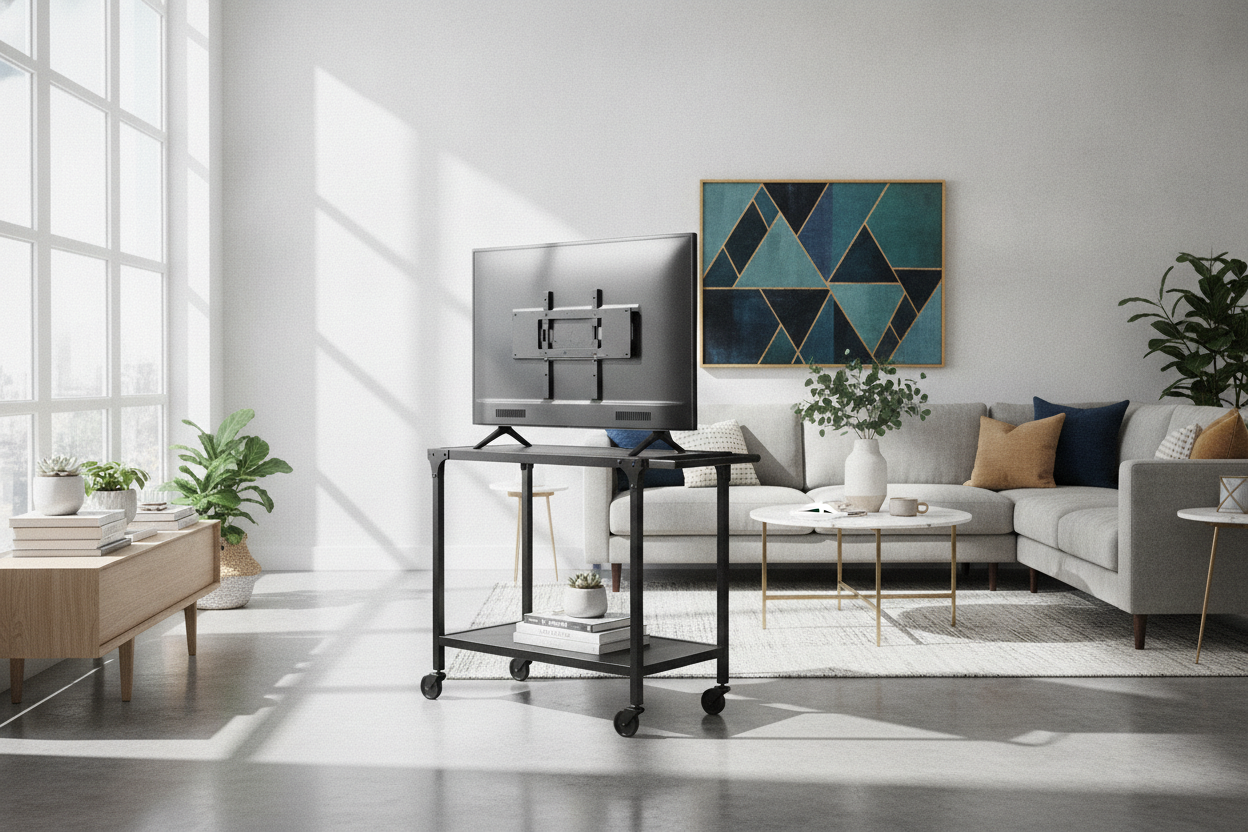
I spent three years living in a 600-square-foot apartment where a massive, espresso-colored media console dictated my entire life. It was heavy, it gathered dust bunnies like a magnet, and it forced my sofa into exactly one position. Last month, I finally got fed up and swapped that beast for a target tv cart.
The difference was immediate. Suddenly, my living room didn't feel like a showroom for a TV stand; it felt like a place where I could actually move around. If you’re tired of your furniture making the rules, this might be the best $100 you ever spend.
- Carts have a much smaller footprint than traditional cabinets.
- Locking casters make the setup surprisingly stable for daily use.
- They are significantly cheaper than most solid wood or MDF furniture.
- You can move your TV to any room or angle in seconds.
The Problem With Heavy, Boxy Media Consoles
Traditional media consoles are designed for houses, not city apartments. They usually sit about 18 to 20 inches deep and run five feet long. In a narrow room, that’s a massive chunk of floor space gone forever. I used to spend hours trying to push my old stand into different angles, but it always looked like a mistake.
It’s a common trap. We think we need all those drawers and shelves for storage, but usually, we just fill them with old HDMI cables and manuals for appliances we don't own anymore. People often make The Big Mistake We Make With Corner TV Stands for Flat Screen TVs by trying to wedge a square peg into a round hole just to save a few inches of walkway.
The boxy console creates a visual dead zone. Because it sits flush against the floor, it stops the eye and makes the room feel smaller. Switching to a cart with open legs and wheels creates negative space, which is a fancy way of saying your floor continues under the furniture, tricking your brain into thinking the room is bigger than it is.
Enter the Rolling Cart: My $100 Layout Hack
I found my industrial-style cart at Target for just under a hundred bucks. It arrived in a flat box that I could actually carry up the stairs by myself—a major win compared to the two-person lift required for most target flat screen tv stands. I was worried the metal would feel cheap or flimsy, but the matte black finish actually looks quite sophisticated against a white wall.
Assembly took me about 35 minutes. It’s mostly just threading bolts into the frame and snapping the casters into the base. I didn't need a drill or a degree in engineering. There’s something satisfying about furniture that doesn't require a weekend-long commitment to put together.
The first time I rolled it into place, I realized I could finally center the TV with my sofa without blocking the radiator. If I wanted to host a dinner party and needed more floor space for guests, I could just wheel the whole setup into the bedroom for the night. That kind of flexibility is impossible with a standard cabinet.
Are Target TV Stands for Flat Screens Actually Sturdy on Wheels?
This is the question everyone asks: Is it going to tip over? I have a 55-inch LED TV, which isn't exactly light. I was terrified that hitting the transition strip between my hardwood floor and my area rug would send $500 worth of tech crashing down. But the physics of these carts are actually pretty sound.
The base is wider than the top, creating a low center of gravity. Most target tv stands for flat screens designed as carts use heavy-gauge steel for the uprights. It doesn't wobble when I walk past it, and the locking wheels are surprisingly grippy. I’ve rolled it over thick rugs and even a stray power cord without any heart-stopping tilts.
When you compare this to bulky alternatives, you realize you don't need 80 pounds of MDF to hold a 30-pound TV. You can Stop Guessing: Solid Wood Corner TV Stands Flat Screens Actually Fit and just embrace the fact that metal and wheels are more than enough for modern, thin displays. Just make sure you tighten the bolts once a year; vibration from rolling can loosen them over time.
The 'Ugly Cord' Dilemma (And How I Solved It)
The one downside to an open-concept cart is that there are no doors to hide your cable spaghetti. If you just plug everything in and let it hang, it looks like a tech explosion. Since I don't have a back panel to hide behind, I had to get creative with cable management.
I bought a pack of black velcro ties and a small cable box that matches the cart's finish. I strapped the power strip to the back of the main vertical support beam so only one cord actually runs to the wall outlet. For my Apple TV, I used industrial-strength mounting tape to stick it directly to the back of the television itself.
The result is a clean, minimalist look. It takes about 20 minutes of extra effort during setup, but it’s worth it. You get the airy look of a designer piece without the mess of a server room. Plus, if you ever need to swap a cable, you aren't crawling inside a dark, dusty cabinet with a flashlight.
Why I'm Never Going Back to a Stationary Setup
Since switching to the cart, my living room has become a multi-purpose space. On Saturday mornings, I roll the TV into the corner and lay out my yoga mat. When I’m meal-prepping on Sundays, I angle the screen toward the kitchen so I can actually see the cooking show I’m following. It’s a level of freedom I didn't know I was missing.
I’ve realized that furniture should serve my lifestyle, not the other way around. I don't miss the storage of my old console because, frankly, I didn't need it. I just needed a place for my TV that didn't feel like an anchor. If you're living in a small space, stop looking for a bigger stand and start looking for one with wheels.
Can I use this for a 65-inch TV?
Check the weight rating on the specific model. Most Target carts are rated for up to 50 or 60 pounds, which covers many modern 65-inch sets, but always double-check your TV's manual before mounting it.
Does it scratch hardwood floors?
The wheels are usually a hard plastic. If you have soft wood floors, I’d recommend looking for locking rubber casters or just being very careful to keep the wheels clean of debris that could cause scratches.
Is it hard to move on carpet?
On low-pile rugs, it’s a breeze. On thick, shaggy carpet, you’ll need to give it a bit more of a shove. Just make sure to grab the cart frame, not the TV screen, when you’re pushing it.

Leave a comment
This site is protected by hCaptcha and the hCaptcha Privacy Policy and Terms of Service apply.