










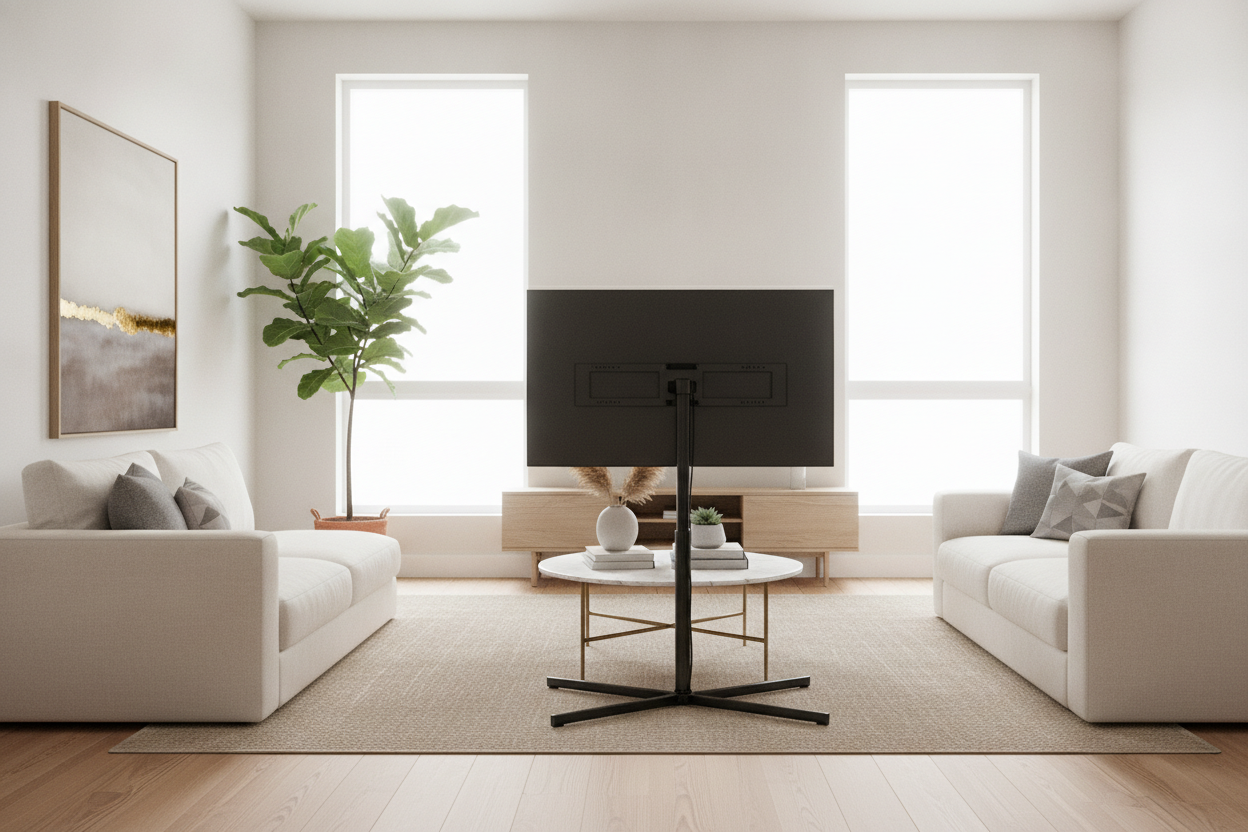
I spent three hours on a Tuesday night with a stud finder that kept beep-beeping at my own hand before I finally threw in the towel. My apartment is a classic rental: 1920s plaster walls, six layers of 'landlord special' eggshell paint, and a layout that makes zero sense. The only logical place for a television is directly in front of the only window that gets decent light, or awkwardly angled in a corner that requires a chiropractor visit after every movie night. I realized I didn't need a drill; I needed a portable stand for tv.
- No holes in the wall means 100% of your security deposit stays in your pocket.
- Locking casters allow you to move the screen to avoid glare or clear space for activities.
- A much smaller footprint than bulky consoles, perfect for studio living.
- Built-in cable management hides the 'spaghetti' mess of HDMI cords.
The 'Where Does the TV Go?' Rental Dilemma
When you live in a space you don't own, you're constantly negotiating with the walls. I used to stare at my living room and realize that a fixed screen would dictate every other piece of furniture. If I mounted it on the far wall, the sofa had to go in the middle of the floor, cutting off the walk-path to the kitchen. If I put it on a low cabinet, I was stuck with a portable tv on stand setup that felt like it belonged in a dorm room. Most small portable tv stand options I found online looked like they’d topple over if someone sneezed too hard.
The real issue is the window. In a 12x14 room, you can't afford to lose a wall to a screen if that's also your only source of Vitamin D. I tried a portable tv mount that was supposed to be 'discreet,' but it still felt like a permanent monument to Netflix. I needed something that could disappear when I had people over for drinks, or at least move to the side so I could actually see the sunset once in a while. A portable flat screen stand isn't just about the screen; it's about reclaiming the floor plan.
Why I Finally Quit Wall Mounts (and Heavy Consoles)
There is a specific kind of anxiety that comes with drilling into cheap drywall. You’re never quite sure if that stud is actually a stud or just a very sturdy piece of debris left behind by a 1970s renovation. After my last move, I looked at the heavy black entertainment center I had lugged through three different zip codes and realized it was a dinosaur. It took up six square feet of floor space just to hold a device that weighs less than a bag of groceries. It was visual clutter I didn't want anymore.
Switching to a portable tv mount stand was a minimalist revelation. Instead of a 200-pound piece of particle board, I have a sleek, cold-rolled steel pole on high-quality rubber casters. It feels industrial but intentional. I’ve seen portable tv tables that look like hospital equipment, but if you pick one with a matte finish and hidden wire channels, it actually looks like a piece of high-end tech decor. Plus, when I move next year—which, let's be real, I probably will—I don't have to spend a Saturday afternoon with a tub of spackle and a sanding block. I just unlock the wheels and roll it into the moving truck.
The Surprising Perks of a Roaming Television
I didn't realize how much a fixed TV was limiting my life until I got a portable tv on a stand. Now, my living room is a multi-purpose zone. If I’m doing a yoga video, I roll the tv mount portable into the center of the room and angle it down so I can actually see the instructor while I’m face-down on a mat. When I’m sick, I don't have to squint at a tiny laptop screen; I just roll the whole rig into the bedroom. It’s like having a 50-inch iPad on wheels.
The biggest win, though, is the glare. In my old setup with traditional stationary TV stands, the 4 PM sun would hit the screen at such a perfect angle that I couldn't see a thing for two hours. Now? I just give the stand a little nudge to the left. Problem solved. I’ve even used it as a portable entertainment center on my balcony for a 'movie night under the stars' (or at least under the streetlights). It’s the kind of flexibility that makes a small apartment feel twice as big because you aren't locked into one single configuration.
But Will It Actually Hold a Giant Screen?
I know what you're thinking because I thought it too: 'Is my $800 investment going to face-plant onto the hardwood?' The physics of a portable tv stand 55 inch model are actually pretty impressive. Most of these stands use a heavy H-shaped or X-shaped base that keeps the center of gravity incredibly low. I’ve got a 55-inch OLED on mine, and even when my dog gets the zoomies and clips the base, it barely wobbles. You want to look for steel that’s at least 2.5mm thick—none of that flimsy aluminum stuff.
Stability is all about the VESA mount and the weight rating. Most portable tv stands for flat screens are rated for up to 80 or 100 pounds, which is overkill for modern LED sets. My only mistake was buying a cheap model first with plastic wheels. They scratched my floors and sounded like a freight train. I upgraded to a version with 3-inch polyurethane casters, and now it glides silently. If you’re worried about tipping, just keep the height at eye level rather than cranking it up to the ceiling. It’s safer and better for your neck anyway.
Is a Mobile Setup Right for Your Space?
If you’re a homeowner with a dedicated media room, sure, bolt that thing to the studs. But for the rest of us—the renters, the studio dwellers, and the people with 'awkward' living rooms—a portable entertainment center is the only way to go. It’s especially useful if you’ve transitioned to working from home. I’ve found that using a TV monitor on stand as a secondary display for big spreadsheets during the day, then rolling it back to the 'living room' area at night, helps me mentally separate work from life.
In the end, furniture should serve you, not the other way around. Don't let a poorly placed cable jack or a lack of studs dictate where you sit. Get a stand that moves with you. It’s the ultimate hack for making a temporary space feel like a custom home.
FAQ
Will the wheels ruin my hardwood floors?
Only if you buy the cheap plastic ones. Look for a stand that specifically lists 'non-marring' or 'polyurethane' wheels. They’re soft, silent, and won't leave those annoying black streaks on your floor.
How do I hide the cables?
Most quality stands have a hollow center pole. You feed the power and HDMI cables through the top and out the bottom. Use a few velcro ties to secure the slack at the base, and it looks incredibly clean.
Can one person assemble this alone?
Usually, yes. It took me about 30 minutes. The only part where you might need a friend is actually lifting the TV onto the mounting bracket, especially if you’re dealing with a 55-inch screen or larger.

Leave a comment
This site is protected by hCaptcha and the hCaptcha Privacy Policy and Terms of Service apply.