










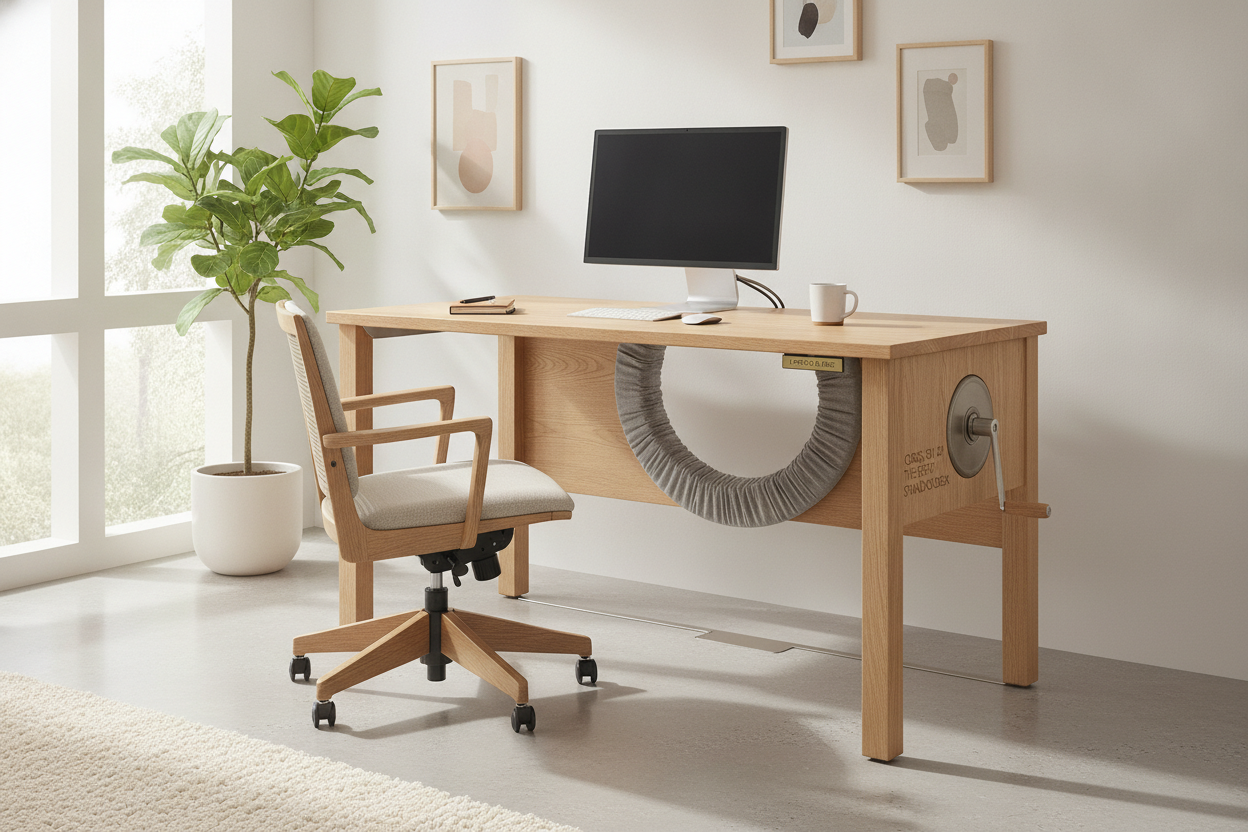
I spent three hours last Saturday zip-tying cables to the underside of my motorized desk, only for the motor to seize up on Sunday. I was left with a $600 paperweight stuck at 42 inches. That was the moment I realized the best crank standing desk isn't a budget compromise—it's a lifestyle choice for the sane.
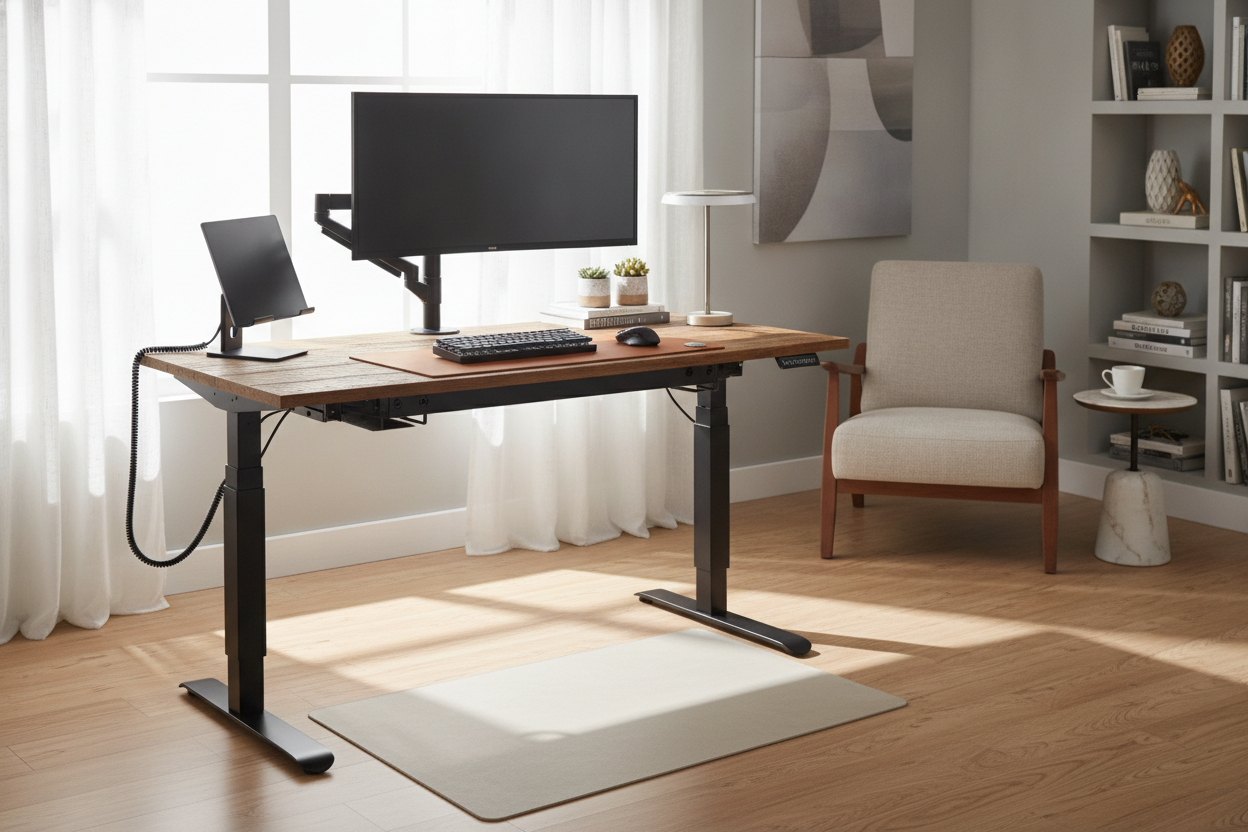
If you have ever crawled under a desk with a flashlight trying to figure out why your 'smart' workstation is flashing an E08 error code, you know my pain. I’m done with planned obsolescence. I want furniture that works when the power is out and doesn't require a degree in cable management just to look decent.
Quick Takeaways
- No power cords: You can place your desk anywhere, even the middle of a room.
- Zero electronics: No motors to burn out or control boxes to fry.
- Better aesthetics: Manual desks often look like furniture, not tech equipment.
- The 'Crank' Factor: It takes about 30-40 seconds to transition, which is a great micro-break.
The Death of the Desk Motor (And Why I Stopped Caring)
We’ve been sold this idea that an electric lift system is the gold standard of the modern office. But after three years of remote work, I’ve realized that motors are just a ticking clock of failure. When a motor dies—and it will—you aren't just losing the height adjustment; you're losing your entire workspace until a replacement part arrives from a warehouse halfway across the world.
Then there is the cord situation. A motorized desk requires a power cable trailing down to the outlet. Even with the fanciest snake-style cable organizers, you still have a black rubber tail following your desk everywhere. By switching to a best hand crank standing desk, I reclaimed my floor space. No more tripping hazards, no more bulky power strips taped to the frame, and no more worrying about a power surge killing my furniture.
What Makes the Best Hand Crank Standing Desk Actually Good?
Not all cranks are created equal. I’ve tested cheap versions where the handle felt like it was made of recycled soda cans and the gear ratio was so low I had to spin it 200 times just to move an inch. That’s not a desk; that’s a punishment.
A high-quality manual desk uses a steel drive rod and a high-efficiency gear box. You want a 'turns-per-inch' ratio that feels snappy—usually around 3 to 5 turns for every inch of travel. The handle should be heavy, preferably with a folding mechanism so you can tuck it away when you're done. If the handle feels gritty or catches as you spin, send it back. A good mechanical desk should feel like a well-oiled bicycle: smooth, silent, and satisfyingly tactile.
The Ultimate Freedom of a Floating Workspace
The biggest perk of ditching the plug is the layout freedom. Most people shove their desks against a wall because they need to reach an outlet. Without a motor, your desk can live anywhere. I moved mine to the center of my home library, facing the window instead of the drywall.
It functions exactly like a traditional writing computer desk but with the hidden superpower of height adjustment. When I’m done for the day, I can roll it into a corner or leave it floating in the room without a single wire betraying its position. If you’re a minimalist who hates 'cable clutter,' this is the only way to live.
Is It Actually Annoying to Crank Every Day?
This is the question I get most often. 'Don't you get tired of spinning that thing?' Honestly? No. It takes me roughly 35 seconds to go from sitting to standing. In a world where we spend eight hours a day staring at a screen, those 35 seconds of physical movement feel like a necessary reset for my brain.
If you choose a model like the Jarvis crank-powered standing desk, the motion is so fluid that it doesn't feel like a chore. I’ve found that the manual effort actually makes me more intentional about my posture. I don't just mindlessly click a button; I decide to stand, I do the work to get there, and I stay there until I’m ready to sit again. It’s a rhythmic, analog ritual that feels much more 'human' than the whir of a cheap electric motor.
Embracing the Analog Aesthetic
Electric desks often look like they belong in a corporate cubicle or a gaming basement. They have plastic control pads and thick, boxy legs to hide the motors. Manual desks, on the other hand, lean into their mechanical nature. There is something incredibly cool about seeing the gears and the drive rod.
In fact, my industrial crank standing desk has become the focal point of my office. It has a cast-iron handle and visible bolts that give it an architectural vibe. It doesn't look like a piece of tech that will be obsolete in five years; it looks like a piece of machinery that will still be working when my grandkids are looking for a place to put their holographic laptops.
Personal Experience: The Interview Disaster
I learned my lesson the hard way. Two years ago, I had a final-round job interview via Zoom. I wanted to stand to keep my energy up, so I hit the 'preset 2' button on my old electric desk. The left motor engaged, the right one didn't. My monitors tilted at a 30-degree angle, my coffee mug started sliding toward the edge, and the control panel started smoking. I did the whole interview sitting on the floor with my laptop on a stack of books. That was the last day I ever trusted a desk with a motherboard.
FAQ
Do manual desks have a lower weight capacity?
Usually, yes. While some electric desks can lift 350 lbs, most manual desks are rated for 150-200 lbs. Unless you are storing lead bricks on your desk, 150 lbs is more than enough for three monitors, a laptop, and a heavy mechanical keyboard.
Can I add a keyboard tray to a crank desk?
Absolutely. Just make sure the drive rod (the metal bar connecting the legs) doesn't sit exactly where the tray's sliding track needs to go. Most modern manual frames are designed with this in mind.
Is it hard to turn the handle if the desk is heavy?
If the gear ratio is good, no. The physics of the gears do the heavy lifting for you. It feels slightly more resistant than spinning a kitchen whisk, but it certainly doesn't require a gym membership to operate.


Leave a comment
This site is protected by hCaptcha and the hCaptcha Privacy Policy and Terms of Service apply.