










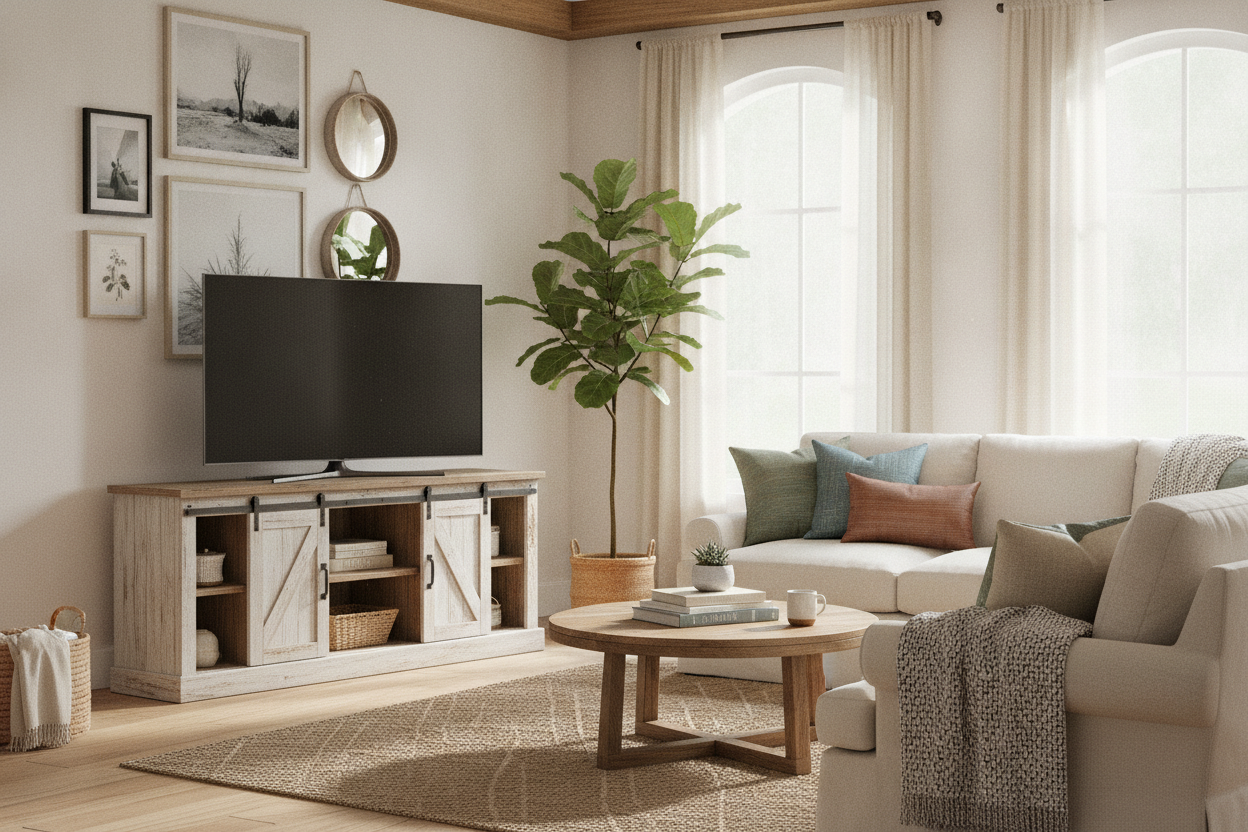
I spent three weeks staring at 47 open browser tabs, trying to figure out why my living room felt like a waiting room at a tire shop. I had the 'perfect' mid-century console, the kind with the tapered legs and the walnut veneer that cost more than my first car. But in my quirky, window-heavy 1920s bungalow, it looked ridiculous. To keep the TV centered, I had to block half a window and shimmy past the sofa like a crab. Finally, I swallowed my pride and looked into farmhouse corner tv stands. It felt like a betrayal of my design aesthetic, but my floor plan was winning the war.
Quick Takeaways
- Corner units reclaim 'dead space' that usually just collects dust and cat toys.
- Modern farmhouse styles have moved past the heavy distressing of the 2010s into cleaner, more versatile lines.
- Deep triangular footprints offer superior cable management for bulky gaming consoles.
- Diagonal placement reduces glare from windows that sit opposite flat walls.
The Day I Realized My Straight-Wall Layout Was Failing
For two years, I forced a massive 65-inch flat screen against the only unbroken wall in my house. It seemed like the logical choice, but it turned my living room into a sports bar. Every piece of furniture had to point directly at that one wall, creating a rigid, awkward traffic pattern. If you wanted to get to the kitchen, you had to walk directly between the viewer and the screen. It was a layout nightmare that no amount of expensive throw pillows could fix.
The realization hit me during a dinner party when I noticed four people sitting in a straight line on the sofa, staring at the black rectangle of the TV instead of each other. The room had no flow. By insisting on a traditional wall-mounted setup, I was sacrificing the conversation circle that makes a home feel like a home. I needed to move the TV, but the only available spot was a corner tucked between two windows. A standard console would have stuck out into the room like a sore thumb, but a corner unit promised to tuck the tech away.
Wait, Do They Have to Look Like 2014 Pinterest?
My biggest hesitation was the 'farmhouse' label. I didn't want my house to look like a craft fair or a 'Live Laugh Love' sign. I was worried about cheap, faux-distressed MDF that peels the moment you set a drink down. But the market has evolved. A high-quality standard TV stands takes up a massive footprint, but a well-built wood rustic corner tv stand uses that rear wedge to provide stability without the bulk. I started looking for pieces with authentic grain, matte hardware, and clean silhouettes.
There is a massive difference between a 'rustic' look that is just printed contact paper and a real rustic corner tv stand made from solid pine or reclaimed oak. The real stuff has weight and texture. It doesn't scream for attention; it just feels settled. I eventually found a farmhouse corner tv stand for 65 inch tv that used a dark, charcoal-stained wood rather than the typical 'antique white.' It looked modern, architectural, and surprisingly sophisticated. It turns out, the corner rustic tv stand doesn't have to be a relic of the past—it can be the anchor of a contemporary room.
The Geometry of Hiding Ugly Tech in Plain Sight
There is a specific kind of magic in the diagonal. When you push a farmhouse corner entertainment center into the corner, you are utilizing space that is almost always wasted. In a small room, every square inch of floor matters. By angling the screen, you actually make the room feel wider because you are opening up the center of the floor. It’s a visual trick: the eye follows the lines of the walls to the corner, and the farmhouse corner tv stand fills that void perfectly.
I was worried that a rustic corner TV stand for 65 inch TV would feel like a giant monolith. Instead, because it sits back into the corner, the screen feels less imposing. It’s no longer the first thing you see when you walk into the room. This modern farmhouse corner tv stand approach allowed me to keep my oversized screen without letting it dictate the entire vibe of the house. Even a rustic farmhouse corner tv stand with a bit of bulk manages to feel lighter because it isn't competing for wall space with my art or my windows.
Let's Talk About the Unexpected Storage Perks
One thing nobody tells you about the rustic corner tv cabinet is how much deeper the storage is compared to a flat unit. Because of that triangular back, you have this massive cavern behind the doors. I managed to stash a PS5, a chunky mesh router, and a tangled nest of power strips in the back wedge, and there was still room for a stack of board games. You just don't get that kind of depth with a 15-inch deep mid-century console.
I’ve found that mixing these heavy-duty pieces with other substantial furniture, like a six drawer storage unit in a nearby alcove, helps ground the room. The rustic corner entertainment center becomes part of a larger storage story rather than a lonely island of wood. If you're tired of seeing wires peeking out from the sides of your media unit, the corner layout is your best friend. The walls literally hide the exit points of your cables.
How I Styled the Corner So It Doesn't Look Like an Afterthought
The mistake people make with a corner tv stand farmhouse style is leaving the space above it totally blank. It makes the TV look like it’s in time-out. To blend my farmhouse corner tv cabinet into the room, I added a tall, trailing Pothos on a floating shelf just above the corner. The greenery softens the hard angles of the TV and the wood. I also tucked a large, textured seagrass basket next to the stand to hold extra blankets, which helps bridge the gap between the stand and the rest of the seating area.
Layering textures is the key. Since the wood rustic corner tv stand is quite 'hard,' I balanced it with a plush rug that sits just under the front feet. I opted for a corner tv stand rustic in tone but kept my other accents—like lamps and vases—very modern. This 'transitional' mix keeps the room from feeling too themed. It doesn't look like a cabin; it looks like a curated, comfortable home where the layout actually makes sense for real life.
FAQ
Will a corner stand fit my 65-inch TV?
Most are designed for it, but you have to check the weight capacity and the width of the TV's legs. Some 65-inch TVs have wide-set feet that might hang off the edges of a smaller corner unit. Always measure the distance between the TV's stand legs, not just the screen size.
Is assembly harder for corner units?
Honestly, it can be a bit of a puzzle. Because of the triangular pieces and the angled back panels, you'll want to pay close attention to the orientation of the boards. It’s a two-person job if you want to keep your sanity, especially when aligning the doors.
Do corner TV stands look dated?
Only if you buy the ones with the glass shelves and shiny silver poles from 2002. If you stick to a farmhouse corner tv stand with solid wood textures and matte hardware, it looks like a deliberate architectural choice rather than a dated necessity.

Leave a comment
This site is protected by hCaptcha and the hCaptcha Privacy Policy and Terms of Service apply.