










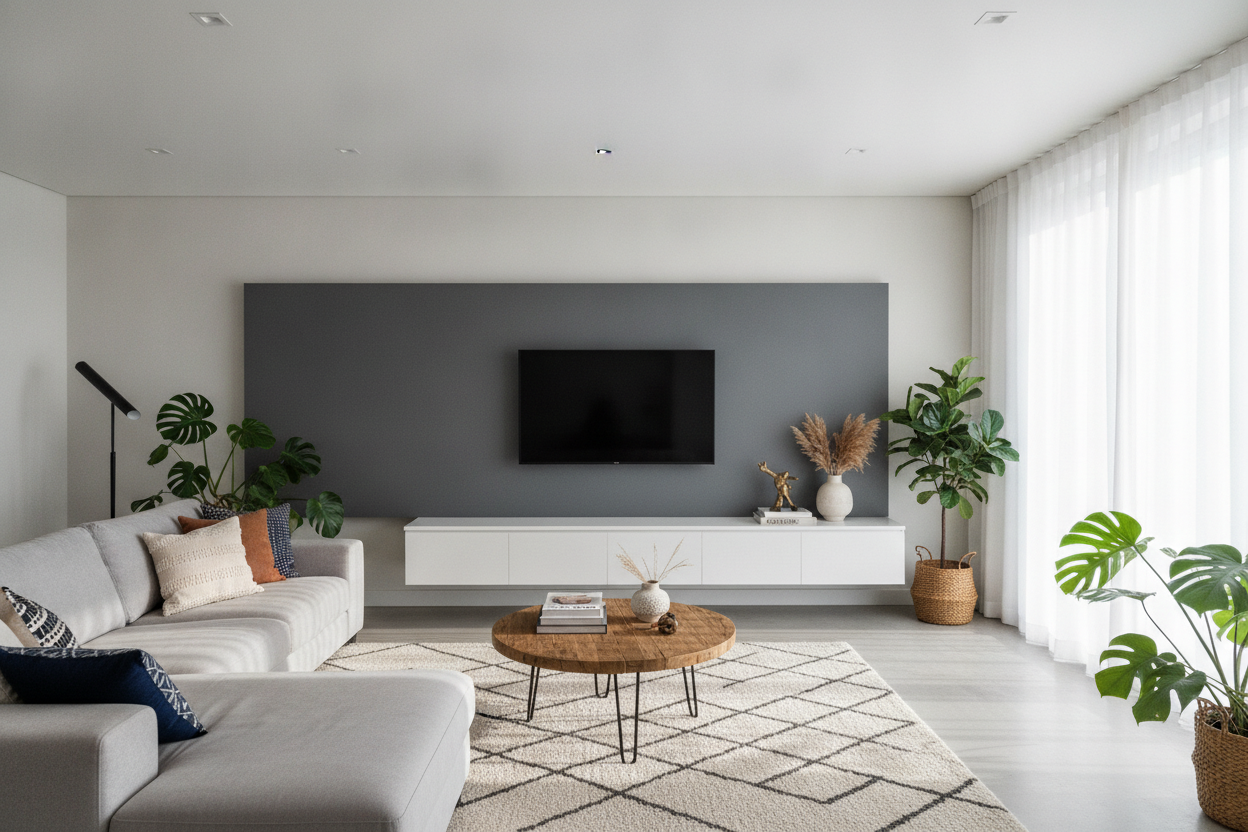
I spent three hours last Tuesday trying to hide a thick, black HDMI cord behind a ceramic vase. It didn't work. The vase just looked like it had a tail, and the cord still peeked out like a shy snake. My living room was a Pinterest dream until you looked at the 'cord spaghetti' under the screen. That's when I finally committed to the idea of a floating wall for tv setup to hide my shame.
- It is a false bump-out wall designed to hide every single wire.
- Requires basic framing, drywalling, and painting skills.
- Costs between $200 and $500 depending on your finish.
- Provides a high-end, custom architectural look that furniture can't replicate.
The Cord Chaos That Finally Broke Me
I tried every 'hack' in the book. I bought cable raceways that looked like cheap plastic tubes glued to my eggshell paint. I even upgraded to expensive traditional TV stands, hoping the height would mask the mess. But there is always that awkward six-inch gap where the cords dangle like vines in a tech-infused jungle. It kills the vibe of a clean, minimalist room.
The frustration isn't just about the mess; it's about the visual clutter. When you mount a TV directly to a flat wall, it looks like an afterthought. I wanted my screen to feel integrated, like it was part of the house's DNA, not just something I bolted onto a stud while holding a level in one hand and a beer in the other.
What Even Is a Floating Wall? (And Why Do People Build Them?)
A floating wall—or a bump-out—is essentially a shallow box built onto your existing wall. You use 2x3 or 2x4 lumber to create a frame that sits about 4 to 6 inches off the original surface. This creates a hollow 'utility' space. You can run power, internet, and HDMI cables inside this cavity without ever touching your actual structural walls.
People build a floating wall tv feature because it creates depth. Instead of a flat, boxy room, you suddenly have an architectural focal point. You can add LED strip lighting behind the edges to create a soft glow, making the entire unit look like it's hovering. It’s the ultimate move for anyone obsessed with the 'clean desk' aesthetic but for their entire living room.
The 'Looks Easy on TikTok' Reality Check
Don't let those 30-second DIY reels fool you. They skip the part where you're covered in white drywall dust at 11 PM, questioning your life choices. Framing the wall is the easy part; it’s the mudding, taping, and sanding that will test your patience. If you aren't ready for a full-blown construction zone in your house for three days, you might want a simpler route.
If the thought of sawdust makes you break out in hives, a freely arranged TV stand with LED is a much faster way to get that glowing, modern look. You get the backlighting and the cord management without having to learn how to tape a drywall corner. I chose the hard way because I’m stubborn, but I spent at least four hours just sanding the joints to get them smooth enough for paint.
The Hardware You Actually Need (Don't Skimp Here)
When you build a false wall, you are essentially hanging your expensive OLED on a wooden box you built. This is not the time to use $5 plastic anchors. You need heavy-duty toggle bolts or, better yet, make sure your horizontal blocking is screwed directly into the original wall studs. I used a recessed media box so the plugs sit flush inside the wall. If you don't, the TV will stick out too far, ruining the 'floating' illusion.
To finish the look, you need a place for your peripherals. Pairing your new wall with a wall mounted media console keeps the floor clear. It maintains that 'zero gravity' feel while giving you a spot to hide the PS5 and the remote you always lose.
Why You Still Need Something Underneath
One mistake I see constantly is a massive floating wall with a TV on it and... nothing else. It looks top-heavy, like a giant head on a tiny body. You need visual grounding to balance the weight of the screen. Integrating a cabinet for tv on wall setups provides that necessary anchor. It bridges the gap between the floor and the floating feature, making the whole thing feel intentional rather than just a weird box sticking out of the drywall.
Final Verdict: Am I Glad I Did It?
The total cost for my DIY project was about $340, including the lumber, a sheet of drywall, and a gallon of 'Deep Charcoal' paint. Was it a hassle? Absolutely. My vacuum cleaner gave up the ghost trying to suck up the drywall dust. But every time I sit down to watch a movie, I don't see a single wire. The room feels bigger, more expensive, and infinitely more organized.
If you have the tools and the grit, build the wall. If you’re a renter or just hate the smell of joint compound, stick to high-quality modular furniture that mimics the look. Either way, kill the cord spaghetti. Your living room deserves better.
FAQ
Is a floating wall safe for heavy TVs?
Yes, as long as the frame is anchored into the original wall studs. Use 3-inch lag bolts to secure your 2x4s to the house's structure, and your TV won't go anywhere.
How much space do I lose?
Usually about 5 to 6 inches. In a small room, this can feel like a lot, but the visual 'cleanliness' usually makes the room feel larger overall.
Do I need an electrician?
If you are moving outlets, yes. If you are just using a 'power bridge' kit designed for in-wall use, many DIYers handle that themselves, but always check your local building codes first.

Leave a comment
This site is protected by hCaptcha and the hCaptcha Privacy Policy and Terms of Service apply.