










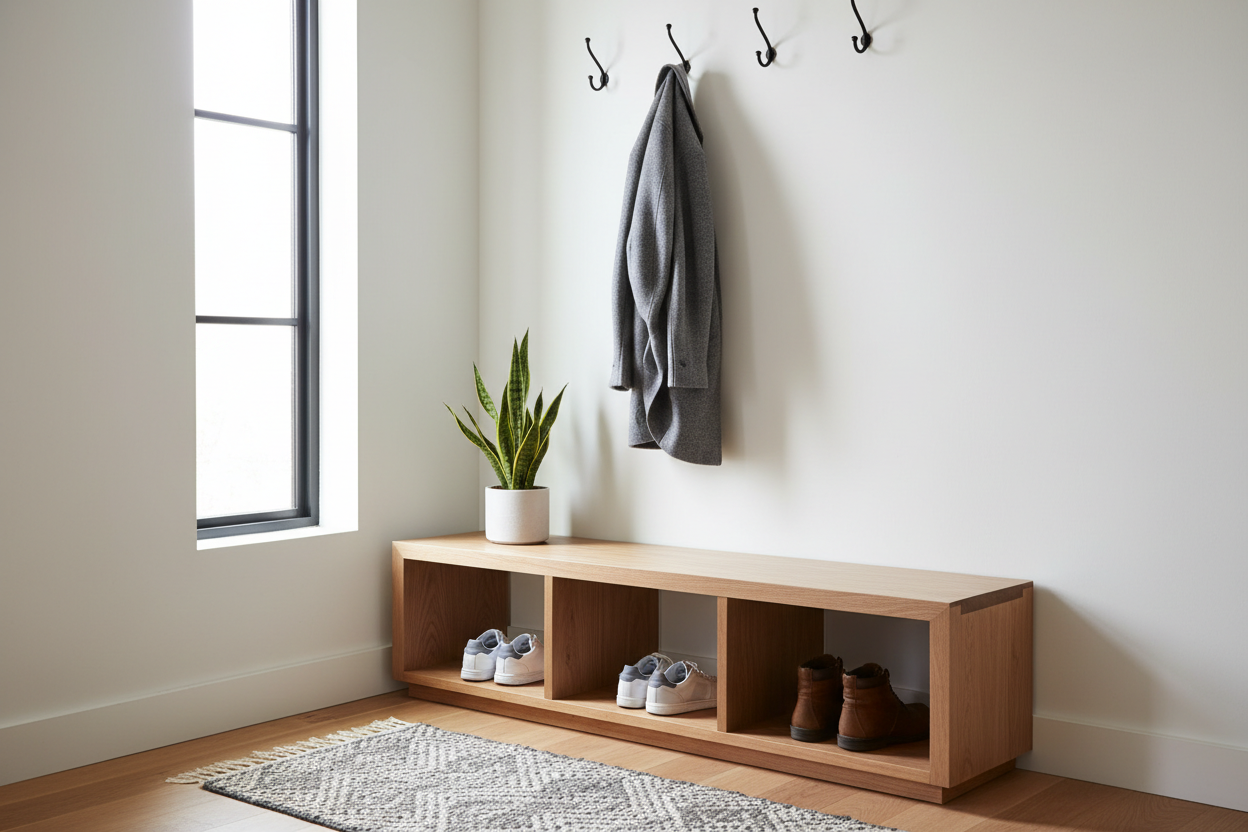
Entryways are notoriously difficult to manage. They serve as the primary drop zone for life’s debris, yet they often lack the square footage to handle the volume of shoes, bags, and gear we throw at them. If you live in an urban apartment or an older home with a tight hallway, you have likely stared at a pile of sneakers blocking your front door and wished for a magic fix. This is exactly where the room and board cubby bench enters the conversation, specifically designed to bridge the gap between industrial durability and residential aesthetic.
Finding furniture that fits a narrow corridor without making the space feel claustrophobic is a challenge. Most standard storage benches protrude too far into the walking path, resulting in bruised shins and a cramped visual field. I spent months taping out dimensions on my floor, trying to find something that offered storage without sacrificing flow. That search eventually led me to the room and board slim cubby bench, a piece of furniture that seems to have a cult following among interior designers and organization enthusiasts alike.
Why Dimensions Are the Dealbreaker
In the world of entryway furniture, three inches can make the difference between a functional hallway and an obstacle course. Standard benches usually clock in at around 14 to 16 inches deep. While that depth is comfortable for sitting, it can dominate a hallway that is only 36 inches wide. The slim cubby bench cuts this depth down significantly, usually hovering around 11 to 12 inches depending on the specific model year and top choice.
This reduced footprint transforms how a space feels. When I installed the slim version in my own entryway, the visual weight of the corridor lifted immediately. It hugs the wall tightly. You still get the definition of a designated "mudroom" area, but you don't lose the ability to walk past with groceries in hand. The trade-off, naturally, is seating comfort. You aren't going to lounge on a bench this shallow for hours, but for the thirty seconds it takes to tie your laces, it provides adequate support without dominating the room.
Build Quality and Material Choices
One reality you have to accept with this piece is the price point. It is an investment. However, the cost reflects the construction. Unlike flat-pack furniture held together by cam locks and hope, the room and board cubby bench is constructed from welded steel. There is no assembly required, and there is no wobble. The frame feels substantial—you could likely drop a dumbbell on it without denting the steel.
The customization options allow it to blend into various decor styles. You typically choose between a natural steel finish, which shows the weld marks and industrial character, or powder-coated colors that look more uniform and modern. I opted for a white powder coat to match my trim, which helped the bench disappear into the wall rather than standing out as a feature piece. The wood tops vary from walnut and maple to ash, allowing you to match existing flooring or furniture. This mix-and-match capability prevents it from looking like generic office furniture.
Living with the "Slim" Limitations
While the room and board slim cubby bench solves the space issue, it introduces a few quirks regarding shoe storage. Because the cubbies are shallower, you need to be realistic about what fits. If you wear a men's size 12 or larger, your shoes are going to overhang the edge. For my household, this wasn't a dealbreaker, but it does disrupt the perfectly clean look if you are expecting everything to be hidden entirely.
High-top sneakers and stiff boots can also be tricky. The vertical clearance in the cubbies is fixed. I found that ankle boots had to be laid on their sides or placed on the very top of the bench (if no one was sitting there), while the cubbies were reserved for running shoes, flats, and sandals. If you are a family of ski boot wearers or heavy-duty work boot users, the slim profile might frustrate you. For everyday street shoes, however, it functions perfectly well.
A Note on Versatility Beyond the Front Door
While most people buy this for the front hall, the utility of a slim cubby bench extends to other rooms. Because of its narrow profile, it works exceptionally well at the foot of a twin bed in a child's room or even in a large bathroom for towel storage. The steel construction handles humidity better than cheap particle board, making it a viable option for damp environments provided the wood top is sealed properly.
I have seen these units used as low media consoles in small studio apartments. The cubbies are the perfect size for routers, gaming consoles (check for ventilation), or vinyl records, although the records will overhang slightly on the slim model. This versatility helps justify the price tag; if you move to a new house with a massive mudroom where you don't need a slim bench, you can easily repurpose it elsewhere in the home.
The Delivery and Setup Experience
Ordering from Room & Board is generally different from the typical e-commerce experience. Because these items are often made to order—especially if you choose a specific steel color and wood combination—lead times can vary. My order took about five weeks to arrive. The delivery service was "white glove," meaning they brought the piece inside, placed it exactly where I wanted it, and took away the packaging materials.
This level of service matters when you are dealing with a heavy steel frame. You don't want to be dragging a solid metal bench up three flights of stairs alone. The piece arrives fully assembled. You simply check the wood top for scratches and ensure the leveling glides on the feet are adjusted for your floor. It is a refreshing change from spending a Saturday afternoon with an Allen wrench.
Is It Worth the Investment?
There are cheaper ways to store shoes. You can buy plastic racks or bamboo shelves for a fraction of the cost. But those solutions rarely survive more than a few years of daily abuse. The room and board cubby bench is built like a tank. It withstands the daily grind of dropped backpacks, wet umbrellas, and pet claws without deteriorating.
If you plan to stay in your current home for a long time, or if you move frequently and need furniture that survives the moving truck, this bench is a solid buy. It brings order to chaos in the tightest of spaces. For anyone struggling with a narrow hallway that seems impossible to furnish, the slim profile offers a rare combination of heavy-duty storage and minimal footprint that is hard to find elsewhere.
Frequently Asked Questions
Can you actually sit comfortably on the slim version of the bench?
Yes, but it is more of a perch than a lounge seat. The depth is sufficient for sitting down to tie shoes or check your phone quickly, but it feels significantly shallower than a standard dining chair. It is designed for utility rather than relaxation.
Do large shoes fit inside the cubbies of the slim bench?
Shoes larger than a men's size 10 or 11 will likely overhang the edge of the cubby. While they still fit inside the compartment physically, the heels will stick out past the frame, which may affect the visual cleanliness of the entryway.
Is the wood top removable or replaceable?
The wood tops are generally secured to the steel frame but can be removed if you have the right tools, though it is not designed to be swapped out frequently. Room & Board sells the tops and bases as a cohesive unit, but the high-quality wood can be sanded and refinished if it gets damaged over years of use.



Leave a comment
This site is protected by hCaptcha and the hCaptcha Privacy Policy and Terms of Service apply.