


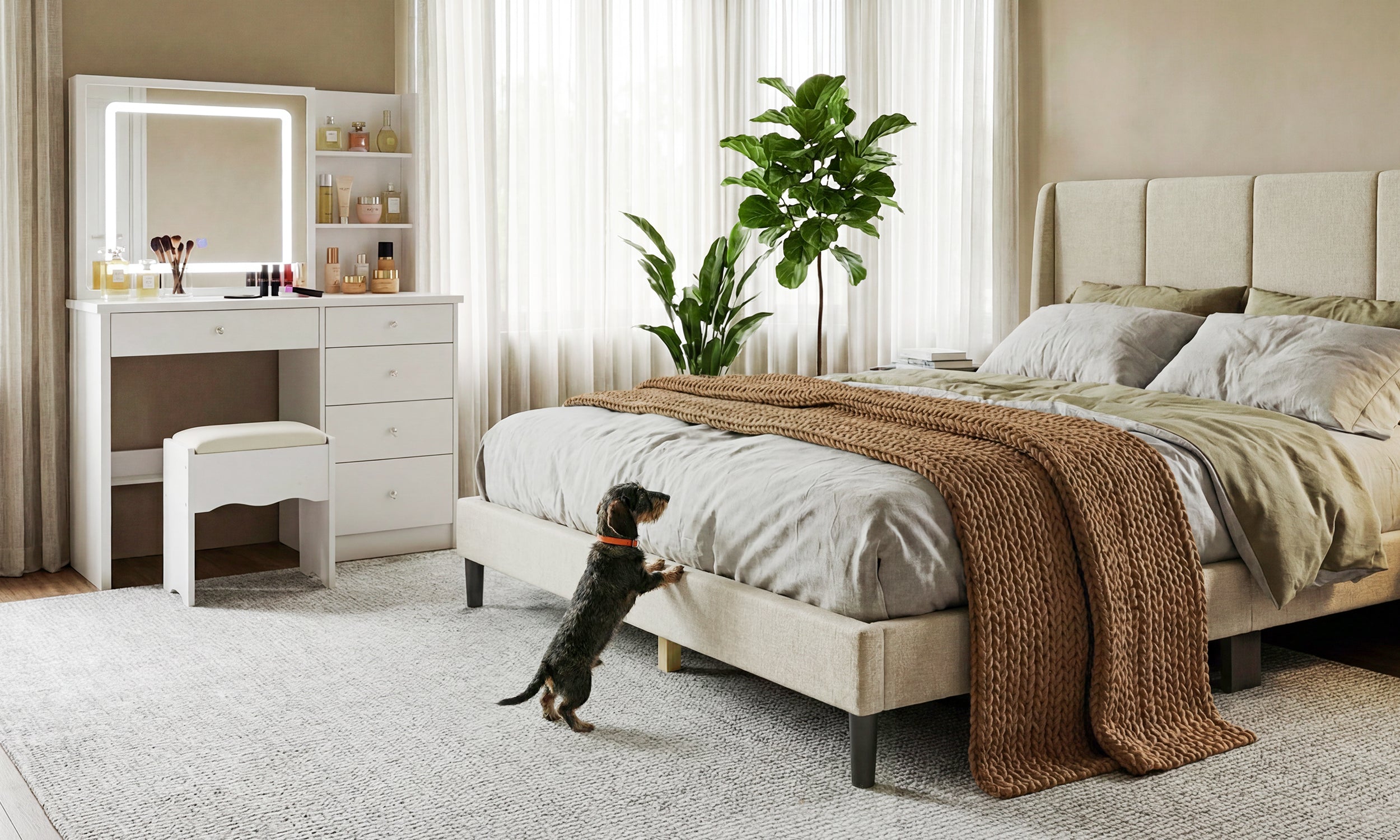



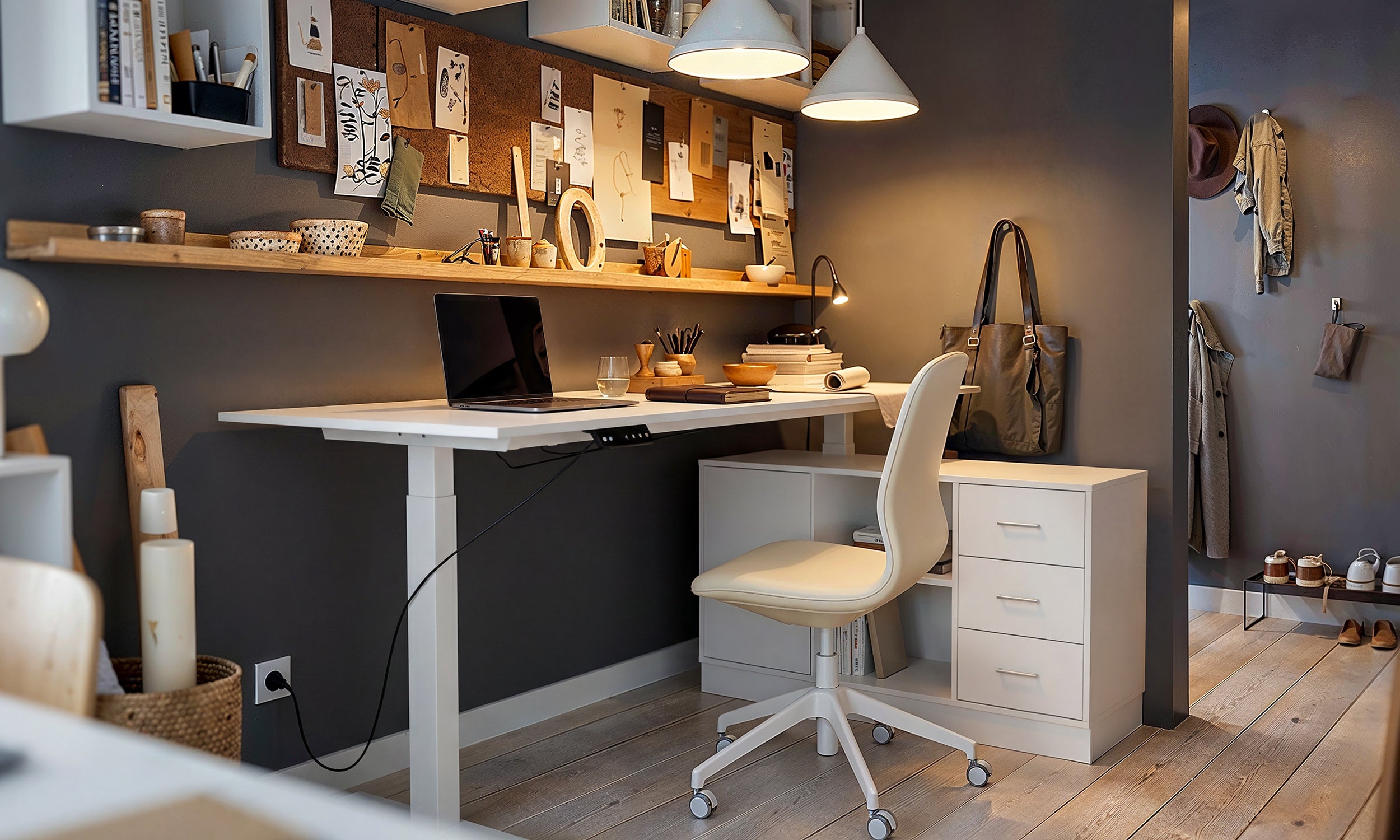




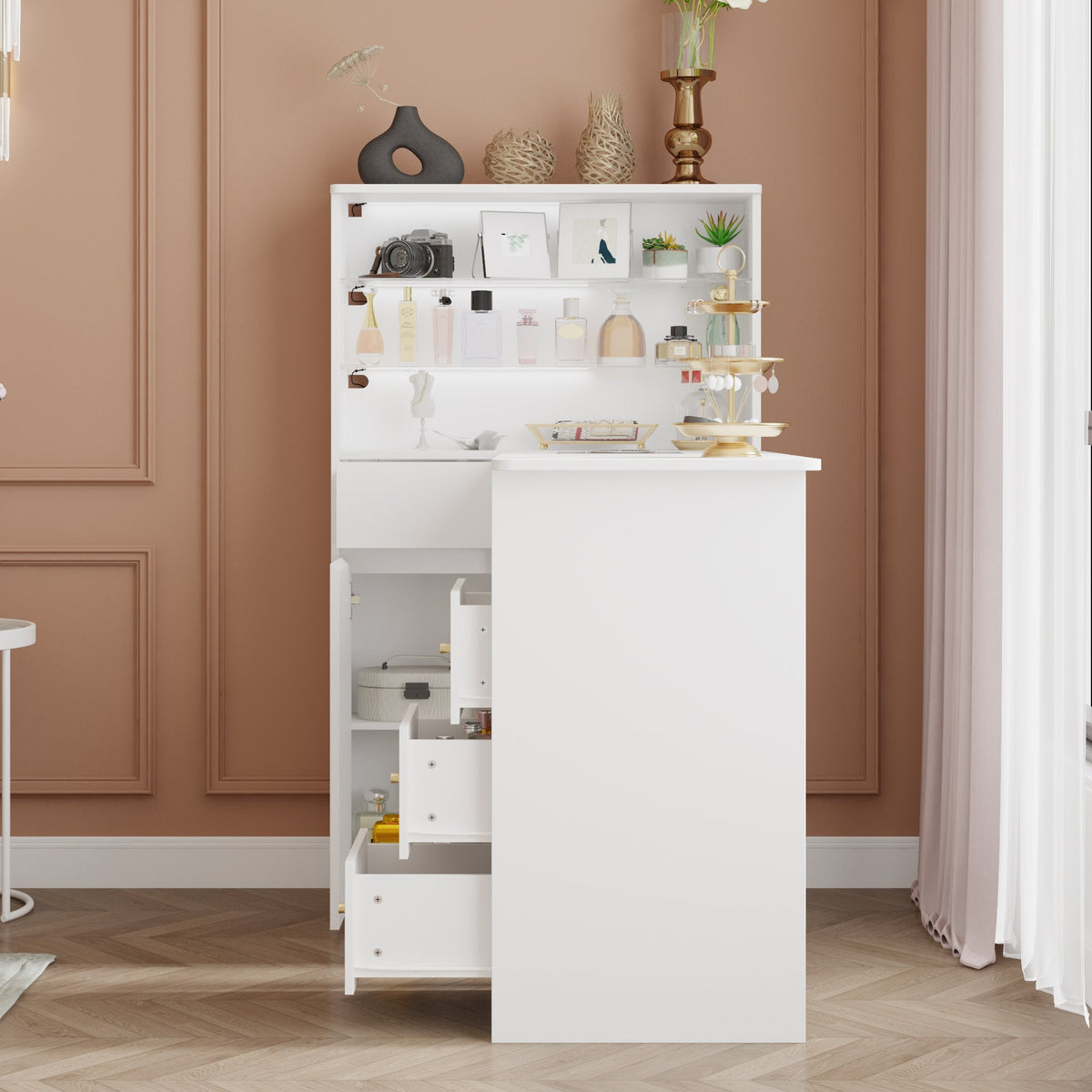
A good manicure table gives two people facing each other a work surface at the right height and depth, keeps polish and tools within reach, supports the client's forearm on a padded rest, puts bright light on the hands and controls both dust and fumes. A built-in dust collector pulls filing dust down into a bag or filter, but it is a dust tool: it does not take solvent and acrylic vapors out of the room, so ventilation still matters. OSHA puts it plainly in its nail salon guidance: "Ventilation is the best way to lower the level of chemicals in a salon!"
Below: what the collector does, NIOSH's ventilated-table figures, sizing, lighting, storage, power and home versus salon setups. To compare stations, start with the FUFU&GAGA makeup vanities and beauty stations collection.
Key takeaways
- Dust is not fumes: a dust collector with a bag catches filing particles. Acetone, monomer and polish vapors need fresh air or exhaust ventilation.
- Best case is ducted: NIOSH's ventilated table pulls air down at the technician's side and exhausts it outdoors, and it does not recommend charcoal filters that recirculate the air.
- Height follows the elbow: for seated hand work, CCOHS advises keeping materials at or slightly below elbow height, with armrests where appropriate.
What does a manicure table need?
A manicure table, also called a nail table or nail tech table, has five jobs, in a salon or a spare room:
- A shared work surface: deep enough for the client's hands and forearms on one side and the technician's tools and arms on the other, with a top that wipes clean.
- Storage within reach: drawers or shelves for polish, files, buffers, bits, cotton and towels, so the technician does not stand up mid-service.
- Arm support: a padded armrest or wrist cushion for the client, and a soft edge for the technician's forearms.
- Task light: bright, even light on the nails without glare or shadows from the technician's own hands.
- Dust and fume control: a dust collector or downdraft vent for filing dust, plus room ventilation or exhaust for vapors.
What does a dust collector on a manicure table actually do?
On most tables, the dust collector is a small electric fan under a perforated vent in the top. Filing over the vent pulls dust down into a bag or filter that you empty or replace, keeping the surface and the client's lap cleaner.
What a bag cannot do is remove gases. The chemicals that worry safety agencies are mostly vapors from the products themselves. NIOSH names acetone, dibutyl phthalate, ethyl acetate, formaldehyde, methacrylate compounds, toluene and triphenyl phosphate, and its nail technician safety page says workers "can breathe in the dusts or vapors from these chemicals, absorb them through the skin, or ingest them." A fabric dust bag is built to catch particles; unless a listing says the unit exhausts outdoors or filters vapors, assume it does not.
OSHA draws the same line for masks. Its nail salon chemical hazards page says N95 respirators help when buffing or filing nails or working with acrylic, but "They do not protect workers from vapors or gases, such as hazardous chemicals." A dust collector and a dust mask solve the same half of the problem.
Dust collector vs ventilated table vs room ventilation
| Control | What it handles | Where the air goes | Source |
|---|---|---|---|
| Built-in dust collector with bag | Filing and buffing dust at the vent | Back into the room through the bag | How these units work; check each listing |
| Ventilated (downdraft) table, ducted | Dust and vapors at the hands | Outdoors | NIOSH HC 28 |
| Ventilated table with charcoal filter | Dust and some vapors until the charcoal is full | Back into the room | NIOSH HC 28 (not recommended); OSHA (change filters monthly) |
| Portable local exhaust unit | Dust and chemicals near the work area | Filtered, or exhausted outdoors | NIOSH, OSHA |
| Room ventilation (exhaust fan, HVAC, open windows) | General vapor levels in the room | Outdoors or through the HVAC system | OSHA |
What NIOSH says about ventilated nail tables
The most detailed public guidance is a NIOSH Hazard Controls sheet, Controlling Chemical Hazards During the Application of Artificial Fingernails (HC 28, publication 99-112, 1999). It focuses on ethyl methacrylate (EMA), the main chemical in most acrylic nail products, and notes that both EMA and MMA, a similar chemical the FDA banned from nail products in 1974, "can cause contact dermatitis, asthma, and allergies in the eyes and nose." Its key points for anyone choosing a table:
- The table is the main control. NIOSH researchers found that a ventilated table "protects the nail technician best against breathing EMA," because it puts local exhaust close to the work.
- Exhaust outdoors. "Exhaust this air outdoors. Charcoal filters that allow the air to be used over again are not recommended because it is hard to know when the charcoal is full."
- Vent on the technician's side. The air intake (the downdraft face) sits on the technician's side, under a perforated cover, and the client's side of the table should be "a little higher" so the client's hands hang over the vent.
- Airflow figures. An air speed of 620 feet per minute directly above a 13 by 4 inch downdraft face works well, with a 2.5-inch baffle around it, and the exhaust fan should move at least 250 cubic feet per minute. Too much air past the nails can make the product crystallize.
- Keep fans off the vent. Comfort fans should not blow directly on the downdraft face, because strong air movement interferes with the exhaust.
Those numbers describe a ducted table built for acrylic work. Most bag collectors sold for home use are not ducted, and many listings give no airflow figure. If a seller lists airflow in cubic feet per minute and says where the air goes, compare it with NIOSH's figures; if not, treat the collector as a dust aid and plan ventilation separately.
OSHA's page adds upkeep for salons that use ventilated tables: make sure they are turned on, change charcoal filters at least once a month and empty the catch basin weekly. For a bag collector, follow the maker's instructions for emptying and replacing the bag.
How big should a manicure table be?
There is no official standard size for a manicure table, so size it from the people and tools that will use it. Measure three things.
Height: start at the elbow
CCOHS's guide to working in a sitting position advises "Providing materials at or slightly below elbow height," with elbows close to the body and bent between 90 and 120 degrees, and "Providing armrests where appropriate." A cushion under the client's hand changes the working height without changing the table. OSHA's nail salon ergonomics page says to "Raise and position the client's hand or foot to avoid bending over."
To check a table: sit in the chair you will use, feet flat, shoulders relaxed, and have someone measure from the floor to the underside of your elbow. Compare that with the listed table height plus the height of the armrest cushion. If the work ends up well above your elbow, you will lift your shoulders; well below, you will lean forward.
Depth: two sets of arms
A nail table is shared across its depth. The client's forearms rest on one side, the technician's arms and tools sit on the other, and in a ventilated design the vent sits in between, on the technician's side. Sit facing a partner across your current table or desk, put the client's forearm on a folded towel and measure how much depth the two of you use without stretching. That number, not a catalog average, is your minimum depth.
Width and footprint: storage and chairs
Width comes from what sits on the table: a lamp, a polish rack, a tool tray, perhaps a curing lamp. An L-shaped station or side cabinet moves storage off the work surface.
For floor space, add the table depth to the space each chair needs when pushed back with someone in it. Measure your own chairs; as a worked example, a 20-inch-deep table with chairs that each need 30 inches comes to 20 + 30 + 30 = 80 inches, about 6 feet 8 inches, before any walkway.
Armrest, chair and posture
Manicures mean long stretches of leaning, gripping and fine finger movement. OSHA's nail salon ergonomics guidance is short and practical:
- "Use an adjustable chair that gives proper back support and can be raised and lowered."
- Keep feet flat on the floor "and use a footrest if needed."
- "Put a towel or foam pad on the work table edge for a softer surface for the arms."
- "Avoid resting hands, wrists, forearms, and elbows against hard and/or sharp edges of work tables."
- "Take frequent breaks if possible," and change positions or tasks.
Look for rounded front edges, room for a wrist cushion and knee space for both people; drawers right under the work area can block knees.
Lighting the work
OSHA's advice is to "Adjust the lighting to see without bending over a work table." In practice that means:
- A task lamp on an arm placed on the side opposite the technician's working hand, so the hand does not shadow the nail.
- Diffused, even light rather than a bare bulb glaring off glossy polish.
- A neutral color so polish shades look the same in the chair as they do outdoors, and a window nearby if you can manage it.
Our lighted vanity guide covers light color and placement in more detail for a beauty corner at home.
Storage: polish, tools and waste
Storage on a nail table is about two things: reaching what you need and keeping chemicals closed. OSHA's chemical hazards page lists steps that apply at home as well as in a salon:
- Close bottles tightly when not in use, and keep only the product needed at each workstation.
- Put soaked cotton and other waste in a metal can with a tight, self-closing lid, and empty it daily.
NIOSH also recommends dispenser bottles with small openings and pressure-sensitive stoppers so less nail liquid evaporates. Shallow drawers for tools, upright racks for polish and a closed cabinet for refills work well, with the lidded can beside the technician.
Power and electrical safety
A modern nail station can draw on several devices at once: the dust collector, a task lamp, a nail drill, a curing lamp and sometimes lit shelves. Before you buy, check the listing for what plugs in and place the table where its cord reaches a wall outlet without stretching.
If you need more outlets, the CPSC sheet Household Extension Cords Can Cause Fires is the reference to follow:
- "Extension cords should only be used temporarily."
- Check the cord's rating on its tag or packaging, and do not power appliances beyond it. A cord that gets hot is a warning sign that it may be overloaded.
- "Do not run extension cords under carpets, through doorways or under furniture."
- Choose cords listed by a recognized testing laboratory such as UL, ETL or CSA, and unplug them when not in use.
Home nail station vs salon setup
The table may be the same, but the room around it is not.
At home
- Pick a room with a window you can open and a door you can close, away from the kitchen and any space where people eat. NIOSH says eating and drinking should not be allowed where artificial nails are applied.
- No smoking or open flames nearby: NIOSH notes that many salon chemicals, nail products included, "catch fire easily."
- Use the collector for dust and the window or an exhaust fan for vapors. OSHA suggests letting in fresh air "by opening doors and windows" and arranging fans so air moves in one side and out the other.
- Close everything after each session: caps on, waste in the lidded can, collector bag emptied as the maker instructs.
If you only do your own nails now and then, a vanity or desk you already own may be enough, provided you add a padded rest, a lamp and fresh air. Our desk vs vanity guide helps you decide which to use for a mixed beauty and work corner.
In a salon
- Ventilation is a system, not a table feature. OSHA tells salon owners to keep the exhaust system on, run the HVAC fan continuously during work hours where there is no exhaust system, and consider portable units that pull dust and chemicals from the work area.
- State rules: salon licensing, ventilation and equipment rules vary by state and city, so check with your state cosmetology board and local building department before you lay out the room.
- Front of house: the reception counter has its own sizing rules; see our salon reception desk guide.
Manicure table buying checklist
- Work height: listed table height plus armrest lands at or slightly below your seated elbow height.
- Depth: at least the depth you measured for two people facing each other without stretching.
- Dust collector details: where the vent sits (technician's side is NIOSH's layout), how it is emptied and how many bags or filters are included.
- Airflow and exhaust: an airflow figure in cubic feet per minute and whether the air is exhausted or recirculated; NIOSH's fan figure for a ducted table is at least 250.
- Ventilation plan: an openable window, exhaust fan or portable unit for vapors, whatever the table includes.
- Armrest: a padded wrist rest or room for one, and no hard edge under the forearms.
- Storage: drawers for tools, upright storage for polish, a closed cabinet for refills.
- Power: what plugs in, cord length to your outlet and whether you will need a rated, listed extension cord.
- Footprint: knee room for both people, and the table plus both chairs pushed back fits your floor plan.
Our pick: an L-shaped manicure table with a built-in dust collector
Sizes and features below come from the product listing.
L-Shaped Manicure Nail Table with Electric Dust Collector
An L-shaped station at 49.8" H x 47.2" W x 29.5" D, weighing 123.2 lb. The electric dust collector is built into the table and comes with one dust bag. Storage runs on every side: 4 removable drawers, 6 open shelves and 1 cabinet, and the tempered glass shelves on the left have LED light strips for showing polish colors. The table plugs in to run the collector and the shelf lights. It is made of manufactured wood (particle board) with a surface listed as stain resistant that wipes clean with a dry cloth, and it needs assembly.
Best for: a home nail studio or a small salon corner where one technician wants storage and a dust collector in a single freestanding piece.
Skip it if: you need numbers to compare the collector: the listing gives no airflow, wattage, noise figure or work-surface height, and it does not say the collector exhausts outdoors, so plan room ventilation for vapors. It lists no armrest, so add a wrist cushion. The title says 35.4" but the spec says 47.2" wide; plan for 47.2".

Shopping for a nail station
Tape the table and both chair zones on the floor, check the outlet and window, then compare sizes, storage and dust collector details in the FUFU&GAGA makeup vanities collection. Treat anything a listing does not state as unknown until the seller confirms it.
FAQ
Does a manicure table with a dust collector remove fumes?
Not on its own. A bag or filter collector catches filing dust. Vapors from acetone, monomer and polish need room ventilation or local exhaust that sends air outdoors. NIOSH recommends exhausting ventilated tables outdoors and does not recommend recirculating charcoal filters, because it is hard to know when the charcoal is full.
How tall should a nail table be?
There is no single standard. Measure your seated elbow height and aim for work at or slightly below it, as CCOHS advises for seated hand work, then raise the client's hand on a cushion so neither of you bends over, as OSHA recommends.
Is a dust mask enough when filing nails?
OSHA says N95 respirators help when buffing or filing nails or using acrylic powder, but they do not protect against vapors or gases. Surgical masks, it says, do not protect against breathing in gases, vapors or particulates. Ventilation is still the first control.

Leave a comment
This site is protected by hCaptcha and the hCaptcha Privacy Policy and Terms of Service apply.