










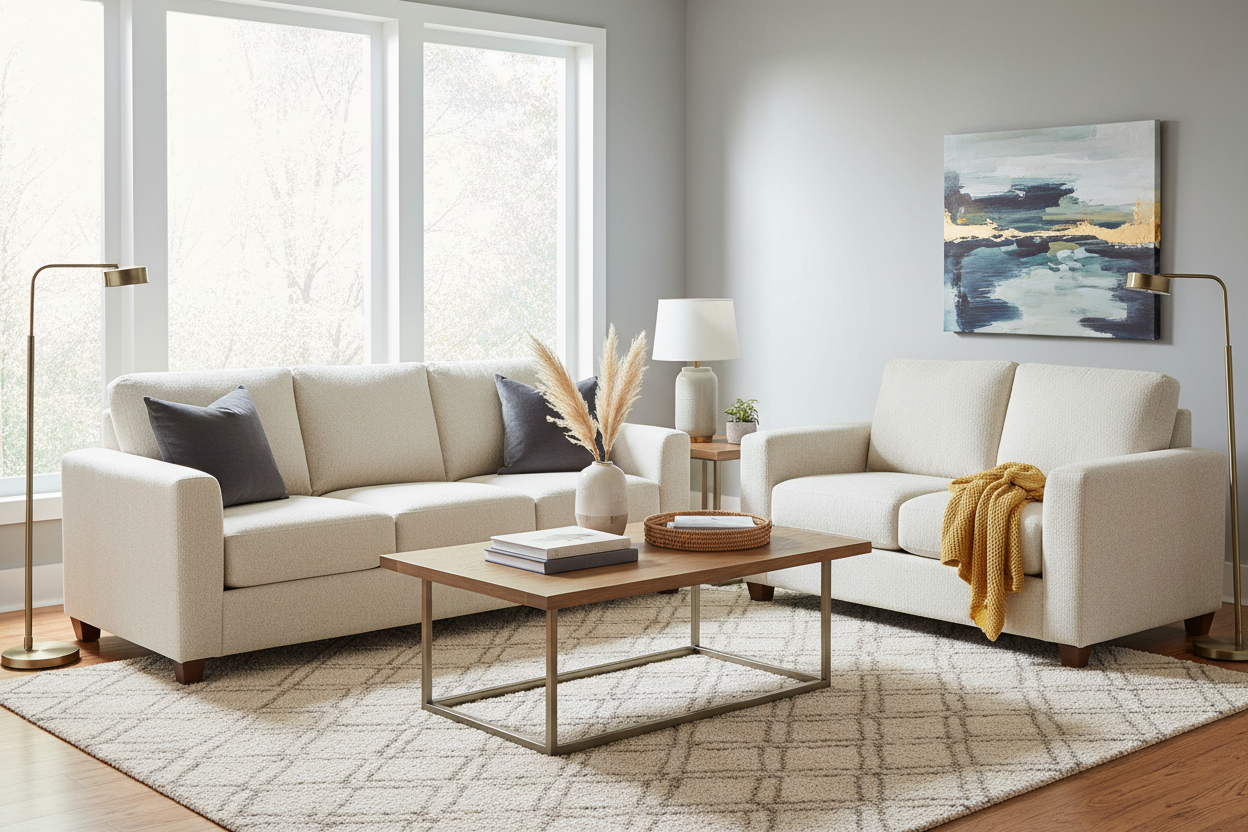
There is a pervasive myth in the interior design world that purchasing a set is a shortcut to a generic, uninspired living room. I often see clients shy away from a matching sofa and loveseat because they fear the dreaded "furniture showroom" aesthetic. However, when treated as a foundational canvas rather than the final statement, a matching set offers unparalleled cohesion and visual calm. The challenge isn't the furniture itself; it is how you manipulate the negative space and accessories around it to create a room that feels collected, not just purchased.
Key Features to Look For
Before committing to a set, evaluate these critical factors to ensure longevity and style versatility:
- Scale and Proportion: Ensure the pieces don't overpower the room's dimensions; measure depth as strictly as width.
- Suspension System: Look for 8-way hand-tied springs or heavy-gauge sinuous springs for long-term shape retention.
- Fabric Durability: Opt for performance fabrics (like Crypton) or high-rub count weaves if the set is for a high-traffic family room.
- Silhouette: Choose clean lines (track arms) for modern spaces or rolled arms for traditional settings to maintain design flexibility.
Breaking the "Matchy-Matchy" Effect
The primary design dilemma with a sofa matching loveseat is the potential for visual monotony. When two large upholstered pieces carry the same color, texture, and silhouette, they can swallow the room's energy. To counteract this, we must introduce contrast through "bridge elements."
Never place a matching coffee table and end tables alongside a matching seating set. Instead, mix materials. If your sofa and loveseat feature a heavy linen weave, pair them with a sleek glass coffee table or a raw-edge wood console. This variation in texture breaks up the visual weight and adds necessary depth to the design scheme.
Space Planning and Layout Strategies
The placement of your set dictates the room's traffic flow and conversation zones. In an open-concept living area, the L-shape configuration is standard, but it requires breathing room. A common error is pushing the arms of the sofa and loveseat until they touch.
The "Floating" Technique
Ideally, pull the furniture away from the walls. Floating your matching sofa and loveseat creates a sense of airiness. Place a substantial square corner table between them—not just to fill the gap, but to house a table lamp that provides warm, mid-level ambient lighting. This separates the identical fabrics and creates a distinct architectural corner.
Material Quality and Ergonomics
Beyond aesthetics, the structural integrity of the set is paramount. As a specialist, I always advise checking the frame construction. Kiln-dried hardwood frames are the gold standard because they resist warping due to humidity changes.
Ergonomically, sit on both pieces. Surprisingly, manufacturers sometimes alter the seat depth or cushion density between the sofa and the loveseat due to frame tension differences. Ensure the comfort level is consistent across both pieces so your guests don't fight over the "good" seat.
Lessons from My Own Projects
I want to share a specific realization I had while installing a project in a pre-war apartment last year. The client had purchased a high-end, Italian leather matching sofa and loveseat in a dark cognac hue. On the floor plan, it fit perfectly. However, once we physically moved them in, the room felt instantly claustrophobic.
The issue wasn't the footprint; it was the "visual mass." Because the leather was non-reflective and dark, and the pieces had high, boxy arms, they absorbed all the light in the room. I learned a hard lesson that day: if you are buying a matching set, pay attention to the arm height. Low-profile or tuxedo arms allow sightlines to pass through, keeping the room feeling open. We ended up having to swap the heavy wooden coffee table for a clear acrylic one just to reflect light back up from the rug and salvage the layout. It’s a detail you don't think about until you're standing in the room wondering why it feels smaller.
Conclusion
A matching set doesn't have to be boring. It provides a harmonious backdrop that allows your art, rugs, and lighting to truly shine. By paying attention to scale, breaking up the uniformity with contrasting textures, and planning your layout with precision, you can achieve a space that feels sophisticated and intentionally designed.
Frequently Asked Questions
Are matching sofa and loveseat sets out of style?
Not necessarily. While the trend has shifted toward eclectic mixing, a matching set is a timeless choice for traditional and transitional homes. The key is to avoid matching the accent chairs and tables to the sofa set, which keeps the look modern.
How do I arrange a matching set in a small living room?
In tight spaces, avoid the L-shape if it cuts off the room's entry. Instead, place the sofa on the main wall and position the loveseat perpendicular, but ensure there is at least 30 inches of walking clearance. Use a round coffee table to improve flow around the corners.
How do I add color if my set is neutral?
Treat the matching set as a canvas. Use a large area rug to anchor the space and introduce a color palette. Then, layer throw pillows and blankets in varying textures (velvet, boucle, silk) that pull colors from the rug, rather than matching the sofa fabric.


Leave a comment
This site is protected by hCaptcha and the hCaptcha Privacy Policy and Terms of Service apply.