










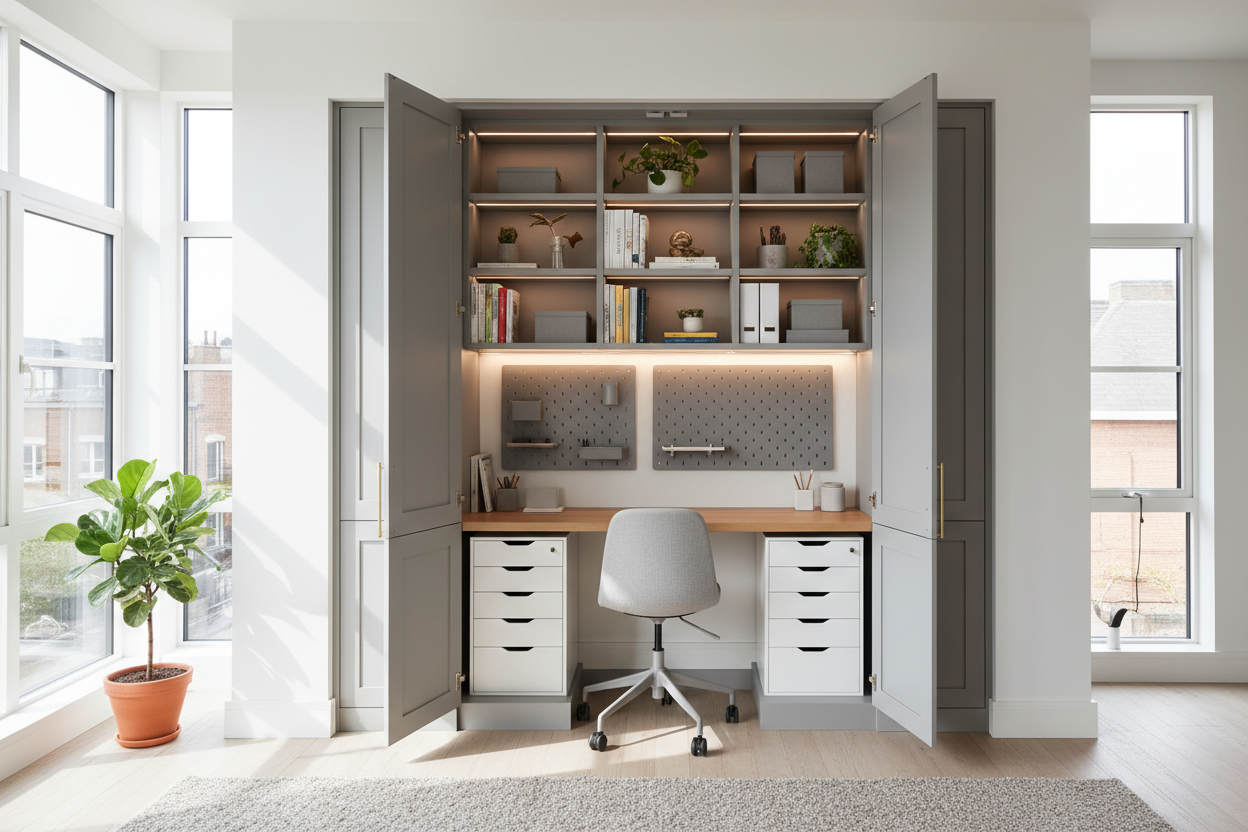
As an interior designer, the most frequent request I receive isn't for a specific aesthetic, but for a psychological boundary. In the era of hybrid work, the inability to physically leave the office creates a mental strain. The visual noise of monitors, tangled cables, and stacked paper disrupts the sanctuary of a living room or bedroom. The solution lies in a concept that balances high functionality with complete concealment: the office in a cupboard ikea hack.
Essential Planning Checklist
Before purchasing a single hinge or panel, consider these critical factors to ensure your hidden workspace functions as well as it looks.
- Depth Requirements: Ensure a minimum depth of 23-24 inches to accommodate a monitor stand and keyboard without preventing the doors from closing.
- Ergonomics: The desk surface must sit at roughly 28-30 inches high; standard shelf placement often misses this sweet spot.
- Cable Management: Plan for a false back or grommet holes before assembly to route power without pinching cords.
- Lighting: Integrated dimmable LED strips are mandatory, as overhead room lighting will likely be blocked by the cabinet roof.
- Hinge Clearance: Standard 110-degree hinges may obstruct your elbows; opt for 155-degree or sliding hardware.
Selecting the Right System: PAX vs. SEKTION
When designing a hidden office, you are generally choosing between two primary IKEA ecosystems: the PAX wardrobe system or the SEKTION kitchen system. Your choice dictates the structural integrity and layout of your workspace.
The SEKTION Approach: Robust and Custom
For a built-in look that mimics high-end millwork, I often recommend an IKEA Sektion desk configuration. Because these are kitchen cabinets, they are engineered to bear significant weight. By utilizing IKEA desk base cabinets (standard 24-inch depth), you create a sturdy foundation for a countertop. The advantage here is modularity; you can stack office wall cabinets IKEA units above the desk surface for vertical storage that goes all the way to the ceiling, creating a seamless library wall.
The PAX Approach: The All-in-One Solution
If you prefer a freestanding piece, the PAX system offers height and depth but requires reinforcement. The standard shelves are not designed for the repetitive pressure of typing or leaning. If you go this route, I recommend reinforcing the desk shelf with angle brackets or opting for a custom-cut piece of solid timber rather than the particleboard shelf provided.
Ergonomics and The Hidden Desk
The biggest failure point in DIY hidden offices is poor ergonomics. A standard kitchen counter height is 36 inches, which is far too high for a seated desk. When utilizing IKEA desk height cabinets or modifying taller pantry units, you must ensure your work surface sits at the standard ergonomic height of 29 inches.
Furthermore, consider the "knee well." If you are using base cabinets for storage, you must leave a minimum of 24 inches of width empty beneath the desktop to allow for comfortable chair movement. Without this, you will find yourself sitting sideways or perched uncomfortably on the edge of your seat.
Lessons from My Own Projects: The "Elbow Room" Issue
I want to share a specific hurdle I encountered during a project in a compact downtown apartment. We designed a beautiful "cloffice" using a tall pantry unit. On paper, the dimensions were perfect. However, once installed, we realized a critical oversight: the door hinges.
We used standard hinges that encroached about two inches into the cabinet interior on both sides. Every time the client typed, their elbows would brush against the metal hardware. It was a sensory annoyance that ruined the workflow. We had to disassemble the doors and swap them for 153-degree wide-angle hinges that swing the door completely clear of the opening. Additionally, we hadn't accounted for the depth of the monitor plug sticking out of the wall; we ended up having to use a hole saw to cut into the cabinet backing to reclaim that crucial inch of depth so the doors could actually close. Always measure your equipment with the cables plugged in, not just the device itself.
Conclusion
Creating a hidden workspace is about reclaiming your home's tranquility. By carefully selecting between an IKEA Sektion desk setup or a PAX modification, and paying close attention to the nuances of depth and hinge clearance, you can build a station that is a powerhouse by day and invisible by night.
Frequently Asked Questions
How do I handle ventilation for a computer tower inside a cupboard?
Heat buildup is a serious concern. If housing a PC tower, install a mesh insert in the toe-kick or cut a ventilation grill into the back panel. Ideally, install a small USB-powered fan to exhaust hot air out of the cabinet.
Can I use a pull-out shelf for the keyboard?
Yes, IKEA's Komplement pull-out trays work well, but they can be bouncy. For a sturdier feel, use heavy-duty drawer slides rated for at least 100 lbs and attach a custom wood shelf. This reduces the vibration while typing.
What is the best way to light the interior?
Avoid battery-powered puck lights; they are tedious to maintain. Use the IKEA MITTLED system connected to a TRÅDFRI driver. This allows you to hardwire the lighting and control it via a remote or smart home system, ensuring consistent task lighting.

Leave a comment
This site is protected by hCaptcha and the hCaptcha Privacy Policy and Terms of Service apply.