










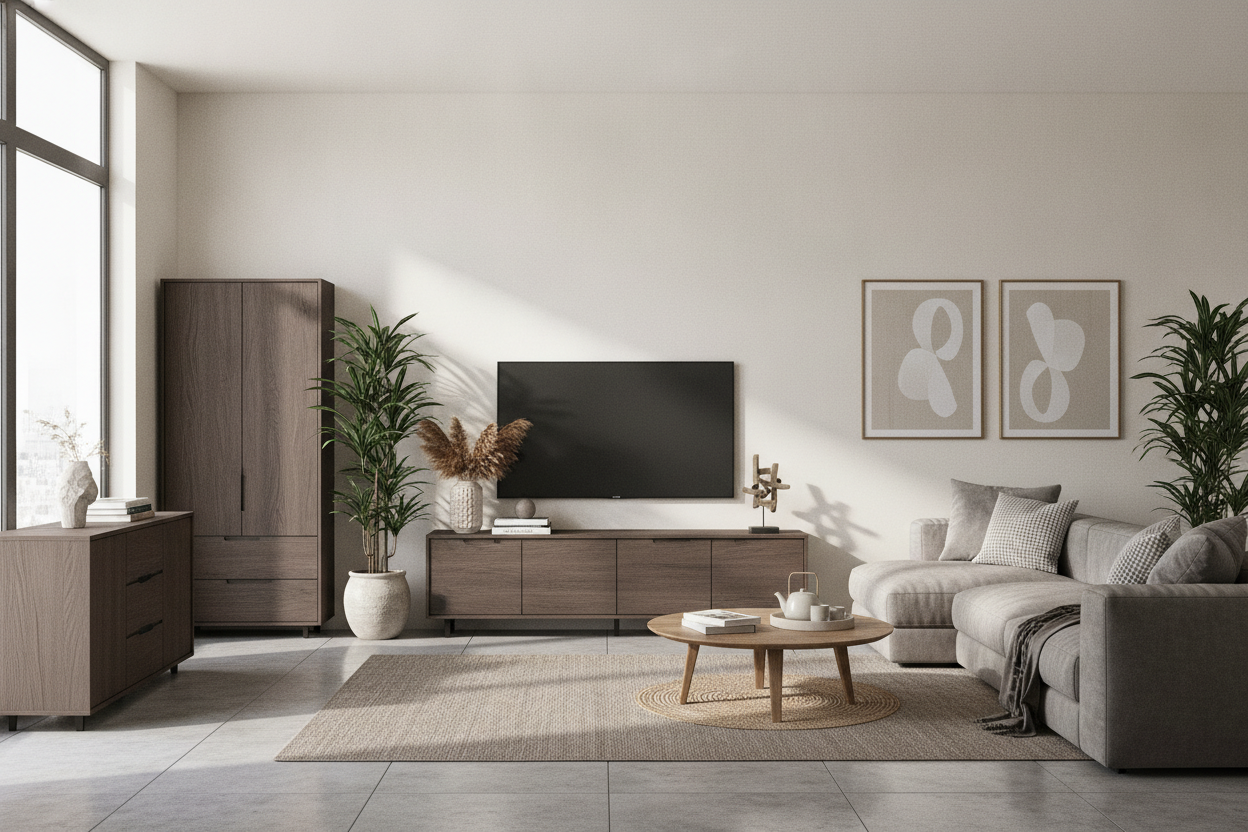
I spent two years pretending my living room looked like a curated Pinterest board. I had the mid-century modern open-shelf unit, the perfectly stacked art books, and three tiny succulents that were slowly dying of neglect. But behind those books was a bird's nest of HDMI cables, a dust-caked PlayStation 5, and a router that blinked like an angry lighthouse every time I tried to watch Netflix.
The breaking point came on a Tuesday night when I realized I was spending more time dusting my 'aesthetic' knick-knacks than actually relaxing. Every time I looked at the TV, my eyes drifted down to the tangle of black wires and the layer of grey fuzz coating my Nintendo Switch. I finally admitted defeat. I didn't need more 'styling opportunities.' I needed a giant wooden box to hide my shame. That is when I bought my first 4 door media console, and I am never going back.
Quick Takeaways
- Closed storage eliminates the visual 'noise' of cords and tech gear.
- A wider console (70+ inches) makes your TV look proportional, not top-heavy.
- Four doors allow for distinct 'zones'—one for gaming, one for tech, one for hobby storage.
- Solid doors are superior to glass if you want to hide clutter completely.
The Open Shelving Delusion (And My Breaking Point)
We’ve all been sold the lie that open shelving is the peak of 'airy' design. In reality, unless you live in a vacuum-sealed showroom, open shelves are just magnets for dust and cat hair. For months, I tried to hide my cable box behind a decorative tray. I tried wrapping my wires in those plastic sleeves. Nothing worked. The room always felt 'busy' because there was nowhere for the eye to rest.
The moment of clarity happened during a midday sunbeam. The light hit my open media stand at just the right angle to reveal a thick, felt-like layer of dust on everything I owned. My expensive receiver looked like it had been pulled from an attic, and the messy pile of board games on the bottom shelf made the whole room look smaller. I realized that 'minimalism' isn't about having fewer things; it's about having a better place to put them. I needed a fortress of storage.
The Visual Math: Why Wider Is Better
Most people make the mistake of buying a TV stand that is the exact same width as their television. This is a design crime. A 65-inch TV sitting on a 60-inch stand looks like a toddler wearing their parent's oversized shoes. To anchor a room, you need scale. Switching to a long 4 door tv stand—specifically one in the 80-to-84-inch range—instantly changed the geometry of my living room.
By choosing a wider unit, the TV suddenly looked like it belonged there rather than just being 'stuck' on the wall. The extra length provides much-needed visual weight, making the furniture feel like a built-in architectural feature rather than a temporary purchase. Even if your room is on the smaller side, a single long, low piece of furniture actually makes the walls feel further apart than two or three small, cluttered pieces ever could. It’s about creating a clean horizontal line that leads the eye across the space.
Zoning the Chaos: My Strategy for Organization
The beauty of a four-door setup is the internal logic. Instead of one giant cavern where things go to die, you have four distinct compartments. In my house, Cabinet One is the 'Heat Zone.' It houses the PS5 and the Xbox. I actually removed the back panel of this section to ensure maximum airflow, because nobody wants a melted console. Whether you're using a swing-door unit or a sliding door TV stand black, the goal is the same: total concealment of the plastic and the heat.
Cabinet Two is for the 'Boring Tech.' This is where the router, the modem, and the external hard drives live. I used adhesive cord clips inside the cabinet to keep everything off the floor. Cabinet Three is the 'Analog Zone'—it holds the board games and the oversized coffee table books I’m not currently pretending to read. Finally, Cabinet Four is the 'Junk Drawer.' Batteries, spare remotes, and those mysterious Allen wrenches that come with every piece of furniture? All hidden. The result is a living room that looks permanently clean, even if there's a disaster happening behind those doors.
Glass Fronts vs. Solid Doors (What You Need to Know)
Before you buy, you have to decide if you're a 'show-er' or a 'hider.' Glass doors can look elegant, but they are snitches. They will tell everyone exactly how messy your cable management is. If you go the glass route, you absolutely must commit to styling a black glass door TV stand with intention—think uniform baskets or very neatly stacked components. If you have a collection of mismatched Wii controllers and neon-colored board games, solid wood or metal doors are your best friend.
The one downside to solid doors is infrared (IR) signals. Most modern remotes use Bluetooth, so they work through wood just fine. But if you have an older cable box or receiver, you might need a $20 IR repeater. It’s a tiny little 'eye' that sits on top of the console and beams the signal to the devices inside. It’s a small price to pay for never having to look at a mess of wires again. Personally, I chose solid doors with a subtle fluted detail. It adds texture to the room without the visual clutter of seeing my router’s blinking green lights all night.
The Golden Rule for Styling a Massive Furniture Piece
Once you have an 80-inch 4 door media console, the temptation is to cover the top with every photo frame you own. Resist that urge. The secret to making a large console look high-end is asymmetry and negative space. I follow the 'Rule of Three.' On one end, I have a large, substantial ceramic vase with some dried branches. In the middle, I leave it mostly empty so the TV has room to breathe. On the other end, I have a small stack of books with a brass object on top.
Avoid the 'picket fence' look where you line up items of the same height across the whole length. You want varying heights to keep the eye moving. By leaving about 30% of the surface empty, the piece feels intentional and 'designed' rather than just a landing pad for mail and keys. It turns a piece of utility furniture into a focal point that actually improves the vibe of the whole home.
My Personal Experience: The Depth Mistake
I’ll be honest: I messed up the first time I bought a large console. I found a vintage-looking 4-door unit on sale and bought it without checking the internal depth. When it arrived, I realized my high-end audio receiver was 16 inches deep, but the cabinet was only 14 inches. I ended up having to saw a giant hole in the back panel so the receiver could stick out the back. It worked, but it was a pain. Always measure your deepest piece of tech—including the plugs sticking out the back—before you hit buy.
FAQ
Do I need a 4 door stand for a small TV?
Yes. Even if your TV is small, a wider stand makes the room feel more anchored and provides extra storage that usually replaces the need for an additional bookshelf or chest of drawers.
Will my consoles overheat inside a closed cabinet?
They can. If you're a heavy gamer, look for a console with built-in ventilation or simply use a hole saw to create a 3-inch vent in the back panel. You can also leave the door cracked during long gaming sessions.
Is solid wood better than MDF for a media console?
For a piece this large, yes. A 4-door unit holds a lot of weight. Cheap MDF can sag in the middle over time, especially if you have a heavy TV on top. Look for kiln-dried hardwood or at least a high-quality veneer over a plywood core.

Leave a comment
This site is protected by hCaptcha and the hCaptcha Privacy Policy and Terms of Service apply.