







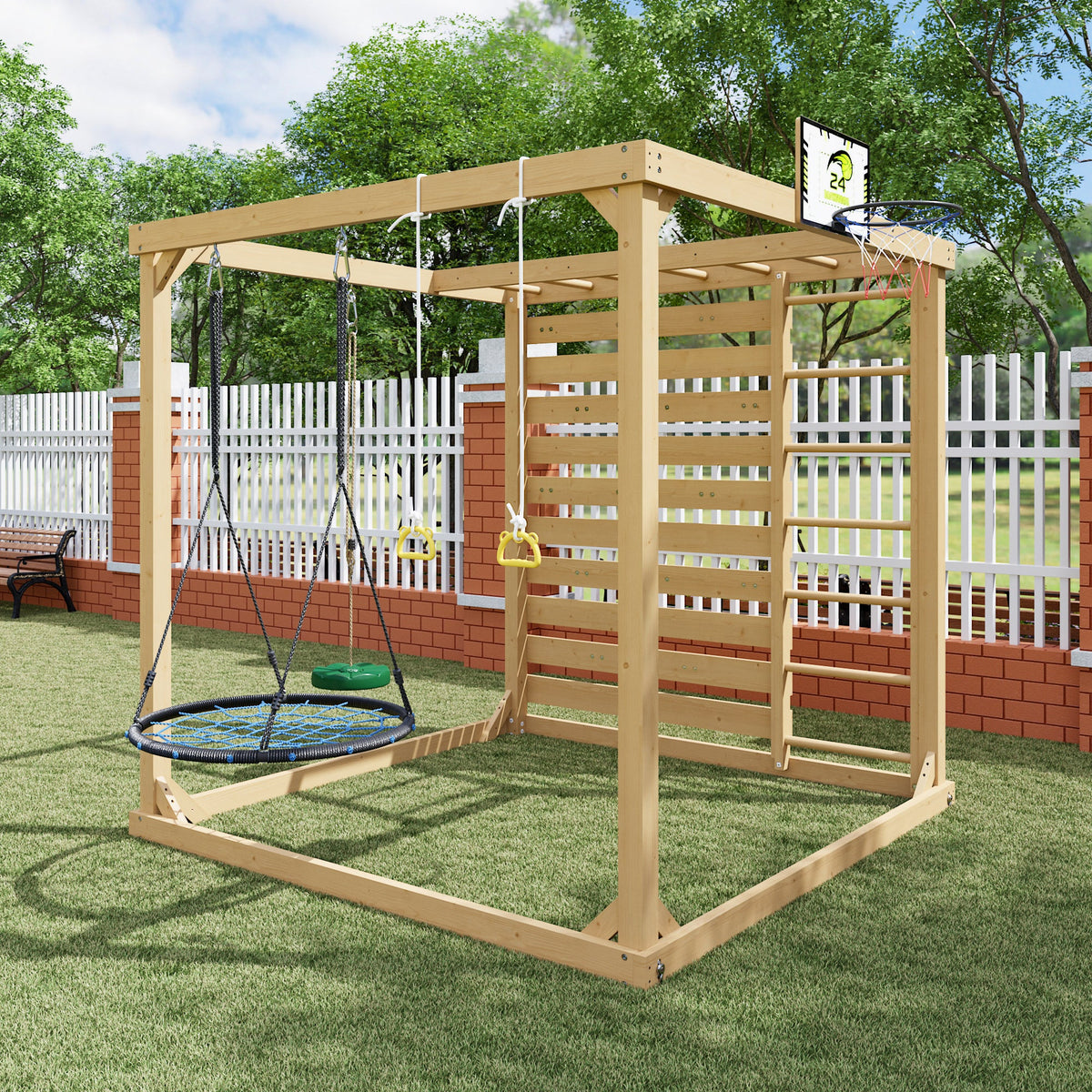
Before you choose an outdoor playset, measure the yard for the playset plus its use zone. The U.S. Consumer Product Safety Commission (CPSC) says to keep protective surfacing at least 6 feet around the equipment in every direction, and in front of and behind a swing, twice the height of the bar it hangs from. Then plan the surfacing (grass does not count), anchor the frame as the maker's instructions say, keep it away from fences, trees and hard surfaces, and match the equipment to your children's ages and the listed weight limits.
Every distance and depth below is quoted from the CPSC Outdoor Home Playground Safety Handbook (publication 324), with the arithmetic shown for a real frame from the FUFU&GAGA outdoor play sets collection.
Key takeaways
- Use zone: 6 feet of surfacing in all directions, and twice the top-bar height in front of and behind to-fro swings.
- Obstacles: place play equipment "at least 6 feet from any structure or obstacle, such as a house, fence, sheds, trees or poles."
- Surfacing: at least 9 inches of wood mulch, engineered wood fiber or shredded rubber mulch for equipment up to 8 feet high. Grass and dirt do not count.
- Anchoring: follow the manufacturer's instructions and bury or cover the anchors.
- Upkeep: nuts and bolts twice a month; swing seats, ropes and chains monthly.
How much space does an outdoor playset need?
A backyard playset needs more ground than its footprint. The handbook's placement rules for protective surfacing are short enough to quote:
- "Extend surfacing at least 6 feet from the equipment in all directions."
- "For to-fro swings, extend protective surfacing in front of and behind the swing to a distance equal to twice the height of the top bar from which the swing is suspended."
- "For tire swings, extend surfacing in a circle whose radius is equal to the height of the suspending chain or rope, plus 6 feet in all directions." The handbook's figure labels this the use zone for multi-axis swings.
How much space for a swing set? A quick chart
Plain arithmetic from those rules. H is the height of the top bar the swing hangs from; the zone runs 2H on each side of the bar, 4H in total.
| Top bar height (H) | In front of and behind the swing (2H) | Total in the swing direction (4H) | Beyond each side |
|---|---|---|---|
| 6 ft | 12 ft | 24 ft | 6 ft |
| 6.6 ft (78.7 in) | 13.1 ft | 26.2 ft | 6 ft |
| 7 ft | 14 ft | 28 ft | 6 ft |
| 8 ft | 16 ft | 32 ft | 6 ft |
A worked example: our 8-in-1 playset measures about 78.7 inches wide, deep and tall. Adding 6 feet (72 inches) on every side gives 78.7 + 144 = 222.7 inches, about 18.6 feet each way. Its top bar can be no higher than 78.7 inches, so for a to-fro swing 2H is at most 157.4 inches (13.1 feet) and 4H about 26.2 feet. Plan a level area of roughly 18.6 x 26.2 feet if every swing moves in the same direction, and up to about 26.2 x 26.2 feet if swings hang from beams facing different ways. Measure your assembled frame; a lower bar gives a smaller zone.
A disc or saucer swing that moves in any direction follows the circle rule: rope length plus 6 feet. On a 78.7-inch frame the rope cannot be longer than about 6.6 feet, so the radius is at most about 12.6 feet from the hanging point.
Choosing the spot
The handbook asks for a location "away from roads and driveways and readily visible from inside the home and patios or porches," free of "low overhanging tree branches, overhead wires, tree stumps and/or roots, large rocks, bricks, and concrete." Choose level ground, which reduces the chance of the set tipping and of loose fill washing away. Keep the set 6 feet from structures, fences and trees, and in front of and behind swings, "a distance equal to twice the height of the top bar."
Inside the zone, keep activities apart: "a slide should not exit in front of a swing," and sandboxes belong away from swings, or behind a guardrail or barrier that separates them from the swings' movement.
What goes under an outdoor playset: protective surfacing
Falls are the reason surfacing matters. The handbook says "About 80% of the injuries occur when children fall from play equipment," and calls shock-absorbing surfacing "one of the most important things you can do to reduce the likelihood of serious head injuries."
It is just as clear about what does not work. Do not install home playground equipment "over concrete, asphalt, or any other hard surface." "Grass and dirt are not considered protective surfacing because wear and environmental factors can reduce their shock absorbing effectiveness." "Carpeting and thin mats are generally not adequate protective surfacing." Ground-level equipment with no elevated play surface, such as a sandbox, needs none.
| Surfacing | CPSC depth | Equipment height |
|---|---|---|
| Wood mulch or chips, engineered wood fiber (EWF), shredded or recycled rubber mulch | 9 in minimum (fill 12 in at first) | Up to 8 ft |
| Sand or pea gravel | 9 in minimum | Up to 5 ft |
| Loose fill under low equipment | 6 in minimum | Under 4 ft |
| Rubber tiles or poured-in-place rubber | As tested to ASTM F1292 | The tested height must equal or exceed the fall height |
The handbook explains that "An initial fill level of 12 inches will compress to about a 9-inch depth of surfacing over time." Tiles and poured rubber "generally require a professional"; ask for the ASTM F1292 test report. Fall height is the vertical distance from a surface for standing, sitting or climbing to the surfacing below.
Which surfacing for a 6 to 7 foot frame?
Find the highest point a child can stand on or climb to. On our 78.7-inch frame that is at most about 6.6 feet: above the 5 feet the handbook allows for sand or pea gravel, below the 8 feet it gives for wood mulch, EWF or shredded rubber mulch. So one of those three, kept at 9 inches, is the match.
For quantity, multiply area in square feet by depth in feet and divide by 27 for cubic yards. An 18.6 x 26.2 foot zone is about 487 square feet; at a 12-inch first fill that is 487 cubic feet, about 18 cubic yards.
To keep it in place, the handbook suggests digging out the perimeter or lining it with landscape edging, allowing for drainage, raking to prevent compaction, and marking the correct level on a support post so you can see when to top it up.
How to anchor and assemble a playset
The handbook notes that play equipment "may need to be restrained with anchors to keep it from tipping over while in use." Its rules: "Follow the manufacturer's instructions for anchoring," and "Be sure anchors are buried or otherwise covered with protective surfacing," because exposed anchors, hooks and bolts trip children. Some playsets include anchors and some do not, so check the parts list early.
Anchors go into the ground, so contact 811 first. The 811 Before You Dig site calls 811 "the free national before-you-dig service" and says "every digging project, regardless of depth, requires contacting 811 a few days in advance."
For assembly, follow the manual, install on level ground, and tighten every connection. The handbook's hardware rules: use the corrosion-resistant bolts and screws the manufacturer provides or recommends, with lock washers or self-locking nuts; cap exposed bolt ends, which "should not protrude more than the diameter of the bolt past the nut"; and close S-hooks so the gaps are "less than the thickness of a dime." Our flat-pack assembly guide has general tips for sorting parts; for a playset, the manual governs every step.
Swings: spacing, seats and toddler swings
The handbook recommends lightweight swings ("Avoid heavy seats of metal or wood") and disc swings "in separate bays, away from other swinging equipment." Its minimum spacings include 8 inches for swings with limited sideways motion, 24 inches between swings with unlimited lateral motion (such as disc swings) and the support poles, and 8 inches between the surfacing and the underside of a hanging seat. Re-check that last one after adding mulch, because the ground rises toward the seat.
The handbook also reports that a 2009 revision of the home playground standard, ASTM F1148, "prohibits the attachment of components such as swings, gliders and trapeze bars from monkey bars," so children falling from the bars do not land on swinging parts. For toddler swings: "Never leave a child in a toddler swing unattended," and fasten the restraint when one is provided.
Strangulation and entrapment hazards
The handbook says deaths on home playgrounds often happen "when children get entangled in and strangle from ropes, cords, or leashes attached to play equipment, or when clothing drawstrings and items worn around children's necks catch on the equipment." Its checklist: "Never attach jump ropes, clotheslines, pet leashes, or cords of any kind to play equipment. Anchor any climbing ropes at both ends. Remove drawstrings from children's clothes."
- Openings: gaps between rungs, posts and rails should be "smaller than 3½ inches" or "larger than 9 inches."
- Angles: fill V-shaped angles that open upward and are less than 55 degrees with a solid gusset.
- Helmets: "Do not allow children to wear bike helmets on play sets"; children "have become entrapped and strangled by the chinstrap."
- Ropes: replace frayed or loose ropes immediately.
Comparing sets with raised decks? The handbook calls for guardrails or barriers on any platform over 30 inches above the surfacing.
Matching an outdoor playset to your children's ages
Age guidance should come from the maker's label and manual. For background, ASTM's F1148 home playground equipment standard covers equipment "intended for use by children aged from over 18 months through 10 years," with separate requirements for toddler swings. Monkey bars and a climbing wall suit children who can climb and hang; toddlers need a toddler swing and close adult supervision.
Weight limits come in two kinds: the total capacity the frame carries with everyone on it, and the limit for one swing. Keep within both. Supervision heads the CPSC checklist: "Be sure to always supervise children on play equipment."
A label to look for: CPSC says manufacturers and importers of children's products must certify compliance "in a written Children's Product Certificate (CPC)" based on testing by a third-party, CPSC-accepted laboratory (see the CPSC Children's Product Certificate page).
Wood playsets: materials and care
The handbook says outdoor wood "should be naturally rot-resistant and insect-resistant (e.g., cedar or redwood) or treated to prevent such deterioration," and "Creosote-treated wood and coatings that contain pesticides should not be used." With pressure-treated wood, check that the hardware is compatible with the treatment chemicals.
Wood care is mostly inspection: look for "splintering wooden surfaces" and sand them smooth. If your playset arrives unstained and you want to finish it, use only what the manual allows and follow the finish maker's label.
Inspection and maintenance schedule
Save the manual so you can order parts later. The handbook recommends:
| How often | What to check |
|---|---|
| Twice a month | Nuts and bolts (tighten as needed); caps and plugs on bolt ends and tubing |
| Monthly | Swing seats, ropes, chains and cables |
| Regularly | Broken or missing parts, splintering wood; rake loose fill and top it back up |
| Cold weather | Remove plastic swing seats if the manufacturer recommends it |
Outdoor playset buying checklist
- Measure a level area: frame size plus 6 feet on every side, and 2H in front of and behind each swing beam.
- Keep that area 6 feet from buildings, fences, trees and poles, and clear of wires and low branches.
- Pick surfacing rated for the set's height and budget for a 12-inch first fill.
- Read the age range, total weight capacity and swing weight capacity.
- Check whether anchors are included, and contact 811 before installing them.
- Look at where swings and rings hang: nothing from monkey bars, disc swings in their own bay.
- Check openings (under 3½ or over 9 inches), capped bolts and closed hooks.
- Look for a Children's Product Certificate, and keep the manual.
Our pick: a cedar 8-in-1 playset
Our pick from FUFU&GAGA is a compact cedar climbing frame that packs several activities into one footprint. Here is what its listing states, and what to check before you order.
78.7" 8-in-1 solid wood outdoor playset with swings, climbing wall and basketball hoop

A square cedar frame about 78.7 inches wide, deep and tall, weighing 185.8 lb. The listing describes a swing, a climbing wall, monkey bars, hanging rings, two ladders, a basketball hoop and a sandbox in the base. Its spec names disc and web (saucer) swing types and rings, but the spec and title disagree on how many swings are included, so check the parts list in the User Manual tab. The hardware is stainless steel, parts are pre-cut and pre-drilled, and assembly is required. The listing gives an 800 lb total weight capacity, a 200 lb swing weight capacity and seating for 3, and says the playset is CPC and ASTM certified from independent lab testing, without naming the ASTM standard. It is not pre-stained, and anchors and stakes are not included.
Our product photos show the frame on a lawn so every part is visible. Grass is not protective surfacing: install it over wood mulch, EWF or shredded rubber mulch at the depth given above, with the full use zone around it, and hang the swings and rings only from the points the manual shows.
Best for: families who want climbing, hanging, swinging and ball play in a small footprint, with room for the use zone worked out above.
Skip it if: you need a stated age range before buying (the listing gives none; read the manual's warning label first); you want a slide or a raised deck (none are listed); or you want the sandbox apart from the swings. In the product photos the sand fills the base under the swings, while CPSC advises placing sandboxes away from swings or separating them with a barrier. Ground anchors are not included, so plan to buy ones that match the manual.

| Feature | As listed |
|---|---|
| Size | About 78.7 x 78.7 x 78.7 in; 185.8 lb |
| Weight limits | 800 lb total; 200 lb per swing; seats 3 |
| Wood and hardware | Solid cedar, not pre-stained; stainless steel |
| Anchors | Not included |
| Age range | Not stated in the listing |
| Certification | CPC and ASTM, per the listing |
FAQ
How much space do you need for a swing set?
Measure the frame, then add the CPSC use zone: at least 6 feet of surfacing on every side, and twice the top-bar height in front of and behind each to-fro swing. A 7-foot top bar needs 14 feet each way, 28 feet in total in the swing direction.
Can you put a playset on grass?
You can set it on a lawn, but the grass is not enough. The CPSC handbook says grass and dirt are not protective surfacing because wear and weather reduce their shock absorption. Add loose fill or a tested surface under and around the play area at the depth the handbook gives for the equipment height.
How deep should mulch be under a playset?
At least 9 inches for equipment up to 8 feet high, per the CPSC handbook. Fill to about 12 inches at first, because it compresses to roughly 9 inches. Mark the 9-inch level on a post and top it up when it drops.
How often should you inspect a wooden playset?
The handbook recommends checking nuts, bolts and caps twice a month, and swing seats, ropes, chains and cables monthly. Look for splinters, loose or missing parts and thin surfacing at the same time, and fix problems before children play again.
Ready to plan your backyard? Measure the use zone first, then browse the outdoor play sets collection.

Leave a comment
This site is protected by hCaptcha and the hCaptcha Privacy Policy and Terms of Service apply.