











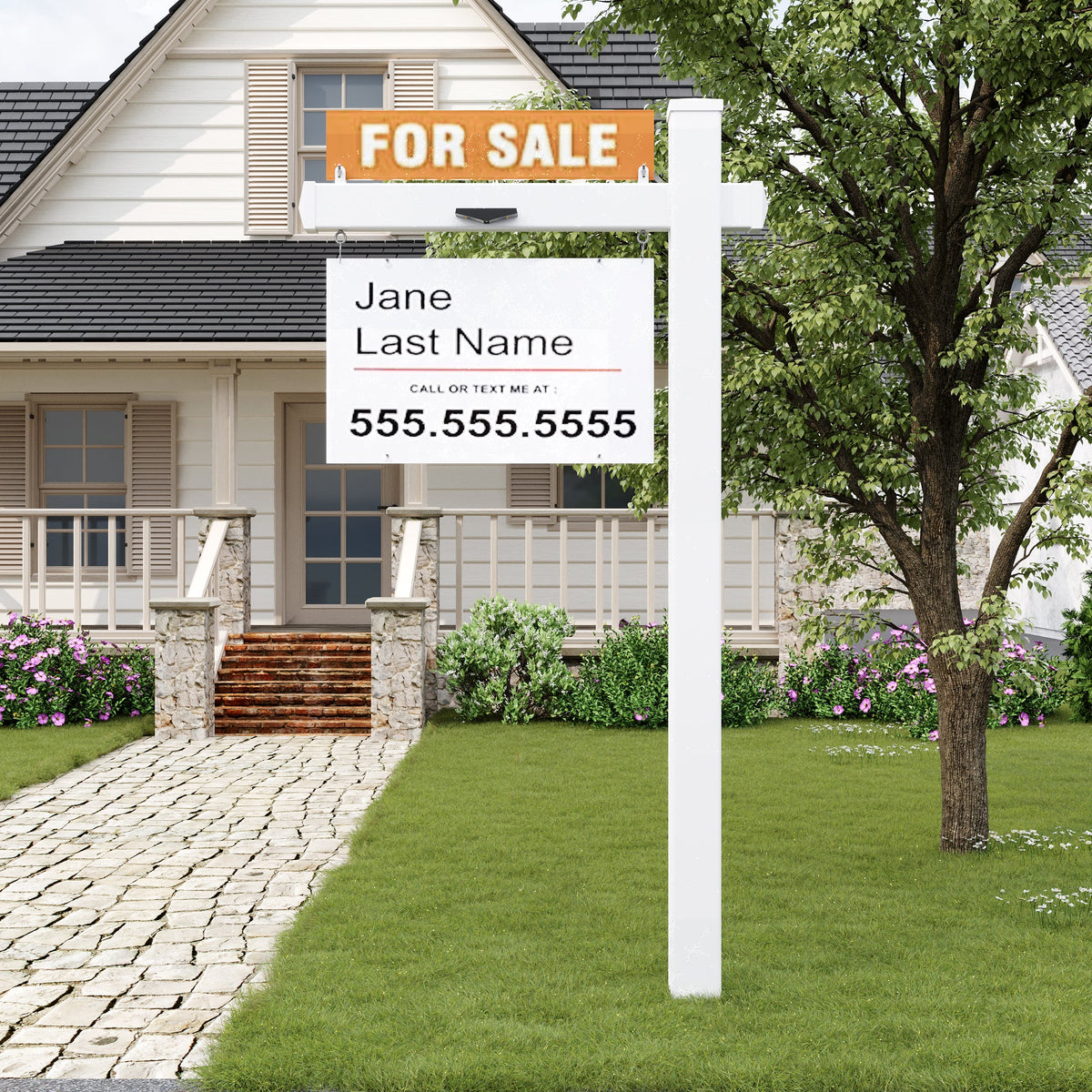
A real estate sign post is an upright post with a crossarm, usually white vinyl (PVC), that hangs a listing sign beside the street where drivers and walkers can read it. To choose one, check four things: the overall height against your city's height limit, an arm sized for the sign you use, how the post goes into the ground (and a call to 811 before you dig), and whether local rules allow a lit sign at all. Some cities cap a residential real estate sign at 5 feet and ban illumination, so a 6-foot solar post is not legal everywhere as delivered.
Below: height and sign size against real sign codes, solar lights, installation, wind, HOA rules, moving a post, and the solar PVC sign post in the FUFU&GAGA outdoor collection.
Key takeaways
- Height is regulated: Scottsdale, Arizona caps residential post-and-panel signs at 5 feet tall; Bloomington, Minnesota and Rancho Palos Verdes, California allow 6 feet. Whatever goes below ground comes off the visible height.
- Lights may not be allowed: Scottsdale and Bloomington both rule out illumination on these signs. Check before you pay for a lit post.
- Stay on private property: all three cities keep real estate signs out of the public right-of-way, and Bloomington wants on-site signs at least 10 feet from it.
- Call 811 first: the national 811 service says every digging project, regardless of depth, needs a call a few business days ahead.
- Match the arm to the sign: buy a post whose listing names the sign sizes it fits, and check the sign's area against your local limit.
What is a real estate sign post?
A real estate sign post is a freestanding post with a horizontal arm near the top. The listing sign hangs below the arm, so it faces the street at about eye level and can be read from both directions. A small rider panel ("For Sale", "Open House", "Sold") often sits on top of the arm. Rancho Palos Verdes, California calls this shape an "inverted 'L' signpost" in its sign code. Posts come in white vinyl (PVC), wood and metal; vinyl is the common choice for a clean white look.
| Sign setup | Good for | Watch for |
|---|---|---|
| Post and arm (inverted L) with a hanging sign | A listing that stays up for weeks or months; reads from the street and from both directions | Height and area limits; setting the post in the ground |
| Wire-frame yard sign pushed into the lawn | Short-term signs, directional signs, tight budgets | Sits low; some cities cap yard signs at 3 feet |
| A-frame open house sign | Open house days; set out and taken in the same day | Some cities limit the hours and size and ban attachments, lights included |
How tall should a real estate sign post be?
Tall enough that the sign clears shrubs and parked cars, and no taller than your local code allows. A 6-foot post, like ours at 71.9 inches, is right at or above the limit in the cities below, so the local cap is the number to start from. Three published examples show how much rules differ:
| City | Height limit | Sign area limit | Placement | Lighting |
|---|---|---|---|---|
| Scottsdale, Arizona (residential post-and-panel signs) | 5 feet tall | 6 sq ft on lots of 2 acres or less | Private property only; prohibited in the right-of-way | No illumination |
| Bloomington, Minnesota (on-site real estate signs) | 6 feet high | 10 sq ft | At least 10 feet from the public street right-of-way | No illumination |
| Rancho Palos Verdes, California (inverted L signposts) | 6 ft, measured from the lowest grade | 5 sq ft, no attachments of any kind | Within the property for sale; at least 2 ft from vehicle and bike lanes | Not addressed for signposts; A-frame signs may carry no lights |
The arithmetic is simple. A post listed at 71.9 inches is 5 feet 11.9 inches long (71.9 minus 60 is 11.9). If the full length stood above ground it would fit a 6-foot limit, which is 72 inches, by a tenth of an inch. Under a 5-foot (60-inch) limit like Scottsdale's, at least 11.9 inches of it would have to sit below grade. On a slope, a code that measures from the lowest grade, as Rancho Palos Verdes does, counts from the low side, so check how yours measures before you set the post.
Arm length and the sign sizes that fit
The arm decides which signs you can hang. Check two things in the listing: the overall width (the arm span on an inverted L post) and the sign sizes the maker says it holds. Then check the sign itself against your local area limit. Area is width times height divided by 144 to turn square inches into square feet:
- A 24 by 18 inch sign is 432 square inches, or 3 square feet (432 divided by 144).
- A 24 by 36 inch sign is 864 square inches, or 6 square feet: at Scottsdale's limit for residential lots of 2 acres or less and over Rancho Palos Verdes's 5 square feet.
A rider on top of the arm adds area, and some codes do not allow it at all: Rancho Palos Verdes says signpost signs may not contain any attachments. Hang the sign from both ends of its top edge so it hangs level, and leave enough gap between sign and post that the sign can swing without striking it.
Real estate sign post with solar lights: worth it?
A lit sign stays readable for evening drive-bys, and solar lights do it without a cord across the lawn. On our post, the listing says the two solar lights charge in daylight and switch on by themselves at night, with no wiring; the photos show the light on top of the arm.
Check two things first:
- Is a lit sign allowed? Scottsdale lists "no illumination" for residential post-and-panel signs, and Bloomington's rules for on-site real estate signs say "No illumination". If your city or HOA bans lit signs, you can still use the post, but you would have to leave the lights off or take them off, so a plain post may make more sense.
- Will it get sun? A solar light can only store what its panel collects. A post under a big shade tree, on the north side of a house or in the shadow of a fence will charge less. Before you dig, look at the spot at midday and mid-afternoon and move the post a few feet into the open if you can.
Keep the lights pointed at the sign, not at the street or a neighbor's windows, and wipe dust and pollen off the solar panels now and then.
How to install a real estate sign post
The planning matters more than the digging. In order:
- Check the rules. Read your city's sign code and your HOA's sign rules (the checklist below lists what to look for).
- Get permission. If the sign goes on someone else's property, get the owner's permission first, as Bloomington requires for off-site real estate signs.
- Pick the spot. On private property, outside the public right-of-way (Bloomington's diagram marks the strip between the sidewalk and the street as off-limits), clear of the sidewalk and of driveway and corner sight lines. Bloomington allows no sign taller than 3 feet in its clear view triangle, which runs 15 feet each way at a driveway or intersection, so a 6-foot post belongs outside it.
- Call 811. The free national 811 before-you-dig service says to contact 811 a few business days before any digging, regardless of depth, and to wait until all utilities have responded and marked their lines. Treat a driven ground stake the same way.
- Read the manual for the ground fitting. Posts are set in different ways: over a metal stake driven into the soil, in a dug hole that is backfilled and tamped, or on a weighted base for hard ground. Follow the method your post's instructions give, and remember the depth comes off the visible height.
- Set it plumb. Check the post with a level on two adjacent faces, and turn the arm so the sign faces the direction most traffic comes from.
- Hang the sign and any rider. Fasten them the way the post is designed for, and check that the sign hangs level and clears the post.
- Check it after the first windy day. Re-level and re-tamp if the post has leaned.
If the post arrives flat-packed in parts, our flat-pack assembly guide covers sorting and checking parts before you start.
Wind and stability
A hanging sign catches wind, and a 6-foot post gives that wind a long lever against whatever holds it in the ground. Our listing gives no wind rating, so set the post firmly by the method in its instructions, in firm soil rather than loose mulch or a soggy low spot. Let the sign swing a little instead of wiring it tight to the post, take the sign and rider down before high winds are forecast, and check the post afterward.
HOA and municipal sign rules
Sign rules come from the city or county sign code and, for many homes, an HOA or condo association. Follow the stricter one. Scottsdale, for example, says its ordinance regulates the duration, size and placement of temporary signs, not their content. Before you buy or install, find answers to these questions:
- How tall may the sign be, and is height measured from the lowest grade?
- How large may the sign be, and do riders count?
- How many signs per street frontage or per lot?
- How far from the right-of-way, sidewalk, travel lanes and property lines?
- Are lights allowed?
- Is a permit needed?
- When must the sign come down? Scottsdale says no more than 7 days after the activity ends, and Bloomington says seven days after the sale closes.
Ask your HOA or management company for its sign policy in writing. This guide is not legal advice; your city's planning or code enforcement office has the final word.
Moving a sign post between listings
Agents often reuse a post from listing to listing. Take it down with care:
- Remove the sign, rider and hooks first, and bag the small hardware.
- Lift the post straight up out of its stake or hole; rocking it side to side widens the hole and can bend the stake.
- Fill and tamp the hole and rake the lawn so the seller is not left with a hole near the sidewalk.
- Wipe the post clean and check the arm and lights for damage.
- Measure your vehicle: a 6-foot post needs about 72 inches of cargo length unless the arm and post come apart.
- Call 811 again at every new address; marks at one property say nothing about the next.
Real estate sign post buying checklist
- Local height limit: overall post length minus the buried depth is at or under your cap.
- Sign size: the listing names the sign sizes the arm fits, and your sign's area meets the local limit.
- Lighting: lights only where your city and HOA allow them, and a spot that gets sun.
- Ground fitting: you know how the post sets into the ground (stake, hole or base) and whether that part is included.
- Material: a weather-resistant post with rust-resistant hardware, as stated in the listing.
- Sign included or not: the listing says whether a sign or rider panel comes with the post.
- 811 call: booked a few business days before each install.
Our pick: a solar real estate sign post
The FUFU&GAGA range currently has one real estate sign post. The facts below come from its product listing; the assembly guide is in the User Manual tab on the product page.
71.9" Solar PVC Sign Post for Real Estate with Dual Auto-Illuminating Lights

A white vinyl sign post that is 71.9 inches tall, 36 inches wide and 4 inches deep overall and weighs 16 lb. The listing describes rigid PVC that resists UV rays, scratches and impacts, with metal parts and weather-resistant, rust-proof hardware. The arm is sized for 16-inch and 24-inch real estate signs, and the listing says the sign can be hung with screws through the pre-drilled holes or with adhesive. Two solar lights charge in daylight and turn on automatically at night, with no wiring. Assembly is required.
The photos show a sample agent sign hanging from hooks under the arm, a For Sale rider on top of the arm and a light unit on top of the arm shining down on the sign. The listing's specs mention a "For Sale, Se Vende" message and personalization, but it does not say clearly whether a sign or rider panel comes with the post, and it does not say how the post is fixed in the ground or whether a stake or base is included. Read the User Manual tab before you buy if you need to know.

Best for: agents and for-sale-by-owner sellers who want a clean white post that keeps the sign readable after dark, in an area that allows lit real estate signs and a post of about 6 feet.
Skip it if: your city or HOA bans lit signs (as Scottsdale and Bloomington do for these signs) or caps sign height below about 6 feet, unless you can bury enough of the post; your sign is a size the listing does not name; or you need the ground stake or base confirmed as included before you buy (the listing does not say). The listing gives no wind rating.
| Feature | From the listing | What to confirm yourself |
|---|---|---|
| Size and weight | 71.9 in H x 36 in W x 4 in D, 16 lb | Height above ground after setting it, against your local cap |
| Material | Rigid white PVC vinyl with metal parts, rust-proof hardware | That white suits the neighborhood and HOA |
| Signs | Arm sized for 16-inch and 24-inch signs; screws through pre-drilled holes or adhesive | Whether a sign or rider is included; your sign's area against local limits |
| Lights | Two solar lights, auto on at night, no wiring | That lit signs are allowed; a sunny spot |
| Ground fitting | Not described | The method in the User Manual tab; an 811 call before you dig |
| Wind | No rating listed | Take the sign down before high winds |
FAQ
How tall is a real estate sign post?
Check the overall length in the listing; ours is 71.9 inches, just under 6 feet. What matters is the height above ground after it is set, and your local limit: Scottsdale, Arizona allows 5 feet for residential post-and-panel signs, while Bloomington, Minnesota and Rancho Palos Verdes, California allow 6 feet. Any length buried in the ground comes off the visible height.
How deep do you put a real estate sign post?
Follow your post's instructions, because posts are set in different ways: on a driven stake, in a backfilled hole or on a base. Whatever the depth, subtract it from the post's length to get the visible height, and call 811 a few business days before you dig or drive a stake.
Are lighted real estate signs allowed?
It depends on where you are. Scottsdale, Arizona's rules for residential post-and-panel signs and Bloomington, Minnesota's rules for on-site real estate signs both rule out illumination. Rules vary by city, and an HOA may have its own. Check your city's sign code and your HOA policy before buying a post with lights.
Do you need to call 811 to put in a sign post?
Yes. The national 811 service says every digging project, regardless of depth, requires contacting 811 a few days in advance, and that even small projects can have big impacts. The call is free. Wait until every utility has responded and marked its lines, then dig carefully around the marks.
See the sign post and our other yard and garden pieces in the outdoor collection.


Leave a comment
This site is protected by hCaptcha and the hCaptcha Privacy Policy and Terms of Service apply.