










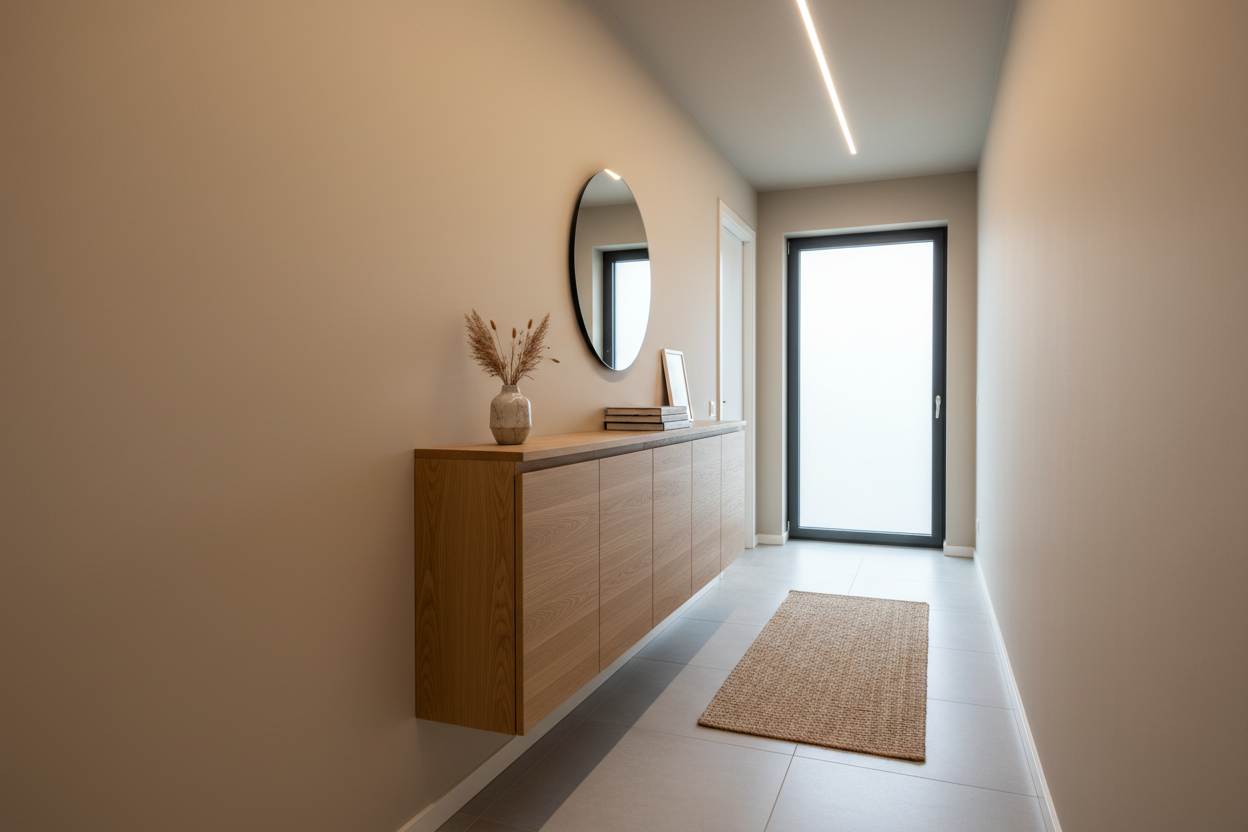
Hallways are notoriously difficult spaces to furnish. They are high-traffic zones that accumulate clutter—shoes, mail, keys, and dog leashes—yet they rarely offer enough floor space to house a standard dresser or console table. If you place normal-depth furniture in a corridor, you immediately create a bottleneck that disrupts the flow of your home. The solution lies in choosing a shallow cabinet for hallway organization. These specialized pieces, typically ranging from 8 to 14 inches in depth, provide essential storage without encroaching on your walking path.
Finding the right balance between storage capacity and physical footprint is the key to a functional entryway. You don't need two feet of depth to store everyday essentials. By utilizing vertical space and clever internal mechanisms like tilting drawers or sliding doors, a shallow hall cabinet can hold just as much as a bulky dresser while keeping your walkway clear and open.
My Battle with the Narrow Entryway
I learned the value of slim-profile furniture the hard way. A few years ago, I lived in a city apartment with a long, corridor-style entrance that was barely 36 inches wide. Desperate for a place to hide my running shoes, I bought a vintage sideboard that looked beautiful in the photo but measured 18 inches deep. It was a disaster. Every time I came home with groceries, I had to turn sideways to shimmy past it. I clipped my hip on the corner more times than I care to admit.
Eventually, I swapped that beautiful but impractical piece for a dedicated shallow hallway cabinet that was only 10 inches deep. It featured drop-down compartments for shoes rather than standard pull-out drawers. The difference was immediate. The hallway felt twice as big, the bruising on my hip healed, and the clutter was still completely hidden. That experience taught me that in tight spaces, geometry matters more than aesthetics.
Understanding Depth: How Slim is Too Slim?
When shopping for shallow furniture, the depth measurement is your most critical data point. Standard cabinets usually sit between 18 and 24 inches deep. In a hallway, that is simply too much. You want to aim for a piece that sits between 10 and 15 inches from the wall.
If you go thinner than 10 inches, you are generally looking at shoe cabinets with tipping mechanisms. These are brilliant engineering feats where the drawer pivots out at an angle, allowing you to store shoes vertically. If you have a bit more room—say, 12 to 14 inches—you can opt for a cabinet with traditional shelves or sliding doors. This depth is usually sufficient for books, baskets for winter accessories, or folded linens, but it might still be tight for larger dinner plates if you were hoping to use it as a china cabinet overflow.
The Swing Radius Factor
Beyond the static depth of the cabinet, you must account for the doors. A cabinet might be shallow, but if it has wide cabinet doors that swing outward, they can block the entire hall when open. This creates a functional hazard, especially if multiple people are trying to get out the door at once.
Sliding doors are the superior choice for narrow corridors. They require zero clearance to open. If you prefer the look of hinged doors, look for units with multiple narrow doors rather than two large ones. This keeps the swing radius small and manageable.
Maximizing Storage in Minimal Dimensions
Since you are sacrificing depth, you need to reclaim that volume elsewhere. The best strategy is to go high. A low-profile console table might look nice, but a taller shallow cabinet for hallway use maximizes the cubic footage available against the wall.
Look for units that offer adjustable internal shelving. Since the cabinet is narrow, you won't be stacking items three rows deep (which is actually a benefit, as things don't get lost in the back). Adjustable shelves allow you to customize the height for specific items, such as tall boots or stacks of mail, ensuring no vertical space is wasted.
Another often-overlooked feature is the base of the unit. Wall-mounted or floating cabinets are excellent for narrow halls. By keeping the floor visible underneath the cabinet, you trick the eye into thinking the space is larger than it is. It also makes vacuuming significantly easier and prevents the "heavy" look that boxy furniture can create in a small tunnel-like room.
Material and Visual Weight
In a small space, the material of your shallow hall cabinet impacts how the room feels just as much as the dimensions. Dark, heavy woods can make a narrow hall feel like a cave. Lighter woods, painted finishes, or materials like metal and glass tend to reflect light and make the piece feel less obtrusive.
Mirrored fronts are a secret weapon for hallways. A shallow cabinet with mirrored doors serves a dual purpose: it hides your clutter and bounces light around the dark corridor, effectively doubling the visual width of the space. If a full mirror feels too modern, consider a high-gloss finish which offers similar light-reflecting benefits without the funhouse effect.
Safety and Anchoring
There is a safety dynamic specific to shallow furniture that requires attention. Because these pieces are tall and thin, their center of gravity is higher and less stable than a deep dresser. They are more prone to tipping over if a heavy drawer is opened or if someone leans on them.
Anchoring these cabinets to the wall is not optional; it is a requirement. Most slim cabinets come with wall straps or brackets. If yours didn't, a simple L-bracket into a stud or a high-quality toggle bolt for drywall will do the job. This ensures that when you pull open a weighted drawer, the cabinet stays perfectly vertical.
Styling the Surface
Once your cabinet is installed, the top surface becomes a prime styling opportunity, often referred to as a "landing strip." Since the surface is narrow, you have to be intentional with decor. A massive round vase won't fit. Instead, opt for oval or rectangular trays to catch keys and coins.
Lean artwork or a mirror against the wall rather than propping up bulky sculptures. Sconces installed on the wall above the cabinet are better than table lamps, which might take up valuable surface area or be easily knocked over in a tight thoroughfare. The goal is to keep the top looking curated, not chaotic, maintaining the airy feel you achieved by choosing a slim cabinet in the first place.
FAQ
What is the minimum walkway width I should maintain in a hallway?
Ideally, you should aim to keep at least 36 inches of clear walking space. If your hallway is 48 inches wide, your cabinet should not exceed 12 inches in depth to maintain a comfortable flow.
Can I use a shallow shoe cabinet for storing things other than shoes?
Absolutely. The tipping drawers in shoe cabinets are perfect for storing rolled items like scarves, t-shirts, reusable shopping bags, or even pet supplies like leashes and waste bags.
How do I make a standard cabinet shallower?
This is generally difficult unless you are a skilled woodworker, as it involves cutting down the frame and drawers. It is usually more cost-effective and structurally sound to purchase a unit specifically designed as shallow furniture.


Leave a comment
This site is protected by hCaptcha and the hCaptcha Privacy Policy and Terms of Service apply.