





A rotating pantry cabinet uses shelves or racks that turn, so food stored at the back swings round to the front instead of hiding behind the first row. That helps most in deep or narrow cabinets, where reaching past jars and boxes is the daily annoyance. Before you buy, check three things: the size and load of the rotating parts, the room the doors and door racks need to open, and how much shelf area round trays give up inside a square cabinet (a circle covers about 79% of the square it sits in).
Below: how turning shelves work, the arithmetic for what fits, food storage and anchoring basics from government and university sources, and four picks from the FUFU&GAGA pantry cabinets collection, one with built-in rotating racks and three alternatives.
Key takeaways
- Rotation solves reach, not space. Turning shelves bring the back row forward; round trays usually hold less than the flat shelf they replace.
- Do the circle math. One round tray covers about 78.5% of a square shelf. On a long, shallow shelf two smaller trays beat one big one.
- Check the swing. A turning rack needs a clear circle as wide as its diagonal, and loaded door racks need room to open.
- Store food cool and dry, 50 to 70 degrees Fahrenheit for canned food per University of Minnesota Extension, away from heat.
- Anchor it and keep the heaviest items low.
What is a rotating pantry cabinet?
It is a tall storage cabinet whose shelves, or part of them, turn on a center pivot. The idea comes from the lazy Susan, which Dictionary.com defines as a revolving tray and, more broadly, "any similar structure, as a shelf or tabletop, designed to revolve so that whatever it holds can be seen or reached easily" (Dictionary.com). The term covers three different things:
- Turntables you add to existing shelves. Round trays, single or two-tier, that sit on a normal shelf. They are the easiest way to try rotation and suit oils, sauces and spice jars, but a tray can't be wider than the shelf is deep or the door won't close.
- Built-in rotating towers. A pole running the height of a tall fitted cabinet, carrying round or D-shaped trays. This is a renovation part that needs a cabinet built or sized for it.
- Freestanding pantry cabinets with rotating racks. A complete cabinet with the turning parts built in: assemble it, anchor it and fill it. Our 31.5-inch pick below works this way.
How much space do round shelves lose in a square cabinet?
Most product pages skip this. The area of a circle is pi times the radius squared, so a circle that just fits a square covers pi divided by 4 of it: about 78.5%. The four corners, roughly 21.5% of the shelf, stay empty unless you tuck small items into them.
Pantry shelves are usually wide and fairly shallow, and the tray is limited by the depth. The arithmetic for a few shelf shapes:
| Shelf (W x D) | Trays | Tray area | Shelf area | Share used |
|---|---|---|---|---|
| 16 x 16 in | One 16 in tray | 201 sq in | 256 sq in | 79% |
| 30 x 16 in | One 16 in tray | 201 sq in | 480 sq in | 42% |
| 30 x 16 in | Two 15 in trays | 353 sq in | 480 sq in | 74% |
| 22 x 11 in | Two 10 in trays | 157 sq in | 242 sq in | 65% |
One big tray on a wide shelf wastes more than half of it, while two trays side by side recover most of the area. Small trays on shallow shelves leave proportionally more dead space, so rotation pays off most on shelves about 15 inches deep or more, where the back row is genuinely hard to reach.
Square rotating racks avoid part of this loss because the rack fills its own corners. The trade-off is the sweep: a rack turning on its center needs a clear circle as wide as its diagonal. A 12 by 12 inch rack sweeps about 17 inches (the square root of 12 squared plus 12 squared), so a bottle leaning out or a bag hanging over the edge will catch on the cabinet sides or the door racks as it turns.
Rotating shelves vs fixed shelves vs door racks
| Storage type | Back row | Space use | Best for | Watch for |
|---|---|---|---|---|
| Rotating racks or trays | Turns to the front | Loses corners with round trays | Jars, bottles, cans, snacks in deep cabinets | Sweep clearance, load per level |
| Fixed adjustable shelves | Reach in or use bins | Full shelf | Boxes, small appliances, bulk bags | Items lost at the back |
| Door racks | One row deep, nothing hides | Inside face of the door | Spices, small jars, packets | Heavier doors, room to swing |
| Pull-out bins | Slide the bin forward | Nearly the full shelf | Grouped categories | Bins must fit depth and door opening |
If you mostly store boxes and bulk bags, fixed shelves hold more. If it is dozens of jars, bottles and cans, rotation or door racks save the most time. For standard pantry heights, widths and depths and how to measure your wall, see our pantry cabinet dimensions guide.
Door clearance: the measurement people forget
On a two-door cabinet each door is about half the cabinet's width, so the doors of a 31.5-inch cabinet are each roughly 15.75 inches wide (31.5 divided by 2) and reach that far into the room when opened square, plus the depth of any shelves mounted on them.
- Hinge side by a wall or fridge: a door with racks often can't open past 90 degrees. Leave a gap, or make sure 90 degrees is enough to turn the racks and reach the door shelves.
- In front: add the open door to your walkway, and avoid a spot where it blocks the path to the stove.
- Loaded doors are heavy: keep the heaviest jars low on the door and close it gently.
Where to put it, and food storage basics
A pantry cabinet doesn't change how long food lasts, but its location and how you rotate stock do.
- Cool, dark and dry. University of Minnesota Extension advises storing canned food "in a clean, cool, dark, dry place at 50 to 70 degrees Fahrenheit," and notes that temperatures over 100 degrees Fahrenheit are harmful to canned foods (University of Minnesota Extension).
- Away from heat. Clemson Extension's pantry guide uses a cool, dry pantry of 65 to 70 degrees as its reference and warns against storage near ranges, hot water pipes or heating ducts, since heat and humidity shorten storage time (Clemson HGIC). That rules out the wall beside the oven.
- First in, first out. Clemson's guide says to use older products first and put new purchases behind them. Rotating shelves make that easy, because "behind" is a half turn away.
- Check cans. The FDA lists can damage as swelling, leakage, punctures, holes, fractures and extensive deep rusting, and says stickiness on a can may mean a leak (FDA).
- Keep cleaners elsewhere. The same FDA page says not to store non-perishable foods near household cleaning products and chemicals.
How to organize a rotating pantry cabinet
- Heavy and tall at the bottom: water jugs, oil and canned goods on the lowest levels keep the weight low.
- Daily items in the middle: breakfast, snacks, coffee and tea at eye to chest height.
- Light, occasional items up high: spare packets, baking extras, paper goods.
- Small jars on the doors, one row deep, labels facing out.
- One category per level, and nothing hanging past the rack edge. Decant oversized bags into containers that fit, and turn slowly when full so tall bottles don't tip.
Anchoring a tall pantry cabinet
A tall pantry puts a lot of weight well above the floor. CPSC estimates that from 2020 to 2022, U.S. emergency departments treated an average of 17,800 tip-over injuries a year, and reports 217 tip-over fatalities from 2013 to mid-2023, most involving TVs and furniture. It advises anchoring furniture securely to the wall and keeping heavier items on lower shelves (CPSC).
CPSC's Anchor It campaign lists the steps: attach a bracket to the wall, move the furniture close, attach the other bracket to the furniture, connect and tighten the strap, then tug it to check (Anchor It). All four picks below list a tip restraint, but the wall fixing must suit your wall; our guide on how to anchor tall furniture to the wall covers studs, drywall and masonry.
Check the ceiling too: a cabinet tilted up from its back sweeps an arc as long as its diagonal (the square root of height squared plus depth squared). That is about 74.8 inches for a 72.2 by 19.7 inch cabinet and about 92.1 inches for a 90.6 by 16.4 inch one, so both clear a standard 96-inch ceiling.
Rotating pantry cabinet checklist
- Width: measure the gap at its narrowest point, leaving room for the doors.
- Depth: deep cabinets gain the most from rotation; ones under about 12 inches gain little.
- Height: tilt-up diagonal under your ceiling.
- Rotating parts: how many, how many levels, and whether size and load are listed. If not, go by the total capacity and keep heavy items low.
- Door swing: door width plus door-rack depth in front, and room on the hinge side.
- Capacity: cans and bottles add up fast.
- Tip restraint included, and a wall you can fix it to.
- Location away from the oven, heating ducts, hot pipes and direct sun.
Our picks: one rotating pantry and three alternatives
Sizes, capacities and features come from each listing. Only the first pick has rotating parts; the others suit spaces or storage where fixed shelves or door racks work better.
31.5" White Kitchen Pantry with Rotating Food Storage Shelves

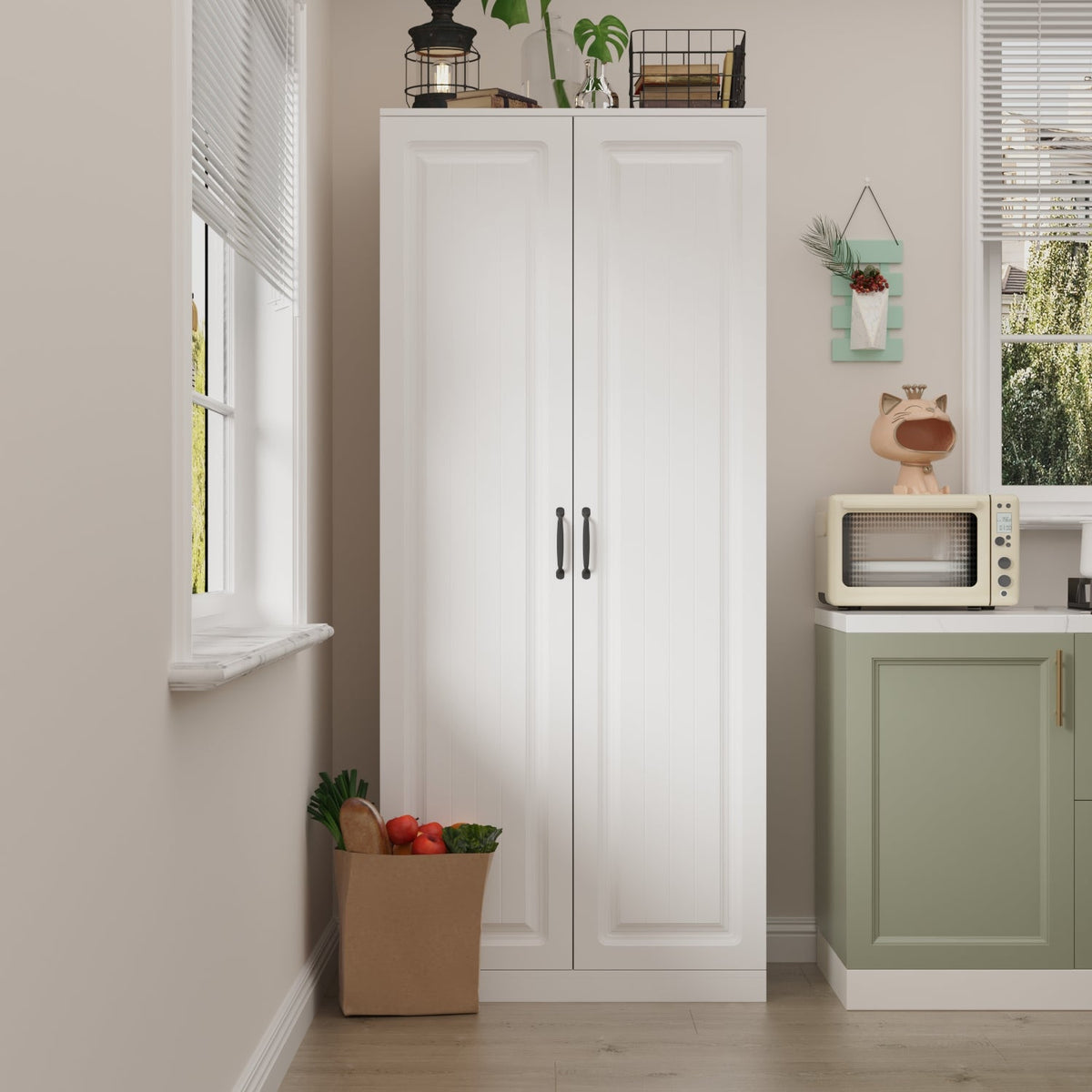
The only true rotating pantry cabinet here. Behind two doors are two rotating racks, each with six levels, that turn so you can reach what's at the back, and each door has nine shelves of its own for jars and seasoning bottles. The shelves adjust for tall bottles or small packets. It measures 72.2" H x 31.5" W x 19.7" D, weighs 219 lb, holds 300 lb in total, and is solid and manufactured wood in white with black metal handles. The listing says a tipover restraint is included: a tilt strap on the back secures it to the wall. Assembly is required.
At 19.7 inches deep it is the deepest cabinet in this list, which is exactly where rotation earns its keep.
Best for: lots of jars, bottles, cans and snack boxes, on a wall gap a little wider than 31.5 inches with room for two loaded doors to swing open.
Skip it if: your walkway can't spare the 19.7-inch depth plus the open doors, or you need rack sizes or a per-level load before you buy: the listing gives only the 300 lb total. At 219 lb, plan on a helper to stand it up and anchor it.
31.5" Natural Pantry Cabinet with Door Shelves and 2 Drawers

The door-rack alternative: no rotation, but nothing on the door shelves hides behind anything else. Each door has three racks with safety bars for spices and bottles. Inside are four shelves 30.3" wide and 15" deep (the top one adjusts) in a cabinet interior 46" high, with two large drawers on full-extension metal slides below. Overall it is 70.9" H x 31.5" W x 15.7" D, weighs 142 lb, holds 180 lb in total, and has a natural wood grain, grooved doors and gold metal handles. Anti-tip hardware is included.
Best for: a kitchen or dining room that wants a furniture look, with door racks for small items and drawers for linens or utensils.
Skip it if: you mainly store heavy bulk goods: its 180 lb total is well below the rotating pick's 300 lb, and only the top interior shelf adjusts.
90.6" Tall Black Pantry Cabinet with 4 Doors
The extra-tall option for a narrow wall: 90.6" H x 31.5" W x 16.4" D, with an upper and a lower pair of doors opening onto four adjustable shelves, each 30" W x 16" D. It weighs 130 lb, holds 150 lb in total and is MDF with a matte black finish. The listing includes a tipover restraint and says wall mounting is part of the setup. It has no rotating parts, but its 16-inch-deep shelves suit add-on turntables (see the shelf table above).
Best for: using wall height in a narrow kitchen, with the top section for things you reach less often.
Skip it if: your ceiling is lower than its tilt-up diagonal (see the anchoring section) or you need to store a lot of weight: it holds 150 lb in total. The top shelves sit high, so keep a step stool nearby.
61" White Food Pantry Cabinet with 5-Tier Shelving

The shallow, compact choice: 61.3" H x 23.3" W x 11.8" D, with two upper and two lower doors and five adjustable shelves 22" wide. It weighs 65 lb, holds 150 lb in total and is white MDF, with a tipover restraint included. At 11.8 inches deep the back row is already within reach, which is why it is an alternative to rotation rather than a candidate for it.
Best for: a small kitchen, laundry room or dining corner with little floor depth to spare.
Skip it if: you want rotating storage or room for wide small appliances: the shelves are 22 inches wide, the cabinet is 11.8 inches deep overall, and the listing doesn't give an inside shelf depth.
Compare the picks
| Pick | Size (H x W x D) | Rotating parts | Shelves and doors | Total capacity |
|---|---|---|---|---|
| 31.5 in rotating pantry | 72.2 x 31.5 x 19.7 in | 2 racks, 6 levels each | 2 doors, 9 shelves per door | 300 lb |
| 31.5 in natural pantry | 70.9 x 31.5 x 15.7 in | None | 2 doors, 3 racks per door, 4 shelves, 2 drawers | 180 lb |
| 90.6 in black pantry | 90.6 x 31.5 x 16.4 in | None | 4 doors, 4 adjustable shelves | 150 lb |
| 61 in white pantry | 61.3 x 23.3 x 11.8 in | None | 4 doors, 5 adjustable shelves | 150 lb |
All four list a tip restraint. Measure your wall, ceiling and walkway first, then compare the rest of the range in the pantry cabinets collection. If this is your first tall flat-packed cabinet, our flat-pack assembly guide covers the build, and every FUFU&GAGA pantry above should be anchored before you load it.
FAQ
Are rotating pantry shelves worth it?
In deep cabinets full of jars, bottles and cans, yes: the back row stops getting lost. They help less in cabinets under about 12 inches deep and for boxes and bulk bags, which fit fixed shelves better. Round trays also give up the corners of each shelf.
How much space does a lazy Susan waste?
A round tray that just fits a square shelf covers about 78.5% of it (pi divided by 4), leaving roughly a fifth in the corners. On a wide, shallow shelf one tray can use under half the area; two trays side by side recover most of it.
What size turntable fits a pantry shelf?
Smaller than the shelf depth, minus anything on the inside of the door that sits in front of the shelf when closed. Measure with the door shut. On wide shelves, two trays each about half the shelf width usually fit better than one.
Can I get a corner pantry with rotating shelves?
Corner lazy Susans are mostly built into fitted base and wall cabinets. For a freestanding option, set a straight cabinet on one wall near the corner and leave a gap on the hinge side so the door nearest the corner opens fully. None of our picks is a corner unit.
Do freestanding pantry cabinets need to be anchored?
Yes. A tall pantry loaded with cans and jars can tip if pulled on or climbed. CPSC advises anchoring furniture to the wall and keeping heavier items on lower shelves. Use the cabinet's restraint with a wall fixing suited to your wall.

Leave a comment
This site is protected by hCaptcha and the hCaptcha Privacy Policy and Terms of Service apply.