










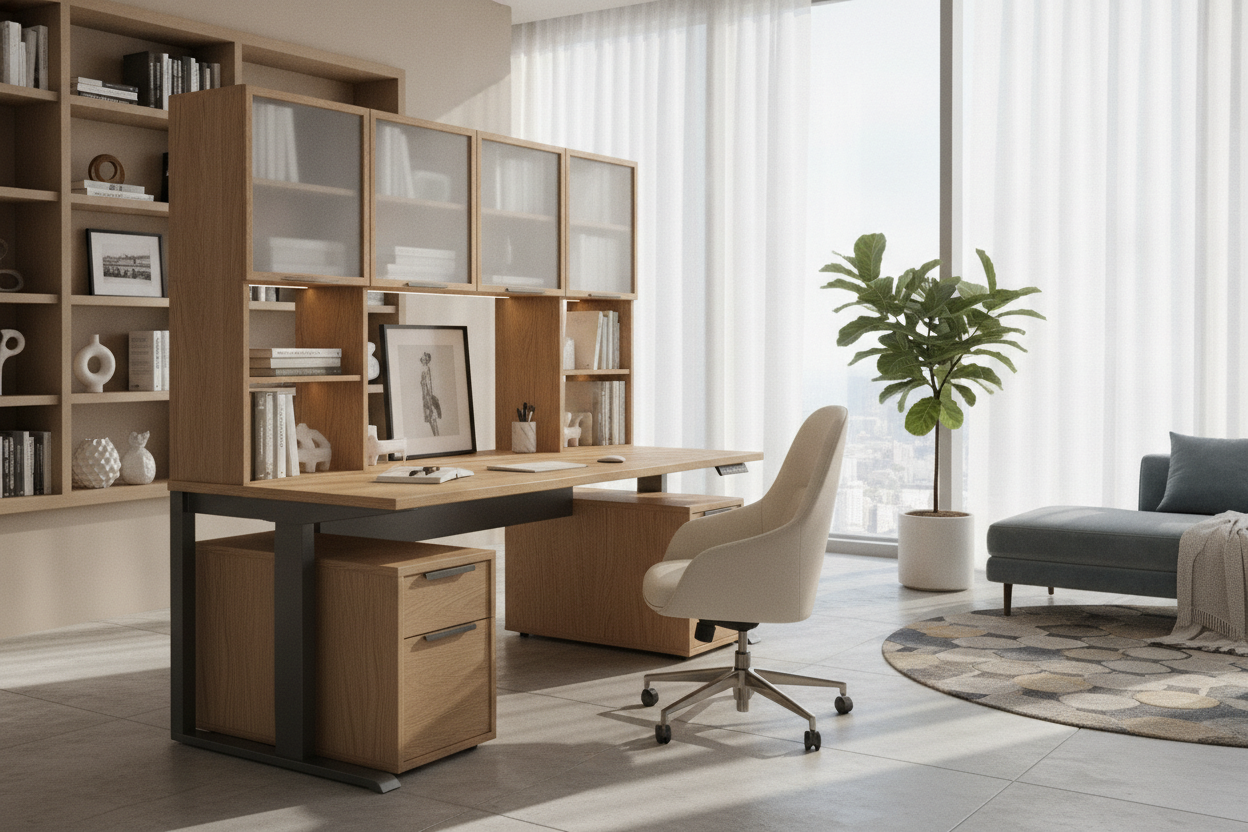
Balancing active sit-stand movement with generous storage is one of the most common challenges in modern workspace design. An adjustable desk with hutch solves this dilemma by unifying dynamic height adjustment with dedicated vertical shelving, allowing you to keep reference books, office supplies, and tech accessories accessible without cluttering your primary work surface.
Historically, traditional executive desks offered extensive overhead hutch storage, while height-adjustable desks prioritized open, minimalist frames. Today, thoughtful planning makes it possible to enjoy the ergonomic versatility of height adjustability alongside the organizational power of upper cabinetry. For an overview of conventional configurations, reviewing our foundational desk hutch guide offers helpful context on standard overhead cabinetry dimensions.
Understanding the Adjustable Desk with Hutch Architecture
Integrating upper shelving with a motorized or manual lifting mechanism requires careful attention to weight distribution, mechanical clearance, and spatial pathways. In a stationary desk setup, overhead weight rests directly on static support legs or brackets. When height-adjustability enters the equation, every object positioned above the desktop actively moves through your room's vertical space.
Home office planners generally achieve this dual functionality through two primary configurations: an attached overhead unit that travels synchronously with the desktop, or a decoupled credenza setup where the storage frame remains stationary while the central desktop glides independently.
Attached Overhead Units vs. Decoupled Credenza Hutches
Choosing between an integrated, mobile hutch and a stationary surround depends on your room layout, device ecosystem, and workflow preferences.
- Surface-Attached Hutches: These units mount securely directly onto the rising desktop surface. The primary benefit is that all stored binders, task lighting, and organizing bins stay within arm's reach whether you are sitting or standing. When selecting an attached setup, lightweight construction and open-backed designs are advantageous to preserve structural balance.
- Decoupled Credenzas and Wall Surround Units: In this arrangement, a standalone credenza or floating wall-mounted shelving unit frames the height-adjustable workstation. The desk moves freely inside the recessed opening without bearing overhead loads. Browsing an adjustable collection helps visualize how modular side towers and stationary shelving can coordinate alongside an active sit-stand desk.
Evaluating Frame Stability, Weight Distribution, and Motor Movement
Adding vertical storage changes the center of gravity of an adjustable height desk with hutch. A top-heavy surface places higher lateral stress on the lifting columns, particularly when elevated to maximum standing heights. Ensuring a smooth, wobble-free experience involves a few key principles:
First, prioritize wide-stance, heavy-gauge steel leg frames engineered for broad desktop platforms. A sturdy base, such as a premium height adjustable desk product, provides the grounded stability needed to counterbalance upper shelving units. Second, organize heavy items like archival books, printers, and metal organizers on the lowest tiers of the hutch or across perimeter storage, reserving higher shelves for lightweight decor and lightweight stationary.
Third, distribute weight symmetrically across the left and right lifting columns. Placing excessive load on one side can cause uneven mechanical wear or trigger anti-collision sensors prematurely during lifting cycles.
Room Fit, Vertical Clearances, and Wall Trajectory Planning
Before installing a stand up desk with hutch, map out the entire vertical travel path. Unlike static desks that occupy a fixed three-dimensional footprint, an adjustable configuration requires unobstructed clearance throughout its full range of movement.
Key environmental checkpoints to review include:
- Ceiling Slopes and Crown Molding: In attic offices or rooms with decorative trim, verify that the highest point of the upper hutch will not contact architectural elements when fully elevated.
- Window Sills and Picture Frames: Position the desk far enough away from wall hangings, window treatments, and sconce lighting to prevent snagging during height transitions.
- Baseboard and Wall Offset: Maintain a subtle gap between the back edge of the hutch and the drywall to account for minor natural frame sway during adjustment.
Cable Routing and Organized Peripheral Management
Managing cords on a sit stand desk with hutch requires a dynamic approach. Because monitors, task lamps, and desktop accessories travel vertically, standard stationary cord ties can pull tight or tangle when the desk elevates.
Incorporate flexible cable management spines or segmented vertebrae channels that expand and contract smoothly alongside the lifting legs. Mount power distribution strips directly beneath the central desktop or inside a discreet raceway at the bottom of the hutch. This ensures that all monitor power cords, charger cables, and lighting leads move together as a single cohesive unit, requiring only one master extension cord to connect down to the wall outlet with sufficient slack.
Styling and Ergonomic Workflow Layouts for Home Offices
A unified aesthetic elevates a dynamic workstation from a purely utilitarian setup to an inspiring, cohesive home office centerpiece. When styling your desk and hutch, pay close attention to monitor sightlines. Position primary displays so the top third of the screen sits at or slightly below eye level, ensuring the lower shelf of the hutch does not force screens downward into an uncomfortable tilt.
Integrate diffuse under-shelf LED strip lighting along the bottom edge of the hutch to illuminate your keyboard tray and writing zone without causing screen glare. Coordinating matching wood tones or clean laminate finishes across your desk surface, hutch paneling, and nearby modular cabinets creates a tailored, intentional look. For more design strategies on achieving a seamless aesthetic, explore our companion desk hutch guide for styling inspiration.
By thoughtfully planning structural balance, vertical clearances, and cord trajectories, an adjustable desk with hutch delivers the ideal union of sit-stand ergonomic freedom and generous home office organization.

Leave a comment
This site is protected by hCaptcha and the hCaptcha Privacy Policy and Terms of Service apply.