










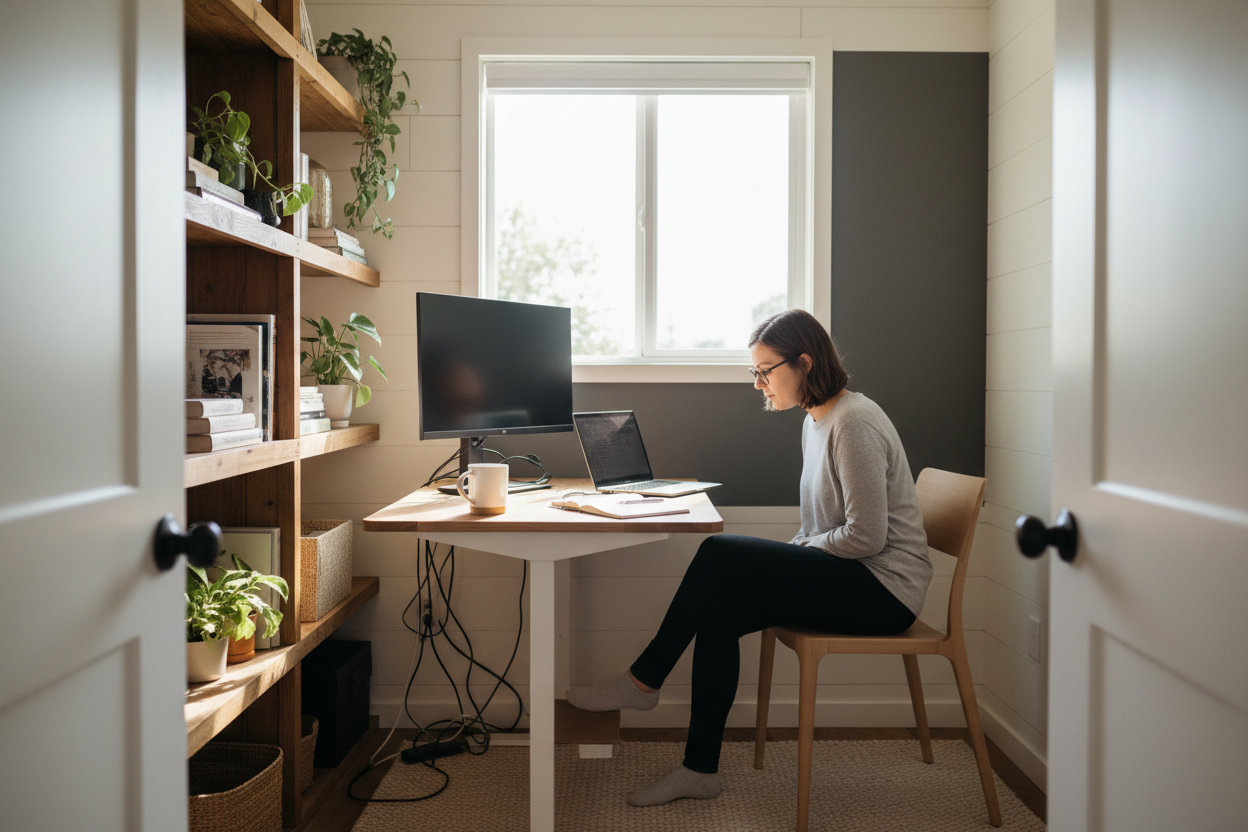
We often romanticize the "cozy" nook, but without ergonomic foresight, a tiny home office quickly devolves from a charming vignette into a claustrophobic nightmare. As a designer, I see homeowners treat the workspace as an afterthought—shoving a desk into a residual corner under a loft bed. The reality is that productivity requires specific spatial geometry, regardless of square footage. This article explores how to manipulate scale, light, and material to create a workspace that feels substantial, even when the footprint is minimal.
Key Features for a Functional Workspace
If you are planning a tiny house with office space, prioritize these core elements to ensure longevity and comfort:
- Vertical Utilization: Floor space is finite; use wall-mounted shelving and cantilevered desks to keep legroom open.
- Material Weight: For a tiny mobile office, choose lightweight hardwoods (like poplar) or high-grade plywood over heavy particle board to reduce towing weight.
- Ergonomic Depth: A desk depth of at least 24 inches is non-negotiable for monitor placement and eye health.
- Acoustic Control: Soft textiles and acoustic panels are essential to dampen sound in small, hard-surfaced volumes.
- Dedicated Lighting: Relying solely on overhead cans creates shadows; task lighting is critical for visual comfort.
Space Planning and Zoning
The most successful tiny house office ideas do not try to replicate a corporate cubicle. Instead, they embrace the architecture of the tiny home. If you are building a tiny house as office from scratch, consider the "landing zone" concept. Rather than a separate room, which chops up the visual flow, integrate the desk into cabinetry or a window bay.
For a tiny home with office capabilities, I often recommend a transformable layout. However, caution is required. A desk that folds away is great in theory, but if you use it daily, the friction of setting it up becomes a barrier to work. A permanent, shallow console that extends when needed often functions better than a completely hidden drop-leaf table.
Materiality and Visual Weight
In a compact environment, visual weight is just as important as physical dimensions. A heavy, dark oak desk will dominate a tiny home office space, making the room feel smaller.
Solid Wood vs. Veneer
While I almost always advocate for solid wood in residential projects, a tiny house home office often benefits from high-quality architectural veneers. They offer the warmth and texture of walnut or white oak without the bulk. If you are outfitting a stationary office tiny house (like a garden pod), you have more freedom with heavier materials like reclaimed timber or stone tops, which anchor the space and add a sense of luxury.
Ergonomics in Micro-Environments
The biggest failure point in a tiny office building or shed conversion is the chair. Standard ergonomic chairs are bulky. In a tiny home for office use, look for chairs with a "low visual profile"—mesh backs or mid-century silhouettes that provide lumbar support without blocking sightlines. Ensure your desk height allows the chair arms to tuck fully underneath; a protrusion of even three inches can ruin the traffic flow in a narrow tiny house hallway.
Lighting and Atmospherics
Lighting defines the boundaries of a room. In a tiny house office space, you want to layer your lighting to push the walls outward visually. Avoid harsh, central overhead lights. Instead, use LED strip lighting under shelves (creating a wash down the wall) and a focused task lamp. This creates depth and separation between the "work zone" and the "living zone," even if they are only inches apart.
Lessons from My Own Projects
A few years ago, I consulted on a custom tiny mobile office for a client who was a travel photographer. We were obsessed with saving space, so we installed a high-gloss, fold-down acrylic desk to reflect light and disappear when not in use.
It was a mistake. Two months later, the client called me. The high-gloss finish was a nightmare—every fingerprint and dust mote showed up instantly in the direct sunlight that flooded the tiny space. Worse, because the unit was mobile, the lightweight fold-down mechanism rattled incessantly on the highway. We ended up ripping it out and installing a fixed, matte-finish birch ply desk scribed directly into the wall studs. It was heavier and took up permanent space, but the lack of vibration and the forgiving matte texture made the workspace actually usable. Sometimes, "clever" mechanisms fail where simple, solid joinery succeeds.
Conclusion
Designing a tiny offices requires a shift in perspective. It is not about shrinking standard furniture to fit; it is about curating a specific set of tools that fit your workflow. By prioritizing ergonomic depth over width and choosing materials that balance durability with visual lightness, you can build a workspace that feels limitless.
Frequently Asked Questions
What is the minimum size for a tiny house office?
While you can fit a laptop on a 12-inch shelf, a functional tiny home office needs a desk surface of at least 36 inches wide by 24 inches deep to accommodate a monitor, keyboard, and mouse without causing cramping.
How do I handle cable management in a tiny office?
In an office tiny home, cables can clutter the visual space rapidly. Use grommets drilled directly into the desktop and route cables through the wall cavity or inside hollow table legs. Wireless peripherals are also highly recommended to reduce visual noise.
Can a tiny house support the weight of heavy office equipment?
If you have heavy servers or large plotters, you must account for this in the chassis distribution if the home is mobile. For a stationary office tiny house, weight is less of an issue, but floor joists should still be reinforced if you plan to install heavy filing cabinets or safes.

Leave a comment
This site is protected by hCaptcha and the hCaptcha Privacy Policy and Terms of Service apply.